
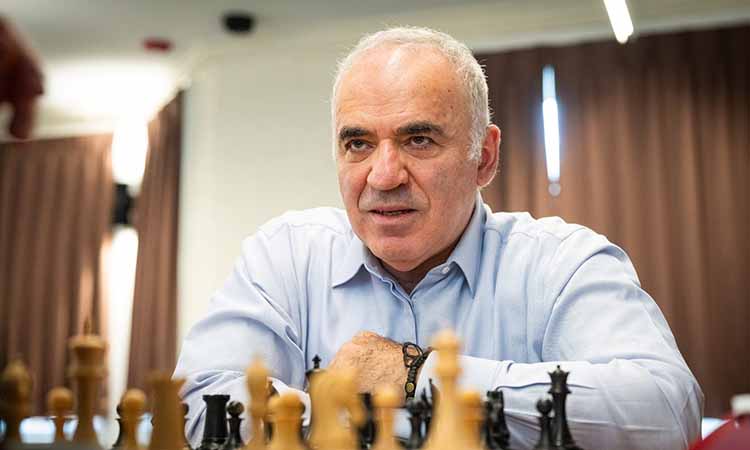
When people talk about genius in chess, one name always comes up first. Garry Kasparov. Dominant for two decades. Peak rating over 2800. World Champion from 1985 to 2000. Naturally, the question follows.
What is Kasparov’s IQ?
The short answer. There is no officially verified number. But that has not stopped speculation, estimates, and repeated claims across the chess world.
This article breaks it down. What numbers are claimed. Where they come from. And more importantly, whether IQ actually explains Kasparov’s dominance at all.
The Claimed IQ Numbers
Most sources online repeat a range rather than a fixed figure. You will often see claims that Kasparov’s IQ is around 135 to 145. Some go even higher, pushing it toward 150 or beyond.
Here is the problem.
There is no publicly documented, standardized IQ test result released by Kasparov himself.
No verified record from institutions.
No official statement confirming a score.
So where do these numbers come from?
Mostly from inference.
People look at his achievements. His memory. His calculation ability. Then they assign a number that “feels right.”
That is not how IQ measurement works.
Why People Assume His IQ Is High
Even without a confirmed score, the assumption that Kasparov has a high IQ is not random. It is based on observable traits.
1. Calculation Speed and Depth
Kasparov was known for calculating extremely complex variations at high speed. Not just 3–5 moves deep. Often 10–15 moves in sharp positions.
In games against elite opponents like Anatoly Karpov, this ability made the difference. He could evaluate positions faster and more accurately under pressure.
That kind of processing speed is often associated with high IQ. But it is not exclusive to it.
2. Memory and Pattern Recognition
Kasparov could recall thousands of games. Not just moves. Entire structures. Strategic themes. Tactical motifs.
This is critical. Because chess is not about raw calculation alone. It is about recognizing patterns instantly.
Grandmasters do not “calculate everything.” They filter positions based on experience.
Kasparov’s edge was that his pattern database was massive and highly organized.
Again, this looks like intelligence. But it is also the result of years of structured training.
3. Adaptability and Preparation
Kasparov revolutionized opening preparation. He built deep opening repertoires and worked extensively with teams and computers.
Before engines became mainstream, he was already using databases and analysis methods far ahead of his time.
This shows strategic intelligence. Long-term planning. And the ability to adapt.
The Deep Blue Moment: Intelligence vs Machines
One of the most cited moments in discussions about Kasparov’s intelligence is his match against IBM Deep Blue in 1997.
He lost the match. 3.5–2.5.
Some people interpreted this as “a machine beating human intelligence.”
That interpretation misses the point.
Deep Blue did not think like a human. It calculated millions of positions per second. It used brute force combined with evaluation functions.
Kasparov, on the other hand, relied on intuition, experience, and selective calculation.
The match highlighted something important.
Chess strength is not the same as IQ.
And neither is the same as computational power.
IQ vs Chess Skill: Not the Same Game
It is tempting to equate chess strength with IQ. Strong player equals high IQ. Weak player equals lower IQ.
Reality is more complicated.
Studies in cognitive psychology show that while there is some correlation between intelligence and chess skill, it is not strong enough to explain elite performance alone.
Here is what actually matters more.
1. Deliberate Practice
Kasparov trained intensely from a young age. He studied under the Soviet chess system. Structured coaching. Systematic improvement.
Thousands of hours of focused practice.
This is the foundation of mastery.
2. Pattern Acquisition
Strong players build mental libraries of positions. Over time, they recognize patterns instantly.
This reduces the need for raw calculation.
It is not just intelligence. It is specialized knowledge.
3. Competitive Experience
Kasparov played hundreds of high-level games. Against the best players in the world.
Experience under pressure shapes decision-making in ways IQ tests cannot measure.
Comparing Kasparov to Other Geniuses
Kasparov is often compared to figures like Albert Einstein or Magnus Carlsen.
But these comparisons are misleading.
Einstein worked in physics. Abstract reasoning. Mathematical models.
Carlsen dominates in practical chess. Endgames. Intuition. Consistency.
Kasparov’s strength was dynamic play. Preparation. Aggressive strategy.
Each domain requires different cognitive skills.
IQ is a general measure. It does not capture domain-specific excellence.
Kasparov’s Own View on Intelligence
Kasparov himself has spoken about intelligence in a more nuanced way.
He has emphasized decision-making, discipline, and preparation over raw intellect.
In interviews, he often highlights the importance of work ethic and structured thinking.
Not just talent.
This aligns with what we see in elite performance across fields. Intelligence helps. But it is not enough.
So What Is Garry Kasparov’s IQ?
If you are looking for a confirmed number, it does not exist.
If you are looking for a realistic estimate, most claims place it somewhere in the high range. Likely above average. Possibly in the 130–145 range.
But that number should not be the focus.
Because it does not explain why Kasparov became one of the greatest chess players in history.

I’m a passionate board game enthusiast and a skilled player in chess, xiangqi and Go. Words for Attacking Chess since 2023. Ping me at Lichess for a game or chat.