
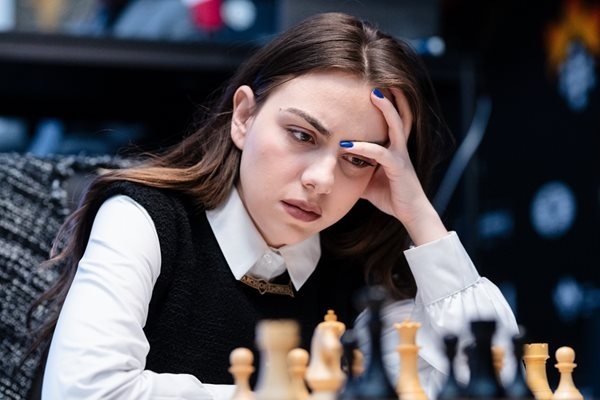
Nurgyul Salimova, currently Bulgaria’s top-ranked female chess player, has publicly warned that she may stop representing her country. The 23-year-old made the statement in June 2026 after finishing tied for second to fourth place at the European Women’s Chess Championship in Batumi, ultimately placing fourth on tiebreaks. Despite this result, which confirms her status among the top 40 women in the world, her professional future remains uncertain due to ongoing administrative conflicts in Bulgarian chess.
At the center of the issue is a long-running dispute between two governing bodies: the state-licensed Bulgarian Chess Federation 2022 and the Bulgarian Sports Chess Federation, which is recognized by FIDE and the European Chess Union. Both organizations claim authority over the sport in Bulgaria. This dual structure has created a legal and administrative deadlock that now threatens the country’s participation in international competitions.
According to Salimova, the consequences are immediate and personal. “Right now I don’t know if Bulgaria will participate in the Chess Olympiad in September. I don’t know if we will be allowed! I don’t know if my rights will be suspended or my rating will be removed?” she wrote. The uncertainty is tied to a deadline set by FIDE, which warned Bulgarian authorities that failure to resolve the federation dispute by July 1 could lead to sanctions, including suspension from international events.
For Salimova, the issue goes beyond a single tournament. “I have signed contracts for international leagues. I have upcoming tournaments. I have goals that I work towards every day. But right now I do not know what will happen to my professional future after July 1,” she stated. The risk is that decisions made at the administrative level, “over which I have absolutely no control,” could directly impact her ability to compete.
The broader problem, as she describes it, has existed for years. “For years, Bulgarian chess has been hostage to conflicts, administrative disputes and battles between federations. (As far as I know) 2 federations. I DO NOT care who is right. The price is paid by the competitors. I pay it.” This statement reflects frustration not only with the current situation but also with a long-term lack of structural stability in Bulgarian chess.
Salimova also highlighted the competitive disadvantage she faces compared to players from other countries. “While in many countries the leading competitors receive systematic support, funding, training camps and entire teams behind them, I constantly have to think about things that have nothing to do with chess – funding, organization, preparation and uncertainty about the future.” As a result, she must divide her attention between performance and logistics, while her rivals can focus entirely on improving their game.
Her comments point to a systemic issue in athlete support. “My competitors can focus all their energy on becoming better chess players. I have to divide my attention between chess and everything else.” This imbalance, she argues, makes it significantly harder to compete at the highest level. “It is hard enough to compete with the strongest in the world. It is even harder when you are not sure of absolutely nothing around you.”
Despite the criticism, Salimova acknowledged Bulgaria’s chess tradition. “Bulgaria has great traditions in this sport. The country has given us world champions. In 2023, the Bulgarian women’s national team became European champions.” However, she warned that without reform, the country risks losing its top talents. “After almost 18 years dedicated to chess, I am tired of problems that I never created. I just want to play chess. If these problems are not solved soon, Bulgaria will lose its talents. Including me.”
Her statement has raised immediate questions about her future federation. While Salimova has not named a specific destination, several factors suggest possible directions. She is eligible to represent other countries and has already participated in international leagues and tournaments outside Bulgaria. Her ranking, experience, and age make her an attractive candidate for federations seeking a top female player.
One frequently mentioned possibility is Turkey. Salimova is of Turkish origin and speaks the language, which could ease a transition. Turkey has invested in developing young chess talent and may benefit from adding an established top-40 player. However, support structures vary, and not all players in the system receive equal backing. Whether Turkey—or another federation—would provide the level of stability and funding she seeks remains an open question.
Other countries with stronger financial resources or structured training systems could also be potential options. In modern chess, federation transfers are not uncommon, especially when players face limited support at home. The process typically involves transfer fees and waiting periods, but for a player of Salimova’s level, opportunities are likely to exist.
For now, her decision appears conditional rather than final. The key factor is whether Bulgarian authorities can resolve the federation conflict before the July 1 deadline. If a unified structure is established and international participation is secured, Salimova may remain. If not, her warning suggests she is prepared to leave.
Her closing message is direct and unambiguous: “I just want to play chess.” In the current situation, that simple goal depends less on her performance and more on decisions made outside the board.

I’m a passionate board game enthusiast and a skilled player in chess, xiangqi and Go. Words for Attacking Chess since 2023. Ping me at Lichess for a game or chat.