
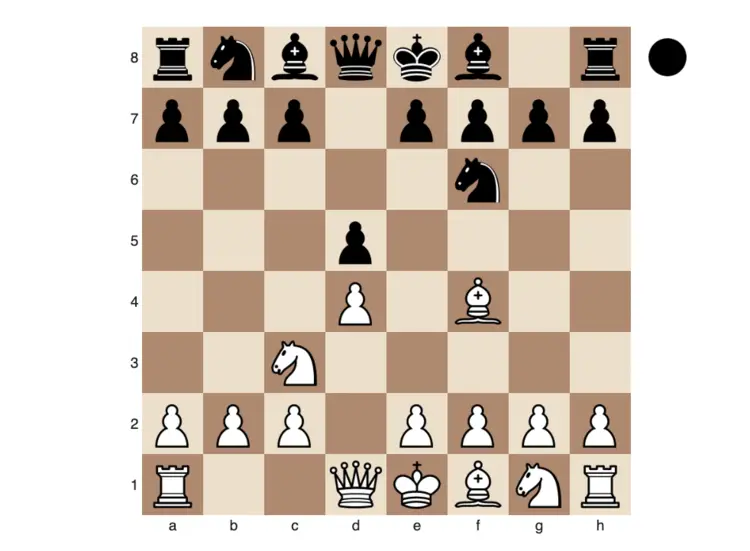
The Jobava London System, sometimes referred to as the New Veresov, has rapidly transformed from an opening footnote into a formidable mainline over the last decade. Unlike the Classical London System, which focuses on a solid, slow-developing structure, the Jobava version is designed for ambition and aggression. It often feels more like a 1. e4 opening due to its emphasis on rapid piece development and early central tension. At its core, the system begins with the moves 1. d4 d5 2. Nc3 Nf6 3. Bf4.
The Core Philosophy and the Power of Nc3
The defining characteristic of this system is the early development of the knight to c3 before the c-pawn has moved. While conventional chess wisdom once suggested that blocking the c-pawn was counterproductive, the Jobava London proves that this move order creates unique attacking opportunities, specifically by preparing an early e2-e4 advance and enabling the dangerous Nb5 jump.
This opening is exceptionally flexible and relatively low on theory, making it an excellent choice for both positional and aggressive players. It aims to catch opponents off-guard, especially those who attempt to play “autopilot” defenses against the London.
The Nb5 Jump: Forcing the Uncomfortable
One of the most potent weapons in the Jobava arsenal is the move 4. Nb5. While it may appear elementary, it forces Black to address the immediate threat of a fork on c7. In many variations, the only saving move for Black is the “uncanny and crampy” …Na6.
Placing the knight on the rim at a6 is a significant concession for Black; the knight is misplaced and usually requires at least two tempos to be rerouted to a more useful square. By forcing this move, White successfully messes up Black’s structure and development right from the start. Even if Black eventually kicks the knight back with …c6, White can simply return the knight to c3, satisfied that Black’s own knight remains stuck on the edge of the board.
Navigating Mainline Defenses
1. The Symmetrical Variation (3…Bf5)
When Black tries to mirror White’s setup with 3…Bf5, they often fall into the Nb5 trap. After 4. Nb5 Na6, White frequently plays 5. a3 to prevent Black from ever playing …Nb4 and to prepare a potential kingside expansion.
In this line, White often launches a devastating pawn storm. By playing f3, g4, and h4, White lashes out on the kingside, forcing Black into a defensive posture. A typical maneuver involves playing h4-h5 to kick the bishop on g6 and then using the g-pawn to harass Black’s knights.
2. The Horwitz Defense (3…e6)
The Horwitz Defense (3…e6) is one of the most common responses. Again, White utilizes 4. Nb5 Na6. If Black attempts to block the knight with 4…Bd6, White is happy to take the bishop, gaining the bishop pair and leaving Black with a wobbly central structure.
If Black develops more traditionally with …Be7, White continues with Nf3 and prepares e3. The goal here is often to set up a powerful kingside attack. If Black castles short, White can use the f-pawn and g-pawn to bust open the position.
3. Challenging the Center: The Steinitz Countergambit (3…c5)
Many players use 3…c5 as a way to quickly equalize or punish the London System. In the Jobava London, however, this counter-strike is less effective. If Black plays 4…Qb6 (a common thematic move to attack b2), White can ignore the threat or play 5. Nb5.
If Black takes on b2 with the queen, White can develop a massive lead in development and piece activity. The queen often becomes trapped or misplaced, while White’s minor pieces dominate the board. In the Open Variation, White can also meet 3…c5 with 4. e4, leading to a forcing, wide-open game where White maintains strong central control.
The “Harry” Pawn: Kingside Aggression
A key theme throughout the Jobava London theory is the aggressive use of the h-pawn (often nicknamed “Harry”) and the g-pawn. By not developing the knight to f3 immediately, White keeps the f-pawn free to move to f3, which supports a quick g2-g4 advance.
This pawn storm serves several purposes:
- Gaining Space: It pushes Black’s pieces back and claims territory on the kingside.
- Trapping Bishops: It threatens to trap the light-squared bishop if it ventures to f5 or g6.
- Opening Files: If Black attempts to block the advance with …h5, White can often use the g5-square as a jumping point for knights or to further weaken Black’s dark squares.
Handling Fianchetto Setups (King’s Indian and Grunfeld)
When Black tries for a King’s Indian or Pirc structure with …g6, White has several aggressive options. One powerful approach is to play 3. e4 d6 4. Be3 Bg7 5. Qd2, preparing to castle queenside and launch a classic “Yugoslav-style” attack with f3, g4, and h4.
Against the Grunfeld (…g6 and …d5), White can utilize the Nb5 idea once more. If Black plays an early …Bg7, White can strike with h4-h5. If Black takes the h5-pawn, White is often willing to sacrifice an exchange (Rxh5) to shatter Black’s kingside and launch a decisive queen attack.
Defensive Tips for White
While the Jobava London is an attacking system, it also requires solid fundamentals:
- Preserve the Jobava Bishop: The dark-squared bishop on f4 is a “noble” and key piece for the attack. Avoid trading it for a knight unless there is a significant positional or tactical gain.
- Central Control: If Black strikes violently at the center (common in Pirc or King’s Indian lines), be prepared to “give up the center” temporarily to focus on piece activity and development.
- King Safety: When launching a kingside storm, White often castles queenside (O-O-O). However, in some lines, even leaving the king on f2 can be safe and useful for keeping the h1-rook active for the attack.
Why Play the Jobava London?
The Jobava London is a practical weapon for club players and elites alike because it forces the opponent to think from move three. It avoids the massive, dry theory of the Queen’s Gambit while offering more attacking potential than the Classical London. Whether you are facing the solid Slav, the aggressive Dutch, or the complex Nimzo-Indian, the Jobava London provides a consistent, flexible framework that puts Black under immediate pressure. By mastering the Nb5 jump and the kingside pawn storm, you can turn a quiet d4 opening into a devastating offensive game.

I’m Xuan Binh, the founder of Attacking Chess, and the Deputy Head of Communications at the Vietnam Chess Federation (VCF). My chess.com and lichess rating is above 2300. Send me a challenge or message via Lichess. Follow me on Twitter (X) or Facebook.