
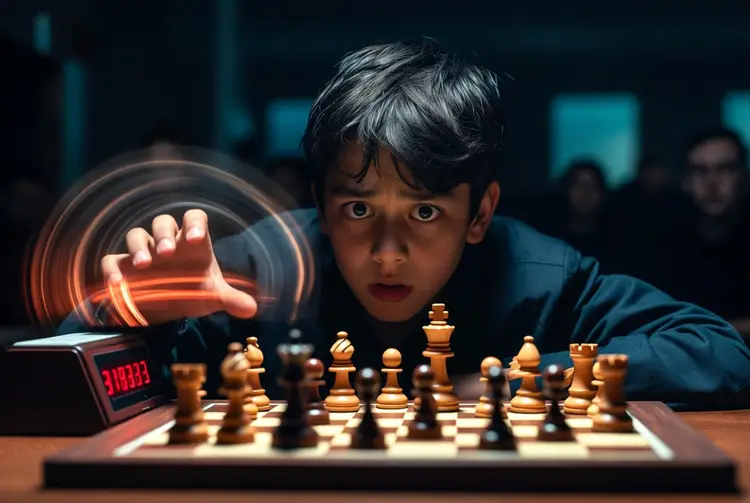
If you’ve ever played over-the-board chess, you’ve probably had this moment: you make a move… stand up… maybe even walk away, then suddenly realize you never pressed your clock.
It feels minor. But in competitive chess, it can cost you the game.
Let’s break down exactly what happens, why it matters, and how tournaments handle it.
First, How Chess Clocks Actually Work
In over-the-board chess, each player has their own timer on a chess clock. When you make a move, you must:
- Move your piece
- Press your side of the clock
Only after pressing the clock does your opponent’s time start. That means one crucial rule: Your move is not “complete” until you press the clock.
“A move is considered completed when the player has made his move on the chessboard and pressed his clock.”
— FIDE Laws of Chess, Article 6.2.1
So What If You Forget?
1. Your Time Keeps Running
This is the most immediate consequence.
If you forget to press the clock, your own time continues to tick down, even if:
- You’ve already made your move
- Your opponent has noticed
- The position on the board has changed
Your opponent is not required to remind you.
If you take too long to realize it, you can literally lose on time without your opponent making a single move.
2. Your Opponent Can Stay Silent
In casual games, people will often say: “Hey, you forgot your clock.”
But in a tournament setting governed by FIDE rules, your opponent is not obligated to help you. In fact, many experienced players will simply:
- Sit quietly
- Watch your time drop
- Wait for you to notice
This isn’t considered bad sportsmanship. It’s part of the rules.
3. Your Opponent Cannot Press It for You
This is important. Your opponent is not allowed to press your clock on your behalf. Why?
Because pressing the clock is part of your move. Only the player who made the move should complete that action. If your opponent presses it, it could create disputes about:
- Whether the move was finished
- Whether a piece was adjusted or changed
So even if they want to help, they usually won’t touch the clock.
4. You Can Fix It, But Only If You Notice in Time
If you suddenly realize your mistake, you can still press the clock. There’s no penalty just for forgetting, unless it causes another issue. So the sooner you notice, the better.
Can You Get Penalized?
Usually, forgetting to press the clock alone is not punishable. However, penalties can happen if:
- You repeatedly forget and disrupt the game
- You create confusion or disputes
- You try to exploit the situation unfairly
In such cases, the arbiter (referee) can step in.
What If You Leave the Board Without Pressing?
This is where things get dangerous.
If you:
- Make a move
- Forget to press the clock
- Walk away
Then your time keeps running the entire time you’re gone.
If your time runs out:
- You lose the game on time
- Even if your position is completely winning
This has happened many times in real tournaments.
Real-Life Situations
Even strong players—including titled players—have made this mistake under pressure.
It often happens when:
- They are low on time
- They’re emotionally invested in the position
- They assume they already pressed the clock
One small habit lapse can undo hours of good play.
Practical Tips to Avoid This
Here’s how experienced players prevent it:
1. Build a routine
Always think: Move → Hand stays → Press clock → Then relax
2. Don’t release your hand too early
Many players keep their hand near the clock until they press it.
3. Say it in your head
Some players mentally repeat: “Move and press”
4. Practice with a real clock
Online chess doesn’t build this habit as strongly.
A Simple Rule to Remember
In over-the-board chess: A move isn’t finished until you press the clock.
Forget that, and the game might keep going, but your time won’t wait.

I’m the senior editor of Attacking Chess, a keen chess player, rated above 2300 in chess.com. You can challenge me or asking questions at Chess.com.