
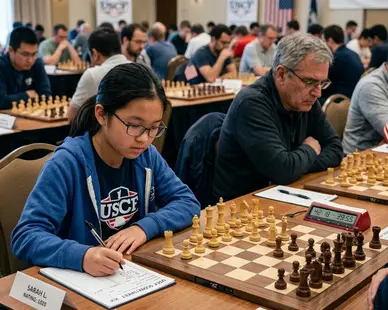
Walking into your first USCF tournament can feel intimidating. The room is quiet. Players stare intensely at their boards. Clocks tick. You might wonder. “Am I ready for this?”
The good news. You don’t need to be a master to enjoy your first tournament. You just need to know what to expect. This guide will walk you through everything. Step by step. So you can show up confident and focused.
What Is a USCF Tournament?
A USCF tournament is an official chess competition rated by the United States Chess Federation (USCF). When you play in one, your games count toward your official rating.
There are different types of tournaments:
- Scholastic. For kids and students
- Open tournaments. Anyone can join
- Sectioned events. Divided by rating (U1000, U1400, U1800, etc.)
If this is your first event, you’ll likely be placed in a lower-rated section. That’s good. You’ll face players close to your level.
Before the Tournament: What You Need to Do
1. Get a USCF Membership
You cannot play in a rated tournament without being a USCF member. Registration is simple and usually done online.
Once you join, you’ll receive a USCF ID. This is how your games are tracked.
2. Register for the Event
Most tournaments require pre-registration. Some allow on-site registration, but don’t risk it.
You’ll need to choose a section. If you’re unrated, you’ll usually be placed in:
- Unrated section
- Or Under 1000 / Under 1200
3. Understand the Time Control
Every tournament has a time control. Common examples:
- G/30. 30 minutes per player
- G/60 d5. 60 minutes with 5-second delay
- 90+30. 90 minutes with 30-second increment
If you’ve only played online blitz, this will feel slow. That’s normal. Use the time.
What to Bring
Don’t show up unprepared. Here’s what you should bring:
- A chess set (some tournaments provide it, but not always)
- A chess clock (optional but recommended)
- A pen (required for notation)
- A scoresheet (sometimes provided)
- Snacks and water
- A sweater (tournament halls can be cold)
Phones must be turned off or silent. If your phone makes noise during a game, you can lose instantly.
Arrival: What Happens First?
Arrive early. At least 20–30 minutes before your round.
When you arrive:
- Find the pairings sheet
- Look for your name
- Note your board number and color (White or Black)
Pairings are usually posted on a wall or online.
The Game: What It Feels Like
This is where things get real.
You sit across from your opponent. Shake hands. Start the clock.
1. You Must Record Your Moves
Unlike online chess, you must write down every move.
Example:
- e4 e5
- Nf3 Nc6
This is called notation. It’s required in most games unless you’re very low on time.
2. Touch-Move Rule
This is one of the biggest differences from casual play.
- If you touch a piece, you must move it
- If you touch your opponent’s piece, you must capture it (if legal)
No takebacks. No “oops.”
3. Silence Is Expected
Talking is not allowed during games.
No advice. No chatting. Just focus.
4. The Clock Matters
Time pressure is real.
If your time runs out, you lose. Even if you’re winning on the board.
Learn to balance:
- Thinking deeply
- Moving efficiently
After the Game
When the game ends:
- Stop the clock
- Shake hands
- Record the result
Results are usually reported to a tournament director.
You can then:
- Analyze your game (quietly, away from active boards)
- Take a break before the next round
The Atmosphere: What Surprises Most Beginners
1. It’s More Relaxed Than You Think
Yes, players look serious. But most are friendly.
After games, many players are happy to discuss positions.
2. You Will Make Mistakes
Everyone does. Even experienced players.
Blunders happen:
- Hanging pieces
- Missing tactics
- Time trouble collapses
That’s part of the learning process.
3. Ratings Don’t Tell the Whole Story
You might face someone rated 200 points higher.
Don’t panic.
At beginner level:
- Games are decided by mistakes
- Not deep theory
You always have chances.
Common Beginner Mistakes (And How to Avoid Them)
1. Moving Too Fast
Online habits carry over.
Fix:
- Use your time
- Double-check every move
2. Ignoring the Clock
Some beginners lose on time in winning positions.
Fix:
- Check the clock regularly
- Keep a steady pace
3. Not Knowing Basic Endgames
Many games reach simple endings.
Fix:
- Learn king and pawn basics
- Practice checkmates
4. Panic Under Pressure
Tournament nerves are real.
Fix:
- Take deep breaths
- Focus on the board, not your opponent
What Rating to Expect After Your First Tournament
If you’re unrated, your first few games will establish your rating.
Rough guideline:
- Beginner: 400–800
- Casual club player: 800–1200
- Strong beginner: 1200–1400
Don’t worry about the number too much.
Focus on improvement.
How Long Does a Tournament Last?
It depends on the format.
- One-day events: 3–5 rounds
- Weekend tournaments: 4–6 rounds
- Major events: 2–3 days
Each round can last 1–4 hours.
Bring patience.
Final Advice: How to Enjoy Your First Tournament
Here’s the truth.
Your first USCF tournament is not about winning.
It’s about experiencing real chess.
You’ll feel:
- Nervous before your first move
- Excited after a good game
- Frustrated after a blunder
That’s normal.
Focus on three simple goals:
- Play every move carefully
- Learn from every game
- Enjoy the process
One Last Thing
Every strong player you admire once sat down at their first tournament. Confused. Nervous. Unsure.
The difference?
They showed up.
So when you walk into that playing hall. Remember this.
You belong there.
Now make your first move.

I’m the senior editor of Attacking Chess, a keen chess player, rated above 2300 in chess.com. You can challenge me or asking questions at Chess.com.