
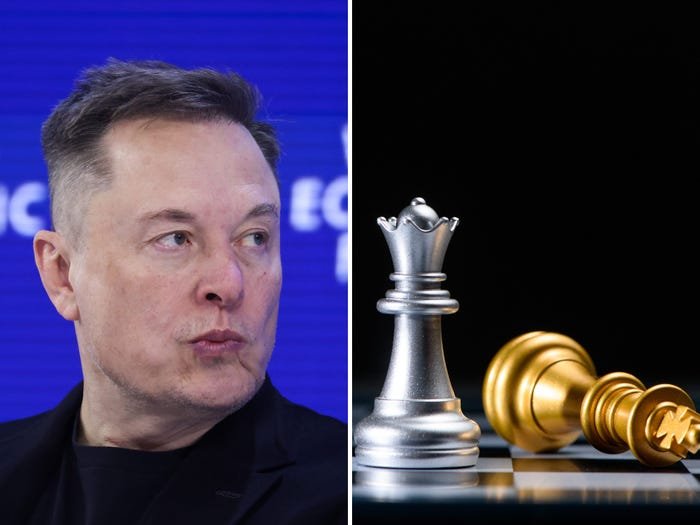
Elon Musk, the world’s richest man, believes artificial intelligence (AI) will eventually fully solve chess. Chess.com, however, has challenged his view of the game’s complexity.
The debate began on Sept. 3, when Musk wrote on X that the number of chess moves that are not “utterly stupid” is very small, and that the game will be fully solved one day.
Musk’s comments quickly caught the attention of Chess.com, one of the world’s largest online chess platforms. Chess.com replied briefly: “Skill issue.”
The phrase is commonly used in video games to mock someone for losing because of a lack of skill.
Musk did not ignore the response. He argued that chess is difficult for humans but not for computers.
“Chess is hard for humans, but not for computers. One day, it will be fully solved like checkers,” Musk wrote. “Between now and then, or even after, have fun. People enjoy many games and sports even though machines are vastly better at them.”
Chess.com then responded with an argument about the enormous size of the game. The platform said the number of possible chess games is about 40 orders of magnitude, or 10^40 times, greater than the number of atoms in the observable universe. Chess.com argued that to solve chess by mapping all possible games, computers would have to deal with this enormous space of possibilities.
Musk said Chess.com was wrong. He distinguished between the number of possible chess games and the number of legal chess positions. According to Musk, the total number of legal chess positions is about 40 orders of magnitude smaller than the estimated number of atoms in the universe.
The 55-year-old world’s richest man believes that artificial superintelligence (ASI) will eventually find ways to solve and compress this information far beyond what humans can imagine. Therefore, he does not see the enormous complexity of chess as an insurmountable barrier.
According to Business Insider, both Musk and Chess.com have a point when it comes to the numbers. The difference is that they are talking about two different things. Chess.com is referring to the number of possible games, while Musk is referring to the number of legal chess positions.
The debate then turned into a back-and-forth argument on X. At one point, Musk called the person running the Chess.com account an “intern”. The account replied that they were a full-time employee. Musk then responded with a coughing emoji.
Chess.com continued to make fun of Musk for replying so quickly, saying that even their friends do not text them back that fast. A Chess.com spokesperson later said: “We understand losing a chess game can be frustrating, but losing a Twitter fight to a so-called intern must be maddening.”
This is not the first time Musk and Chess.com have clashed. In 2022, when Twitter was still called Twitter, Musk said chess was too simple and not useful in real life. He pointed out that the board has only 8×8 squares, with no “fog of war”, technology tree, random map or random starting position. He also noted that both players have the same types of pieces.
Chess.com responded at the time with an article making fun of Musk’s chess knowledge. The platform pointed to special rules and moves such as castling, en passant, pawn promotion and the knight’s unusual movement. Chess.com also responded directly to Musk’s post, but he did not reply at the time.
Musk’s prediction touches on an important question about chess and AI. Computers have long been far better than humans at calculating and evaluating chess positions. However, fully solving a game is not simply a matter of creating a chess engine that is stronger than humans.
A game is considered fully solved when the optimal result can be determined from every legal position, assuming both sides play perfectly. Checkers reached this status after many years of computer calculations, involving an enormous but much smaller search space than chess.
Chess is considerably more complex. The number of possible games is enormous, while the number of legal positions also creates a huge computational challenge. So although top players now rely heavily on powerful chess engines for analysis, this does not mean chess has been fully solved.
Chess has currently been solved only for endgame positions with seven pieces or fewer. Solving the complete game of chess with all 32 pieces would be far more complicated.
Musk has also had another connection with chess. In 2025, Grok 4, an AI model developed by xAI, reached the final stage of a chess competition between AI models but lost to OpenAI’s o3.
The world’s richest man has not always valued chess highly. In 2012, when Tesla held a chess tournament for its employees, Musk shut down the event, saying that the company “does not have time for chess.”
But 14 years later, Musk himself has found time to argue with Chess.com about the future of the game.

I’m a passionate board game enthusiast and a skilled player in chess, xiangqi and Go. Words for Attacking Chess since 2023. Ping me at Lichess for a game or chat.