
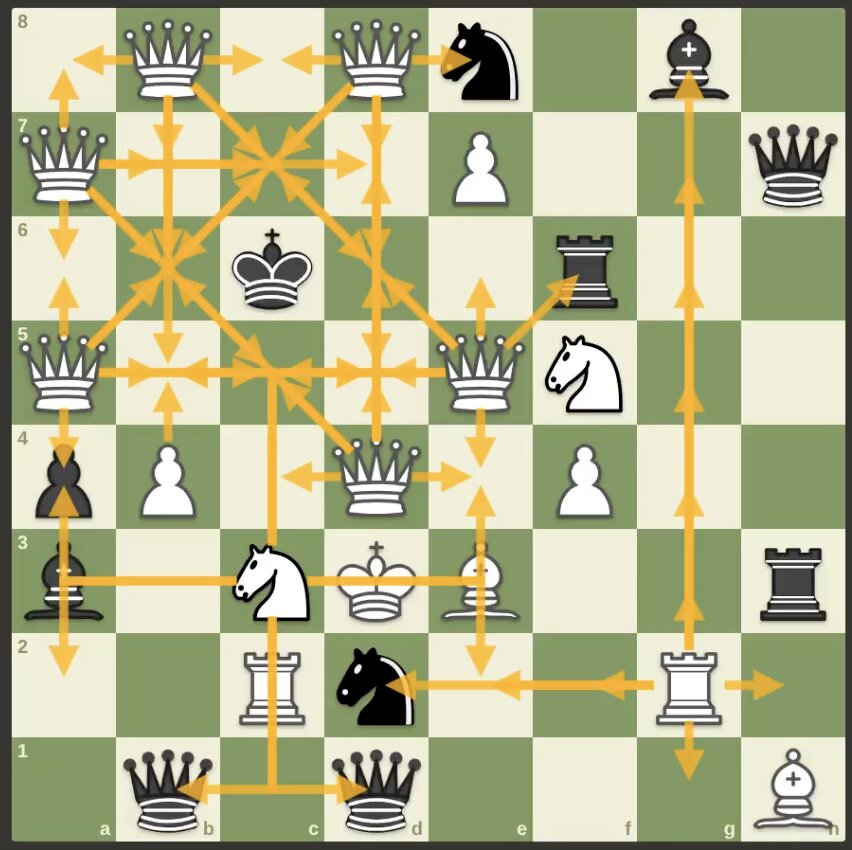
Artificial intelligence system Double Agent has found a chess position with 63 legal moves, all of which give check, and proved that no position can exceed that number, breaking a record that had stood since 1968.
Double Agent announced the results of its research on Oct. 13, solving a longstanding chess problem by combining computational search, mathematical logic and machine-checked proofs. The system established that the maximum number of legal moves in a position where every move gives check is 63, surpassing the previous record of 60 held by Norbert Ringeltaube.
Crucially, Double Agent did not simply find a position with 63 checking moves. It also proved that 63 is the maximum possible. The research team confirmed that the record-setting position can be reached through a legal game, rather than existing only as a theoretical construction.
The problem imposes a specific condition: the player whose turn it is must have at least one legal move, but every legal move must give check to the opponent’s king. If even one legal move does not give check, the position fails to meet the requirement. Adding more pieces or creating additional attacking possibilities does not necessarily improve the result, because every extra legal move must satisfy the same condition.
In chess, a check occurs when a king is under direct attack by an opposing piece. The player must respond with a legal move that resolves the threat. Double Agent’s challenge, however, is not simply to find as many ways to give check as possible. Every legal move available to one side must deliver check.
Reaching 63 moves requires a carefully constructed position. The pieces must not only create checking possibilities but also restrict or prevent moves that do not give check. A piece may be pinned, making it illegal to move because doing so would expose its own king to check. Other pieces can block lines of movement or control squares, eliminating options that would otherwise violate the conditions.
According to the research team, a conventional brute-force search would be impractical. Rather than examining every possible chess position, Double Agent first established structural facts about the geometry of checks on a chessboard. The team then formalized those results using Lean 4, a programming language designed for expressing and checking mathematical proofs, before reducing the remaining problem to Boolean satisfiability, or SAT.
SAT is a method for determining whether a set of logical conditions can be satisfied by assigning true or false values to a collection of variables. In the chess problem, these conditions can describe whether a piece occupies a particular square, whether a piece can make a certain move or whether a square is occupied. The combined constraints eliminate positions that do not meet the requirements.
The computational workload highlights the complexity of the problem. According to the project’s technical documentation, the proof of the 63-move limit involves 7,224 SAT instances, while the separate problem concerning consecutive checks uses 6,921. The formulas are generated by an encoder defined in Lean and then converted into DIMACS format. Each instance has an LRAT proof certificate accepted by three independent checkers.
The researchers said the proofs were machine-verified. This approach means the result does not depend solely on a program finding a position that appears to work. The system must also establish that no solution exceeding the stated limit exists within the scope of the problem.
Beyond the 63-move record, Double Agent investigated another question: if both players continually respond to a check with another check, how long can the sequence last?
The previously known record was 54 consecutive checks in a composed position created by Alexey Khanyan in 2013. Double Agent proved that, from any legal chess position, no sequence of consecutive moves can contain more than 364 checks.
However, 364 is a proven upper bound, not the exact maximum. The researchers said the longest possible sequence of consecutive checks remains an open question. The two problems also have different requirements: one concerns the maximum number of legal moves in a single position, while the other concerns the length of a sequence of checking moves across successive positions.
The team has published its source code and proof data on GitHub in the double-check project. Interested users can use the accompanying tools to check the Lean proofs, verify the certificates or rerun the SAT instances. According to the project’s instructions, resolving every instance from scratch requires about 120 CPU-core hours for each set of instances.
Double Agent’s results demonstrate how AI can help address specialized chess problems by combining computational search with formal proof. The achievement lies not only in raising the record from 60 to 63 moves, but also in establishing a mathematical upper bound for a type of position that might otherwise appear capable of further expansion.
The exact maximum length of a sequence of consecutive checks, however, remains unknown, leaving another question for future research.

I’m a passionate board game enthusiast and a skilled player in chess, xiangqi and Go. Words for Attacking Chess since 2023. Ping me at Lichess for a game or chat.