
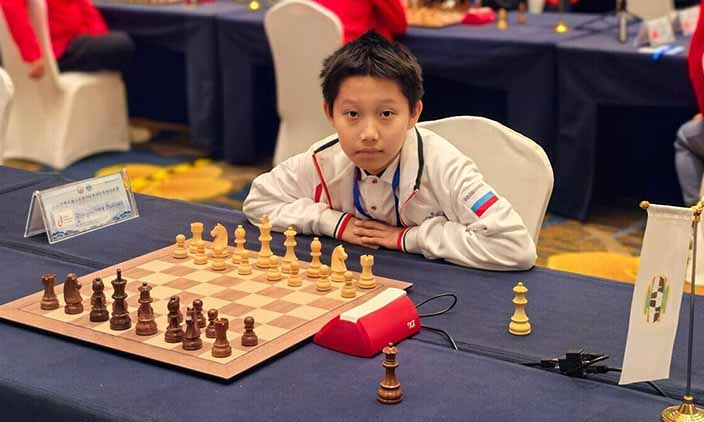
Roman Shogdzhiev, born in 2015, scored 6 out of 9 and finished 10th at the Asian Championship. That result was enough for a performance rating of 2603, which secured his first Grandmaster norm at just 11 years, 4 months and 2 days.
It is a new world record for the youngest player ever to achieve a first GM norm. Previous prodigies reached this milestone later. Illia Nyzhnyk earned his first norm at 11 years, 6 months and 17 days, Gukesh Dommaraju did it at roughly 11 years, 10 months and 23 days, while Faustino Oro did it at 11 years, 11 months, and 10 days. Shogdzhiev broke an 18-year-old record of Nyzhnyk by a clear margin, and he did it in an open continental championship, not a closed event.
His tournament itself was not smooth. He started with a win against a lower-rated opponent, then faced a series of Grandmasters. He drew against Savva Vetokhin and Jingyao Tin, beat A R Ilamparthi, and later defeated Li Di. His only loss came against Kong Xiangrui, the eventual champion. That detail matters because it shows he was competing directly with the strongest players in the event.
The numbers tell the full story. His average opponent rating was 2478, but one opponent was below the 2200 threshold required for norm calculation. According to FIDE rules, that rating was adjusted up to 2200 (for only one opponent), pushing his performance rating to 2603. Without this rule, the norm would not stand. With it, the result becomes official and historic.
While Shogdzhiev made headlines, the tournament itself had its own narrative. Kong Xiangrui, an International Master rated 2497, won the title with 7 out of 9. He tied on points with several players but edged them on tiebreaks based on average opponent rating. This marked the first time in history that an IM won the Asian Championship, earning a direct GM title in the process.
The women’s event followed a similar pattern of tension. Savitha secured the title after winning a critical final-round game with the black pieces. Her victory came not just from her own result, but also from tiebreak dynamics involving opponent strength. Across both sections, young players dominated, with multiple teenage champions emerging.
This trend is not accidental. Access to engines, databases, and online play has compressed development timelines. Players now reach high-level calculation ability earlier than ever. Shogdzhiev fits this pattern. He had already become the youngest International Master in history (at 10 years, 3 months, and 21 days) before this event. Before that, he won both the European and World U8 titles and even defeated multiple Grandmasters at age 8 in rapid and blitz. Born in 2015 in Elista, he learned chess from his father at four and has since trained with a team of elite coaches.
The next step is clear but not simple. To become a Grandmaster, he still needs two more norms and must cross the 2500 rating threshold. At his current pace, both targets look realistic. Some observers expect federations to organize closed tournaments to accelerate the process, a method that has been used before. Whether that happens or not, the clock is already ticking.
The benchmark remains Abhimanyu Mishra, who became the youngest Grandmaster in history at 12 years, 4 months, and 25 days. That gives Shogdzhiev roughly one year to break the record. It is a tight window, but after what he showed in Ulaanbaatar, it is no longer unrealistic.
I’m Xuan Binh, the founder of Attacking Chess, and the Deputy Head of Communications at the Vietnam Chess Federation (VCF). My chess.com and lichess rating is above 2300. Send me a challenge or message via Lichess. Follow me on Twitter (X) or Facebook.