
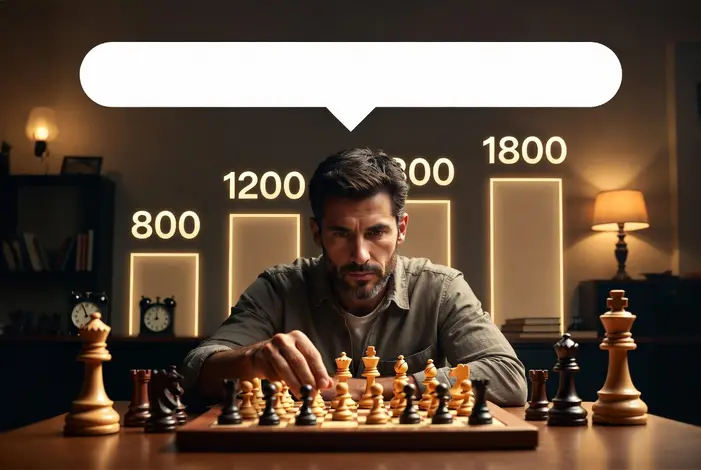
This is one of the most honest questions in chess. Not “Can I become a grandmaster?” but “How far can I actually go if I start as an adult?”
The short answer is this. You can get much stronger than you think. But there are limits, and understanding them will save you years of frustration.
Let’s break it down clearly.
What Does “Starting as an Adult” Really Mean?
When we say “adult beginner,” we usually mean someone who starts learning chess seriously after the age of 18. That matters because most elite players begin very young. Many grandmasters start before age 10, and some even earlier.
Why does that matter?
Because chess at the highest level depends heavily on pattern recognition, calculation speed, and long-term memory built over thousands of hours. These are skills that develop more easily during childhood.
But that doesn’t mean adults can’t improve. It just changes the ceiling.
The Realistic Rating Ranges
Let’s talk in terms of rating, since that’s how chess strength is measured.
Here’s a realistic breakdown for adult beginners who train seriously:
- 1000 to 1400: Very achievable within months to a year
- 1400 to 1800: Achievable with consistent study over 1 to 3 years
- 1800 to 2000: Strong club level. Possible, but requires discipline and structured training
- 2000 to 2200: Expert level. Difficult, but not impossible for highly dedicated adults
- 2200+: Rare for adult starters. This is master level
So what’s the realistic ceiling?
For most adult beginners, reaching around 1600 to 1800 is a strong and attainable goal. Going beyond 2000 is possible, but it usually requires exceptional effort, natural aptitude, and years of focused work.
Real-Life Examples
There are some inspiring cases of adults who started late and still became very strong.
One famous example is John Shaw, who began taking chess seriously as a teenager rather than a child and later became an International Master. However, even that is not a “true adult beginner” case.
A more relevant type of example is the many club players who start in their 20s or 30s and reach 1800 to 2000 after years of consistent study. You’ll find plenty of these stories in local chess communities and online platforms.
There are also modern examples of adult learners documenting their progress online. Some reach 1500 within a year, then spend several more years climbing slowly toward 1800.
The pattern is always the same. Fast improvement early. Then a long plateau.
Why Improvement Slows Down
At the beginner level, progress feels easy.
You learn basic tactics. You stop hanging pieces. You understand simple checkmates. Your rating climbs quickly.
But once you hit around 1400 to 1600, things change.
Now your opponents:
- Don’t blunder as often
- Understand basic strategy
- Punish your mistakes more consistently
To improve further, you need deeper skills:
- Positional understanding
- Endgame technique
- Calculation accuracy
- Opening preparation
This is where many adult learners stall. Not because they can’t improve, but because improvement requires more structured effort.
Time Is the Biggest Factor
Adults have one major disadvantage. Time.
Kids can spend hours every day playing and studying chess. Adults have jobs, families, and responsibilities.
That means progress is usually slower.
But here’s the key point. Consistency beats intensity.
Studying 30 to 60 minutes every day is far more effective than cramming once a week.
If you can maintain a steady routine for years, your rating will keep improving.
Talent vs Hard Work
People often ask if talent matters.
It does. But not in the way most people think.
At the beginner and intermediate levels, hard work matters much more than talent. Almost anyone can reach 1500 or even 1700 with the right approach.
Talent becomes more important at higher levels, especially above 2000. That’s where small differences in calculation speed, memory, and intuition start to matter a lot.
So if your goal is to become a strong club player, you don’t need to worry too much about talent.
What Holds Adults Back
Most adult beginners don’t fail because of age. They fail because of habits.
Here are the most common problems:
They only play blitz games
They don’t analyze their losses
They jump between openings without understanding them
They avoid studying endgames
They expect fast results and quit too early
If you fix these habits, your progress will already be above average.
A Realistic Improvement Path
Here’s what a typical adult improvement journey might look like:
Year 1
Learn the basics. Play regularly. Reach around 1200 to 1400.
Years 2 to 3
Study tactics and simple strategy. Analyze games. Reach 1500 to 1700.
Years 4 to 5
Work on deeper concepts and endgames. Possibly reach 1800 to 1900.
Beyond that
Progress becomes slower. Each 100 rating points can take a long time.
This doesn’t mean improvement stops. It just becomes more demanding.
What Should Your Goal Be?
Instead of aiming for titles like grandmaster, focus on something more practical.
Ask yourself:
- Do I want to beat most casual players?
- Do I want to compete seriously in tournaments?
- Do I want to reach a personal rating milestone?
For many adults, reaching 1600 to 1800 is already a huge achievement. At that level, you understand the game well and can enjoy competitive chess.
The Hidden Advantage of Adult Learners
Adults do have one advantage. They can learn more efficiently.
You can:
- Follow structured study plans
- Use modern tools and engines
- Learn from high-quality online content
- Reflect on your own mistakes
Kids rely more on repetition. Adults can use understanding.
If you combine that with discipline, your improvement can be very steady.
I’m Xuan Binh, the founder of Attacking Chess, and the Deputy Head of Communications at the Vietnam Chess Federation (VCF). My chess.com and lichess rating is above 2300. Send me a challenge or message via Lichess. Follow me on Twitter (X) or Facebook.