
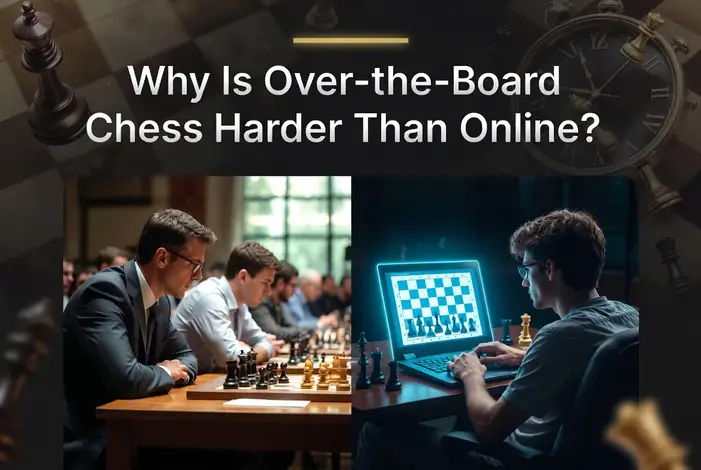
If you’ve ever played both online chess and over-the-board (OTB) chess, you’ve probably felt the difference right away. The same player who crushes games online can suddenly struggle in a real tournament hall. Blunders appear out of nowhere. Time pressure feels heavier. Even simple positions become harder to handle.
So what’s going on?
Let’s break down why OTB chess often feels more difficult than playing online, especially for players who are used to screens.
Contents
1. No Visual Assistance From the Interface
Online chess platforms quietly help you more than you realize.
When you play online:
- Legal moves are highlighted
- Captures are clearly shown
- The board is always perfectly aligned
- No risk of illegal moves
In OTB chess, none of that exists.
You must:
- Calculate everything in your head
- Double-check every move manually
- Keep track of piece interactions without visual hints
This increases the chance of simple mistakes. A missed capture or an overlooked check is much more common in OTB games.
In short: online chess reduces cognitive load. OTB chess puts all of it back on you.
2. Physical Board Vision Is Harder
Looking at a real board is surprisingly more difficult than looking at a screen.
Online:
- Pieces are crisp and standardized
- You can zoom or adjust the board
- Your eyes stay fixed in one position
OTB:
- Pieces vary in style and size
- Lighting conditions can affect visibility
- You’re viewing from an angle, not straight-on
Many players struggle with what’s called board vision. You might calculate a variation correctly in your head but misread the position when you look at the actual board.
That disconnect leads to blunders that “shouldn’t happen.”
3. No Mouse = Slower Execution
Online chess allows fast, almost automatic moves:
- Click or drag. Done.
- Premoves in fast games
- Instant feedback
OTB chess slows everything down:
- You must physically move the piece
- Adjust it properly
- Press the clock
That extra time might seem small, but it changes your rhythm. In time pressure, this becomes critical.
Also, there’s the famous rule: touch-move. If you touch a piece, you must move it (with few exceptions). That adds psychological pressure you never feel online.
4. Psychological Pressure Is Real
This is one of the biggest differences.
Online:
- You’re alone
- No one is watching
- You can play in a relaxed environment
OTB:
- Your opponent sits across from you
- People walk around watching games
- Silence can feel intense
- Tournament stakes feel more serious
Even experienced players feel nervous in OTB events.
This pressure affects:
- Decision-making
- Time management
- Confidence
You might know the right move but hesitate. Or panic and play something worse.
5. Time Feels Different OTB
Time pressure hits differently in real life.
Online:
- The clock is always in your direct view
- You react quickly
- Bullet/blitz habits carry over
OTB:
- You must look up or to the side to check the clock
- Physical movement takes time
- Writing moves (in classical games) adds extra effort
Also, without premoves, you cannot “save time” in sharp positions.
Even players who are strong in online blitz often struggle to manage time in OTB games.
6. No Distractions. But Also No Comfort
Online chess is full of distractions. But those distractions can actually make you more relaxed.
OTB chess removes distractions but also removes comfort.
You cannot:
- Switch tabs
- Listen to music (in most tournaments)
- Take breaks freely
Instead, you sit in one place, fully focused, sometimes for hours.
This level of sustained concentration is exhausting. Many players simply aren’t used to it.
7. Calculation Feels Harder Without Arrows
Online tools train you in subtle ways.
Many players get used to:
- Drawing arrows in analysis
- Using visual patterns on a screen
- Reviewing games with engines immediately
In OTB chess, you lose all of that.
You must:
- Visualize positions entirely in your head
- Remember variations without support
- Trust your calculation
This is why players often say OTB chess is “more pure.” But it’s also more demanding.
8. Emotional Impact Is Stronger
Losing online feels bad. Losing OTB feels worse.
Why?
Because in OTB:
- You invested more time
- You prepared for the event
- You sat face-to-face with your opponent
Every mistake feels heavier. Every loss stays with you longer.
That emotional weight can affect your next game, especially in multi-round tournaments.
9. Less Volume = Less Practice
Online players can play dozens of games per day.
OTB players:
- Might play only a few games per week or month
- Have fewer chances to experiment
- Improve more slowly in practical situations
This makes OTB performance less consistent, especially for players who rely heavily on online experience.
10. Habits Don’t Transfer Perfectly
Some online habits don’t work well OTB:
- Moving too quickly
- Relying on intuition without double-checking
- Playing for tricks instead of solid moves
OTB punishes these habits more harshly.
You need:
- Discipline
- Careful calculation
- Strong fundamentals
So… Is OTB Chess Actually Harder?
Yes. For most players, it is.
But not because the game itself changes. The rules are the same.
What changes is everything around the game:
- The environment
- The tools
- The pressure
- The physical experience
All of these combine to make OTB chess more demanding.
I’m Xuan Binh, the founder of Attacking Chess, and the Deputy Head of Communications at the Vietnam Chess Federation (VCF). My chess.com and lichess rating is above 2300. Send me a challenge or message via Lichess. Follow me on Twitter (X) or Facebook.