

If you play chess on Chess.com or Lichess and you don’t have a FIDE rating, you’ve probably wondered: “What would my FIDE rating be?” That’s a very common question. The short answer is: there’s no exact one-to-one conversion. Online ratings and FIDE (over-the-board) ratings measure similar things: playing strength. But they come from different pools, time controls, and measurement systems.
This article explains the differences, gives practical ways to estimate a FIDE equivalent, and tells you how to actually get a FIDE rating if you want one.
Why online ratings and FIDE ratings aren’t identical
- Different player pools. Online platforms have millions of casual players, juniors, and strong titled players all mixed together. FIDE ratings come from over-the-board (OTB) tournament play and represent a narrower, tournament-oriented pool. That difference alone changes how rating numbers behave.
- Time controls matter. Many online games are blitz or bullet; FIDE ratings are most commonly associated with classical (long) games. Players often perform differently across time controls. A player who excels at fast tactical blitz might have a high online blitz rating but a lower OTB classical rating.
- Rating systems and inflation. Platforms use their own rating algorithms or slight variants of Elo. Rating “inflation” (average ratings drifting upward over time) and differences in starting-point rules cause platform ratings to sit higher or lower than FIDE on average.
- Behavioral differences. Online players sometimes play many casual games, take more risks, or cheat. Over-the-board tournaments generally have stricter anti-cheating oversight, and play is in a different psychological environment (clock pressure, noise, face-to-face opponents).
- Provisional ratings and sample size. New online accounts or new OTB players have provisional ratings that can swing widely. Similarly, a handful of games won’t tell you much about true strength.
Reasonable, practical estimation methods
Because there’s no exact formula, use one or more of these methods and treat the result as a rough estimate, a ballpark, not a gospel.
1. Time-control matching
Pick the online time control you play most and compare to the FIDE discipline you expect:
- If you play long (slow) online games — classical or daily — those tend to be closest to FIDE classical ratings.
- If you play rapid (online 10+0 to 30+0), expect some difference but often closer than blitz.
- If you play blitz or bullet, expect your online rating to be higher than your FIDE classical number, sometimes by tens to a couple hundred points for many players.
2. Platform-specific rough adjustments (typical ranges)
These are ranges, use them as starting points.
- Lichess rapid/classical: often close to your FIDE classical; estimate FIDE ≈ Lichess − 0 to 50 points.
- Lichess blitz: often a bit higher than FIDE classical; estimate FIDE ≈ Lichess − 30 to 120 points.
- Chess.com rapid/blitz: many players see higher numbers on Chess.com than in OTB; estimate FIDE ≈ Chess.com − 50 to 150 points.
Example (digit-by-digit): if your Chess.com blitz is 1800, then a rough FIDE estimate could be:
- 1800 − 100 = 1700
- 1800 − 150 = 1650
So expect roughly 1650–1700 as a possible FIDE classical equivalent.
Quick Estimation (Most Common Searches)
If you have a Chess.com rating
| Chess.com | Estimated FIDE Rating |
|---|---|
| 1200 | ~1000 |
| 1400 | ~1200 |
| 1600 | ~1400 |
| 1800 | ~1600 |
| 2000 | ~1800 |
| 2200 | ~2000 |
| 2400 | ~2200 |
Rule of thumb:
FIDE ≈ Chess.com − 150 (±50 points)
If you have a Lichess rating
| Lichess | Estimated FIDE Rating |
|---|---|
| 1300 | ~1100 |
| 1500 | ~1300 |
| 1700 | ~1500 |
| 1900 | ~1700 |
| 2100 | ~1900 |
| 2300 | ~2100 |
| 2500 | ~2300 |
Rule of thumb:
FIDE ≈ Lichess − 100 (±50 points)
3. Percentile mapping (more work, more accurate)
Find the percentile rank of your online rating (e.g., you’re in the top 10% of active players on the site for that time control). Then look up percentile distributions for FIDE ratings in your country or region (national federations sometimes publish rating lists). Match percentiles to map to a likely FIDE rating. This avoids raw-number mismatches and compares relative standing.
4. Head-to-head test
Play in a few OTB rated events and see how you perform. This is the single most reliable way to find your true FIDE number.
How to get a real FIDE rating (practical steps)
- Register or check with your national chess federation. Most federations handle FIDE registration and tournament submissions.
- Play in FIDE-rated OTB tournaments. Make sure the event is listed as FIDE-rated; organizers will say so.
- Play enough rated games. Federations/FIDE usually require a small minimum number of games against rated opponents to assign an initial FIDE rating (commonly several games in one or more tournaments).
- Results are submitted and processed. After the event your federation will send results to FIDE and a rating will appear when published.
If you’re serious about a FIDE rating, enter rated events rather than only casual or local unrated events.
Things to keep in mind
- Single numbers are imperfect. One number can’t capture playing strength across all formats and conditions.
- Improvement is real and non-linear. If you’re practicing, your online and OTB ratings may move at different speeds.
- Use multiple indicators. Combine online performance, results vs. known-rated players, and a few OTB games to form a clearer picture.
- Avoid overconfidence from online only. High online numbers are encouraging, but OTB play brings different stressors and opponents.
FAQ
Is there an exact conversion from online ratings to FIDE ratings?
No. There is no one-to-one formula because the systems, player pools, and conditions are different.
Why is my online rating often higher than my FIDE rating estimate?
Online games are usually faster and more casual, while FIDE ratings mostly come from slower, over-the-board games.
Which online time control is closest to FIDE classical?
Long online games (classical or daily) tend to be the closest match.
Are Chess.com and Lichess ratings comparable to each other?
Not directly; each platform has its own rating scale and inflation patterns.
How accurate are “rule of thumb” estimates?
They give a rough ballpark, often within ±50–150 points, but not a guarantee.
What’s the best way to know my real FIDE strength?
Play FIDE-rated over-the-board tournaments and see how you score.
Can my online rating still be useful?
Yes—it’s a good indicator of progress, just not a definitive FIDE equivalent.
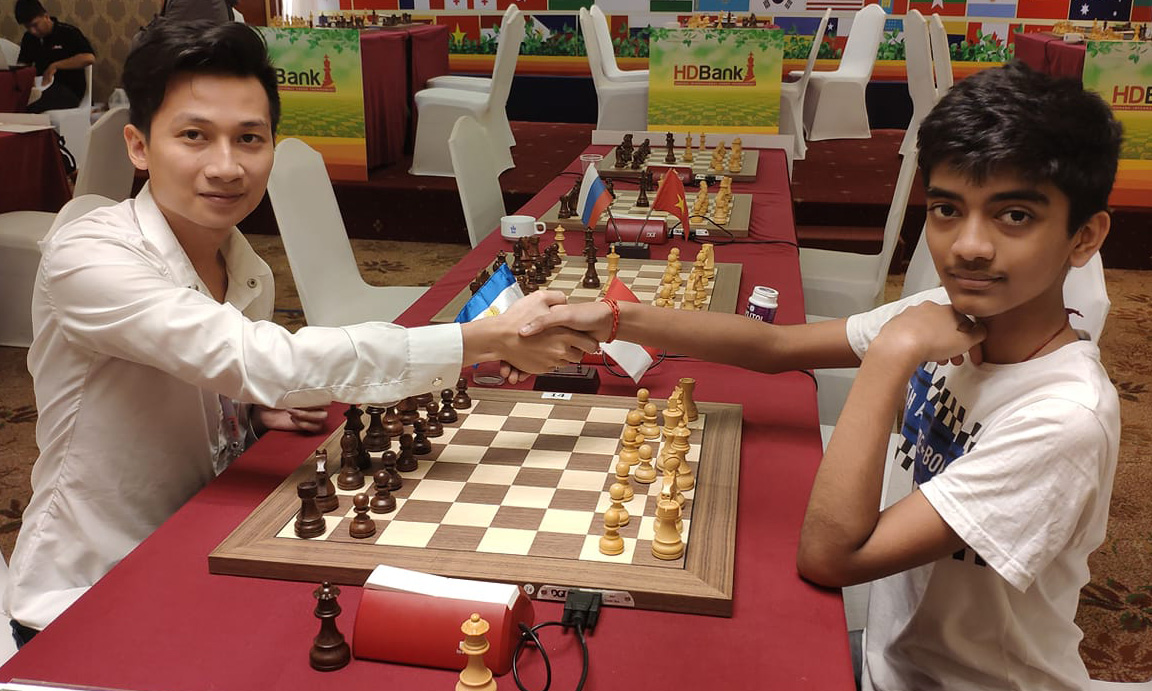
I’m Xuan Binh, the founder of Attacking Chess, and the Deputy Head of Communications at the Vietnam Chess Federation (VCF). My chess.com and lichess rating is above 2300. Send me a challenge or message via Lichess. Follow me on Twitter (X) or Facebook.