
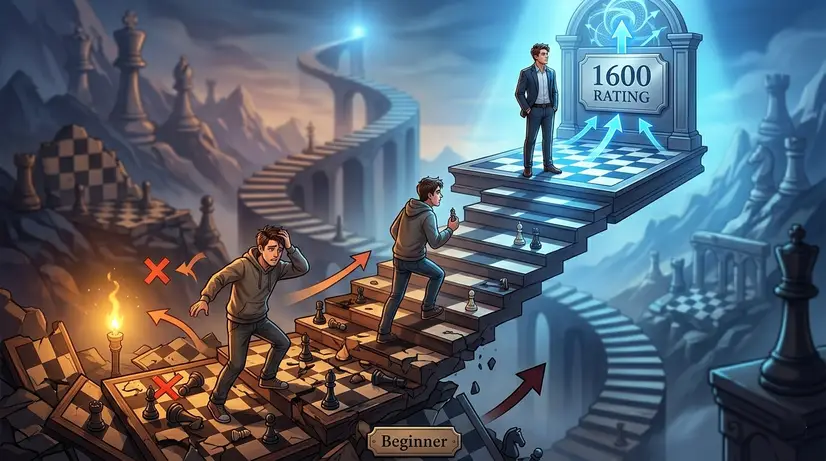
If you’ve ever reached (or are aiming for) a 1600 rating in the US Chess Federation (USCF) system, you’ve probably wondered:
How good is that, really?
Is 1600 strong? Intermediate? Advanced? And what does a player at this level actually know?
The short answer:
A 1600 USCF player is a solid club player. Not a beginner anymore, but not yet an expert. They understand the game well, make relatively few blunders, and can punish mistakes—but still lack consistency, deep calculation, and refined positional understanding.
Let’s break this down in detail.
1. What Does a 1600 USCF Rating Mean?
A chess rating is a statistical estimate of your strength compared to other players. At 1600, you are clearly above average.
- A 1600 player beats a 1500 player about 65% of the time
- Against a 1400, that jumps to around 75%
- Against 1800, they are the underdog (~25%)
In terms of percentile:
- Around top 80–85% of rated players
- Clearly stronger than casual players
- Still far from master level (2200+)
Also note:
- USCF ratings are typically 50–100 points higher than FIDE
So a 1600 USCF player might correspond roughly to:
2. Online Rating Equivalents
Here’s a practical comparison:
| System | Approx Equivalent |
|---|---|
| USCF | 1600 |
| FIDE | ~1500 |
| Chess.com | ~1450–1550 |
| Lichess | ~1750–1850 |
Why the difference?
- Lichess ratings are typically 200–400 points higher than Chess.com
- Online ratings differ due to player pools and rating systems
3. What a 1600 Player Is GOOD At
This is where things get interesting.
A 1600 player is no longer guessing. They actually understand chess.
3.1 Tactical Awareness
This is their biggest strength.
A 1600 player can:
- Spot basic tactics consistently:
- forks
- pins
- skewers
- discovered attacks
- Calculate short sequences (2–4 moves deep)
- Punish obvious blunders quickly
They won’t miss a hanging queen. And they’ll often spot combinations if they’re not too deep.
3.2 Opening Principles (Not Theory)
They don’t memorize 20 moves of theory—but they understand:
- Control the center
- Develop pieces quickly
- Castle early
- Avoid moving the same piece repeatedly
They usually have a basic opening repertoire, but:
- It’s shallow
- It breaks down when the opponent deviates early
3.3 Basic Endgames
A 1600 player knows:
- King + pawn vs king (key positions)
- Basic checkmates:
- King + Queen vs King
- King + Rook vs King
- Simple opposition concepts
However, they may struggle with:
- Complex pawn endings
- Rook endgames (very common but tricky)
3.4 Pattern Recognition
This is underrated.
A 1600 player has seen enough games to:
- Recognize typical checkmate patterns
- Understand common tactical motifs
- Identify “dangerous positions”
They are no longer playing randomly—they are playing with structure.
4. What a 1600 Player Is BAD At
This is what separates them from stronger players.
4.1 Inconsistency
The biggest issue.
A 1600 player can:
- Play like a 1800 in one game
- Play like a 1200 in the next
Blunders still happen—just less frequently.
4.2 Limited Calculation Depth
They struggle with:
- Long forcing lines (5–10 moves)
- Complex tactical positions
- Multi-variation calculation
They often:
- Calculate one line well
- Miss alternatives
4.3 Weak Positional Understanding
This is the biggest gap.
They often don’t fully understand:
- Pawn structures
- Weak squares
- Long-term plans
- Piece coordination
So they might:
- Make good moves… without a plan
- Drift into worse positions slowly
4.4 Poor Endgame Technique
Even if they “know” the basics, they:
- Misplay winning positions
- Fail to convert advantages
- Don’t activate the king properly
This alone can cost many games.
4.5 Opening Misconceptions
They may:
- Over-focus on openings
- Memorize lines without understanding
- Get confused when out of theory
Ironically, openings are often their least important problem.
5. How Long Does It Take to Reach 1600?
This varies massively depending on:
- Age
- Talent
- Training quality
- Time invested
But here are realistic estimates:
Casual Adult Learner
- ~2–3 years with consistent study
Dedicated Improver
- 6–18 months with structured training
Talented Player / Junior
- Possibly under 1 year
Typical Study Time
To reach 1600, most players accumulate:
- 300–1000 hours of chess work
This includes:
- Playing games
- Solving puzzles
- Reviewing games
- Studying basic theory
6. What You MUST Know to Be 1600
If you’re aiming for this level, here’s your checklist.
Tactics (MOST IMPORTANT)
- Solve puzzles regularly
- Recognize all basic motifs instantly
- Calculate short combinations accurately
Openings
- Know 1–2 openings for each side
- Focus on ideas, not memorization
Endgames
- King and pawn fundamentals
- Opposition
- Basic rook endgames (at least concepts)
Game Review
- Analyze your own games
- Identify recurring mistakes
This is where most improvement happens.
7. What Separates 1600 from 1800+
This is the key question.
To go beyond 1600, you need:
1. Better Calculation
- Deeper, more accurate
- Fewer missed tactics
2. Positional Understanding
- Plans based on structure
- Not just “good-looking moves”
3. Consistency
- Fewer random blunders
- Stable performance
4. Endgame Mastery
- Converting small advantages
8. Is 1600 Actually “Good”?
Yes—but with context.
A 1600 player is:
- Much stronger than casual players
- Stronger than ~80% of rated players
- Already a serious chess enthusiast
But also:
- Far below master level
- Still learning core concepts
This is why people call it:
“Intermediate”
“Club level”
Both are true.
9. Final Verdict
A 1600 USCF player is:
- Tactically competent
- Positionally inconsistent
- Strategically developing
- Clearly above average—but not advanced yet
They understand chess.
But they don’t control it yet.
I’m Xuan Binh, the founder of Attacking Chess, and the Deputy Head of Communications at the Vietnam Chess Federation (VCF). My chess.com and lichess rating is above 2300. Send me a challenge or message via Lichess. Follow me on Twitter (X) or Facebook.