
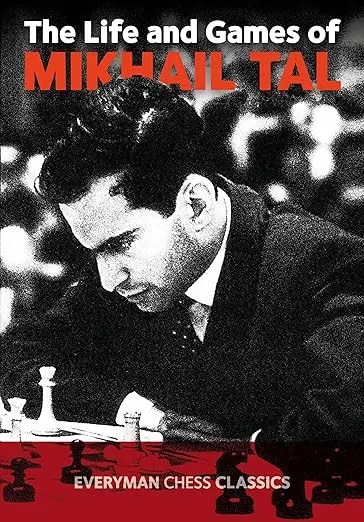
There is a certain type of chess book that sits on the shelf like a textbook—gray, sturdy, and strictly instructional. Then there is The Life and Games of Mikhail Tal.
To call this a mere “game collection” is like calling the Odyssey a travel guide to the Mediterranean. I first picked up this book expecting a sequence of tactical puzzles, but what I found was a sprawling, deeply human, and often hilarious account of a man who didn’t just play chess; he lived it as a fever dream. Mikhail Tal, the “Magician from Riga,” was the eighth World Champion, but in these pages, he reveals himself to be something much more relatable: a man possessed by a beautiful, sometimes destructive, obsession.
Book Contents
1. The Magician’s Confession: An Introduction
2. The Voice in the Room: Tal as a Narrator
3. The Microbes of Chess: A Journey of Emotion
4. Intuition Over the Abyss: The Philosophy of the Sacrifice
5. The Games: Stories Told in Wood and Iron
6. The Fragile Giant: Health, Smoking, and Self-Destruction
7. The Professor and the Child: Rivalries and Psychology
8. Brilliance in the Chaos: The Unique Legacy
9. Final Verdict: Who Should Brave the Storm?
Tal as a Narrator
What strikes me immediately upon opening the book is Tal’s choice of structure. Instead of a standard chronological autobiography, he frames much of the narrative as a dialogue between a “Chess Player” (himself) and a “Journalist”. At first, I found this slightly jarring—a bit of a theatrical gimmick. But as I settled into the rhythm of the text, I realized it was a stroke of genius. It allows Tal to be his own critic. The “Journalist” asks the pointed, sometimes skeptical questions we all want to ask: Were you afraid? Did you really calculate that? Why on earth did you sacrifice that piece?.
Tal’s voice is remarkably candid and self-aware. He doesn’t hide behind the facade of the “invincible grandmaster.” He admits when he was “cocky,” when he was “terribly ashamed,” and when he simply got lucky. There is a warmth to his prose that is rare in the cold world of 64 squares. He describes his first encounter with chess as catching a “dose of microbes,” an infection that he never quite wanted to cure. Reading him feels like sitting across a chessboard from the man himself, late at night, in a room thick with cigarette smoke and the scent of strong coffee.
A Journey of Emotion
The book traces Tal’s meteoric rise from a “fourth category” player at the Riga Palace of Pioneers to the world’s summit. What I appreciated most about this journey was the focus on the emotional landscape rather than just the tournament standings. Tal doesn’t just list wins; he describes the “real tragedy” of falling for a Scholar’s Mate as a ten-year-old. He talks about the “sense of heightened responsibility” that tortured him during team events and the sheer, boyish interest that replaced fear when facing legends like Paul Keres.
His rise felt inevitable to the world, but in the book, it feels precarious. He recounts his matches with a sense of wonder, almost as if he’s surprised he was allowed in the building. When he reaches the 1960 World Championship match against Mikhail Botvinnik, he admits to being so unaccustomed to the “academic” preparation of the champion that he and his trainer, Koblents, felt like children being sent out of the class. This vulnerability makes his eventual triumph feel less like a statistical certainty and more like a heroic, if chaotic, adventure.
The Philosophy of the Sacrifice
If there is a central theme to Tal’s chess philosophy, it is the tension between calculation and intuition. Most chess books preach the “tree of variations,” but Tal is refreshingly honest about the limits of human thought. One of my favorite moments in the book is his description of a game against Vasiukov, where, in the middle of a complex knight sacrifice, his mind wandered to a poem about dragging a hippopotamus out of a marsh. He realized he couldn’t calculate all the branches, so he simply trusted his intuition because the position “promised an interesting game”.
This is the “Tal” mindset in a nutshell. He wasn’t trying to find the “computer-best” move; he was trying to create problems his opponent couldn’t solve. He speaks of sacrifices that “don’t need deep calculation,” where it is enough to see that the opponent will be “squeezed in a vice-like grip”. This approach—valuing the psychological pressure of the unknown over the safety of the known—is what made him the most dangerous player of his era. It’s a philosophy of risk that feels both inspiring and terrifying for a casual player like me.
The Games
The annotated games are, of course, the heart of the book. While John Nunn and others helped update the notation and correct some tactical slips in later editions, the soul of the analysis remains Tal’s. These aren’t dry lists of variations. Tal describes his moves as “trial balloons” or “lightning” attacks.
The annotations reveal his attacking mindset with startling clarity. In his game against Zilber, a 12-year-old Tal is already looking for ways to “weaken” the enemy king position at any cost. In a 1957 game against Aronson, he describes “luring” a bishop away to create a mating threat. There is a joy in these games, a sense of “optimism” that Tal explicitly identifies as his guiding star. However, as a reader, you must be prepared: some of these variations are immensely complex. Tal himself admits that in some games, like his win over Keller in Zurich, providing a “full analysis” was “hardly possible”.
Health, Smoking, and Self-Destruction
One of the most sobering aspects of the book is Tal’s openness about his health problems. He doesn’t complain, but the record is impossible to ignore. He recounts being taken to the hospital with scarlet fever during his first serious tournament. Later, right as he is qualifying for the Interzonal, he discovers “mystical spots” on his lungs and is sent to a sanatorium. His kidney troubles, which would plague him for life, are described with a dark, almost detached humor. He mentions having his “diseased kidney removed” only to jump back into a Candidates tournament ten days later.
Even more striking is his self-destructive streak. He openly discusses how he “officially began to smoke” during the matches with Botvinnik, often using cigarettes to calm his nerves or even to celebrate a move. There is a moment during a match with Benko where both players end up wearing dark glasses—Benko to avoid Tal’s “hypnotic” gaze, and Tal just to poke fun at the absurdity of it. This human side—the hospital stays, the untipped ‘Camel’ cigarettes, and the refusal to let physical pain stop the “song” of the game—paints a portrait of a man who burned twice as bright and half as long.
Rivalries and Psychology
Tal’s descriptions of his rivals offer profound insights into his competitive spirit. His relationship with Mikhail Botvinnik is the cornerstone of the book. He describes Botvinnik as a scientist, a man of “meticulous accuracy” and “iron logic”. The contrast between Botvinnik’s “laboratory” preparation and Tal’s “improvisation” is the book’s great drama. Tal is never bitter; even when he loses the return match in 1961, he admits he was “essentially unprepared” for Botvinnik’s relentless improvements.
He also speaks of Boris Spassky with a deep, almost brotherly “sympathy,” even when Spassky is beating him. His interactions with a young Bobby Fischer are equally fascinating. He describes Fischer as a “15-year-old child” who was “startled” by his own expectations and possessed by an “abnormal sensitivity” to noise. These vignettes show that Tal viewed chess not as a battle of engines, but as a clash of personalities. To him, an opponent’s “confused expression” or “distressed shaking of the head” was as important as the position on the board.
The Unique Legacy
What makes this book different from any other chess autobiography is the sense of ordered chaos. Most grandmasters try to project a sense of total control. Tal, however, embraces the “blunder” and the “adventure”. He describes one game as being played by “beginners” because the pieces were so “amusingly placed. He admits to being “punished” for trying to play “brilliantly” when a simple move would have sufficed.
This book captures the tension of being Mikhail Tal: the brilliance of a man who could see a forced mate in 20 moves while simultaneously forgetting that a pawn was already on g3. It is a book about the beauty of the struggle, where “emotions arise of their own accord” and the player becomes a “composer of the song”.
Final Verdict
Is this book for everyone? Yes and no.
For the strong player, it is an essential study of imagination. The tactical variations are a gold mine of “hussar-like” aggression. For the historian or general reader, it is a gripping memoir of life in the Soviet chess machine, filled with anecdotes about “boot-licking” students and telegrams from Stockholm.
However, casual fans might struggle. The book assumes a high level of chess literacy. If you can’t follow a long variation in your head, you will spend a lot of time flipping back and forth between the text and the diagrams. Some sections, particularly the deep dives into the Sicilian or the King’s Indian, can feel “dated” or “demanding” as theory has moved on significantly since the 1970s.
But if you are willing to do the work—to set up a board and play through these “head-spinning” adventures—you will find something more than just chess. You will find a man who lived with an “unquenchable” enthusiasm for life, even when he had to dictate analysis from a hospital bed. Life & Games of Mikhail Tal is a masterpiece because it reminds us that chess is not a solved puzzle, but a wild, beautiful, and deeply human disease. I finished the last page feeling like I’d just survived a storm, and I wouldn’t have it any other way
Rating: 4.4/5
Guest Author: Dmitri Sokolov
If you’d like to dive deeper into Mikhail Tal’s Life and Games, you can purchase the book through Forward Chess or Amazon.
Buying through these affiliate links comes at no extra cost to you.

AttackingChess Guest Contributors is a collective author profile representing chess enthusiasts, reviewers, coaches, and community members who contribute book reviews, insights, and educational material to the site.
Articles published under this profile may come from different writers with varying backgrounds in strategy, tournament experience, chess literature, and long-term training. All submissions are edited and fact-checked by the AttackingChess editorial team to ensure quality, accuracy, and practical value for readers.
This contributor profile is designed to give a voice to many chess lovers who want to share their perspectives without maintaining individual author accounts. You could submit your article to hxb4693@gmail.com.