
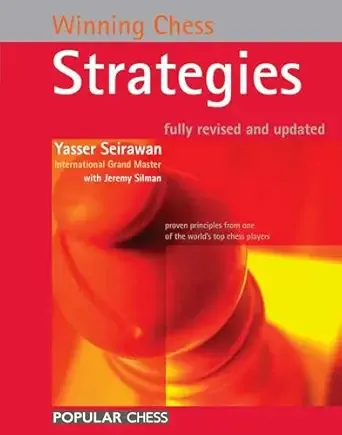
In the journey of every club player, there is a defining moment where the “art” of tactics begins to lose its luster against seasoned competition. You might find yourself frustrated by a “thoughtful positional player” who doesn’t seem to do anything spectacular, yet somehow leaves your position in ruins. This is the pivotal transition from the art of the game to its science. While tactics are born of observation and short-term opportunities, strategy is the science of the “long-range master plan.
Yasser Seirawan argues that strategy actually simplifies the game rather than complicating it. Amateurs often favor a “slashing” style, charging forward with a few pieces while the rest of their army meditates on the back rank. The strategist, however, understands that strategy removes that “blank staring at a board that makes no sense” which plagues so many intermediate players. By shifting your focus to the science of strategy, you stop reacting and start being proactive, transforming the board into a laboratory of logic where every move serves a purposeful objective.
Seirawan’s Approach and the “Five R’s”
This book is a masterclass in accessibility, largely due to the collaborative synergy between Grandmaster Yasser Seirawan and Jeremy Silman. Both are legends for their ability to take the most intimidating, high-level concepts and distill them into language that any club player can grasp. They don’t just teach you where to put your Rook; they teach you how to think.
You might wonder why a Grandmaster is talking about basic arithmetic or the alphabet, but Seirawan insists that the foundation of chess excellence is built on what he calls the “Five R’s.” These are the building blocks of critical thinking, the ability to process information rather than just possessing it.
| The “R” | Definition | Role in Critical Thinking |
|---|---|---|
| (W)rite | Recording moves according to FIDE rules. | Encourages discipline and the ability to review one’s own work for later analysis. |
| Read | Studying chess literature after experiencing losses. | Helps the player stop repeating mistakes of the past by seeking external wisdom. |
| Arithmetic | Calculating point values (e.g., 5+5+4 vs. 5+3+3+5). | Provides a logical basis for evaluation; e.g., realizing you have a “material advantage of two.” |
| Responsibility | Accepting that the player alone is responsible for blunders. | Eliminates excuses; you realize a teammate didn’t drop the pass—it was your own error. |
| Reasoning | Evaluating options (e.g., retreat vs. capture). | The core of decision-making; choosing a path based on logic and safety rather than impulse. |
By mastering these fundamentals, you move from simply “knowing the moves” to “information processing.” Once you have established this mindset, you are ready to engage with the actual curriculum of the “Winning Chess” series.
A Guided Walkthrough of the Table of Contents
The progression of chapters in Winning Chess Strategies is strategically significant for the non-specialist. It moves from the most concrete advantage—Material—to the more abstract master plans, ensuring the reader builds a solid foundation before tackling the nuances of positional play.
1. Chapter 1: The Importance of Strategy – Establishing why a long-term plan beats aimless “move-crunching” with no clear objective.
2. Chapter 2: Making the Most of a Material Advantage – Learning how to use a “bigger army” to systematically crush the opposition.
3. Chapter 3: Stopping Enemy Counterplay – The art of taking the force out of an opponent’s desperate attacks and converting the win.
4. Chapter 4: Understanding Where the Pieces Go – A guide to finding the most effective, “mobilized” squares for your forces.
5. Chapter 5: Superior Minor Pieces – How to ensure your Knights and Bishops outshine their counterparts on the diagonals and files.
6. Chapter 6: How to Use Pawns – Moving beyond pawns as “little wooden men” to seeing them as the soul of your position.
7. Chapter 7: The Creation of Targets – Learning to train your sights on stationary weaknesses, like a stuck e6-pawn, to build a winning plan.
8. Chapter 8: Territorial Domination – Understanding how controlling more squares leads to the suffocating “squeezing” effect Seirawan loves.
9. Chapter 9: Attacking the King – Proving that haymaker blows must come from positionally superior situations.
10. Chapter 10: Faulty Strategies – A cautionary look at why certain plans fail even when they look promising on the surface.
11. Chapter 11: The Great Masters of Strategy – Lessons from the legends who refined the science of the game.
12. Chapter 12: Solutions to Tests – A critical tool for self-correction, allowing you to see if you’ve truly internalized the GM’s logic.
The first major hurdle for most players—Material Advantage—rightfully gets the most thorough treatment in the early chapters.
Mastering the Material Advantage
Material is the most powerful advantage in chess, yet it is frequently mismanaged. Often, a player wins a piece and then immediately loses the game to a random attack. If you’ve ever been in that position, listen to Seirawan: it happens because you stopped thinking strategically the moment you gained the “goodies.”
To capitalize on a material surplus, Seirawan outlines a three-stage plan:
• Consolidation: After winning material, do not immediately attack. Instead, develop all your forces and get your King to safety. “Be patient and get your stuff out!”
• Seeking “Goodies”: Once fully mobilized, look for new targets to devour.
• Defensive Sacrifice: Be willing to give back some material to stop enemy counterplay and simplify the defense.
Seirawan famously uses the metaphor of ballast in a hot air balloon. If you are ahead in material but your position starts sinking due to an enemy attack, you throw some of that material over the side to stop your descent. He illustrated this perfectly in his 1982 game against Anatoly Karpov. At moves 18 and 19 (18.Nxd4 Bxb3 19.Nxb3), Seirawan gave back material to reduce Karpov’s attacking force. This “defensive diversity” allowed him to take the force out of the attack and eventually grind the World Champion into the dust.
Development vs. Greed
To teach the importance of development, Seirawan analyzes “odds games”—historical matches where a master gave up a piece to a beginner. These games serve as perfect strategic warnings.
In Potter-Amateur (1870), played at Queen odds, and Ward-Browne (1874), played at Queen-Knight odds (with the Knight removed from b1), the amateurs made the same fatal error: they moved “only their cavalry” (the Knights) repeatedly while the rest of their “army sat on its starting posts.” Despite their massive material lead, they were wiped out because the masters mobilized every single piece into the fight with tempo. Seirawan offers this stern rule:
“When you are ahead, you should refuse new gifts until your entire army is developed and your King is safe. Once you have accomplished these goals, you are free to take everything in sight.”
Static vs. Dynamic Advantages
A key distinction in the book is between Static (permanent) and Dynamic (temporary) advantages. Strategy aims to create static advantages that won’t disappear after a few moves.
The five static advantages identified by Seirawan are:
1. More Material (Force)
2. Superior Piece Mobility
3. Superior Pawn Structure
4. More Territory (Space)
5. Safe King Position
One of the most effective ways to leverage these is the “Trade, Trade, Trade!” strategy. By trading pieces when you are ahead, you eliminate your opponent’s chances for a “cheapo” (a lucky shot). As seen in the Gormon-Silman (1987) example, trading when ahead leaves the opponent with “no chances to attack whatsoever,” allowing your long-term static advantage to rise in triumph.
Memorable “Seirawan-isms”: Quotes to Live By
Having “sticky” principles to recall in the heat of a match is the hallmark of a consistent winner. Here are five of Seirawan’s best:
• “Strategy requires thought; tactics requires observation.”
◦ Interpretation: Stop hunting for a “trick” on every move. Start building a plan based on the actual features of the board.
• “The game of chess is the touchstone of the intellect.”
◦ Interpretation: Every move is a reflection of how you process information; treat the board as a test of your logical clarity.
• “Be patient and get your stuff out!”
◦ Interpretation: The ultimate cure for premature attacks. You wouldn’t go to war with just three soldiers; don’t attack until the whole army is mobilized.
• “A material advantage is a bit like ballast in a hot air balloon.”
◦ Interpretation: Don’t be greedy. Use your extra material as a currency to buy safety when the opponent starts swinging.
• “Strategy simplifies the game!”
◦ Interpretation: Having a goal gives every move meaning, so you’re never left staring blankly at the board.
Rating Recommendations & Final Thoughts
Yasser Seirawan’s Winning Chess Strategies is more than an instructional manual; it is a journey to a whole different level of chess understanding. It is the survival guide for anyone tired of being “squeezed to death.”
Rating Range Recommendation:
• Under 1000 Elo: Focus heavily on the Five R’s and the rules of material. This will provide the “Arithmetic” you need to stop panicking after a swap.
• 1000-1400 Elo: This is the Sweet Spot. Pay special attention to the chapters on Pawn Structure and Territorial Domination to start outthinking your peers.
• 1400+ Elo: Use this as a refresher on the “Science” of the game and a deep study of the Master games (like the Seirawan-Karpov match) to refine your technique for converting the win.
Real Talk: If you’re tired of playing for “cheap shots” and want to start building a reputation as a consistent winner, this book belongs on your shelf. It takes the mystery out of the “long-range master plan” and gives you the tools to be the one doing the squeezing.
Keep pushing pawns, and I’ll see you across the board.
Rating: 4.6/5
If you’d like to dive deeper into Seirawan’s approach, you can purchase the book through Forward Chess or Amazon.
Buying through these affiliate links comes at no extra cost to you.
I’m Xuan Binh, the founder of Attacking Chess, and the Deputy Head of Communications at the Vietnam Chess Federation (VCF). My chess.com and lichess rating is above 2300. Send me a challenge or message via Lichess. Follow me on Twitter (X) or Facebook.