
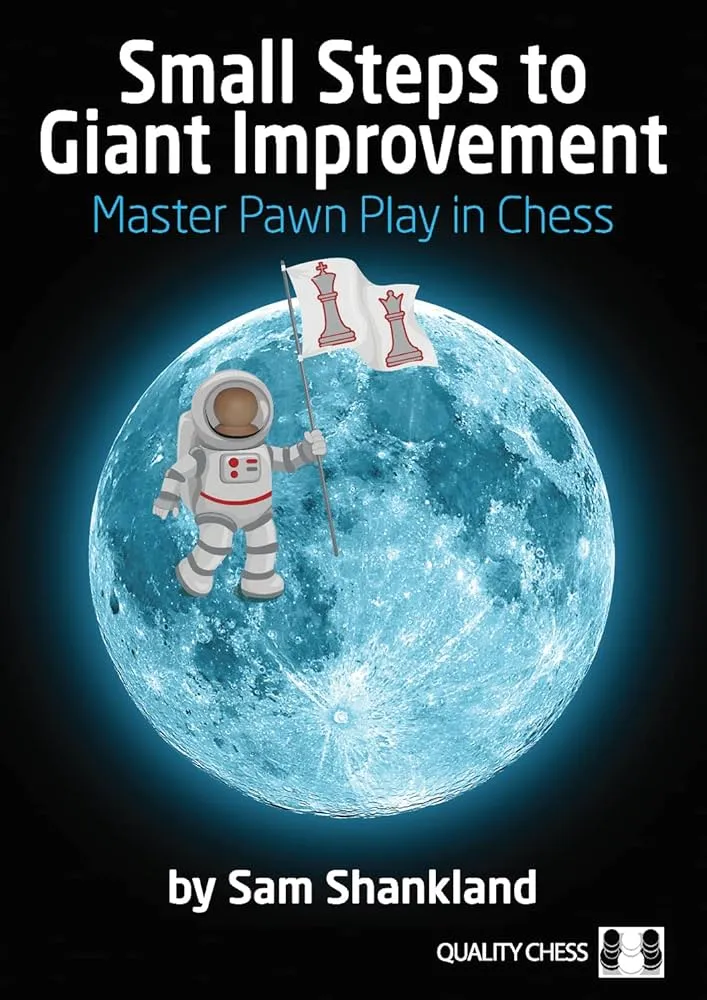
For any serious chess player, there comes a point when the old methods of improvement begin to fail. For years, my own progress was built on a steady diet of tactical puzzles and the diligent memorization of opening lines. But eventually, I hit the wall. My rating stagnated, and the familiar feeling of getting stronger was replaced by a frustrating sense of running in place. Grinding out another thousand puzzles felt less like sharpening a sword and more like polishing a stone; the effort was there, but the edge wasn’t improving. It was this plateau that sent me searching for a different kind of chess book—one that addressed the deeper, more foundational aspects of strategy that I knew were holding me back.
When I first picked up Sam Shankland’s Small Steps to Giant Improvement, my expectations were mixed. Both Shankland and his publisher, Quality Chess, are renowned for producing high-level, challenging material aimed at ambitious players. Seeing the subtitle, “Master Pawn Play in Chess,” I braced myself for a dense, academic treatise on static pawn structures. I imagined something akin to Mauricio Flores Rios’s excellent Chess Structures, a book that catalogues common formations and their associated plans. I was hoping for deep insights but preparing for a difficult, perhaps even dry, study of positional theory.
What I found upon opening the book, however, was something entirely different—and far more valuable—than I could have anticipated.
First Impressions: An Honest Conversation About Mistakes
The first thing that strikes you about this book is its voice. Instead of the dogmatic, authoritative tone common in many chess manuals, Shankland speaks to the reader with a refreshing humility. He doesn’t present himself as an oracle dispensing infallible wisdom, but as a fellow traveler who has struggled, made painful mistakes, and is willing to share what he has learned. This approach immediately creates a bond of trust and makes the profound lessons within feel both authentic and achievable.
The philosophical core of the book is built around a simple, powerful truth that every chess player knows but few truly internalize: pawns can’t move backwards. Shankland makes this the central theme from the very beginning, illustrating its devastating consequences not with a clinical example from a classic game, but with one of his own painful errors. In his game against Georg Meier, he points to his move 57.f5? and admits with brutal honesty:
There was no reason to advance the f-pawn and make it vulnerable on f5. White could have sat tight and asked Black to construct a plan that would make progress… The position is still drawn but White’s margin for error has shrunk significantly.
This willingness to dissect his own fallibility is the book’s greatest strength. By showing us where he went wrong, Shankland makes it clear that mastering these concepts is a journey of self-discipline, not a matter of innate genius. It’s an invitation to learn from his mistakes, transforming the book from a lecture into an honest conversation.
This foundational philosophy of pawn irreversibility sets the stage for a brilliantly structured examination of pawn play in all its facets.
Deconstructing the Method: Pawn Irreversibility
The architecture of Small Steps to Giant Improvement is a masterclass in information design. The book is divided into four main parts, built around a logical and elegant symmetry. Part I teaches you how to avoid making your own pawn-pushing mistakes, while Part II teaches you how to provoke those same mistakes in your opponent. The book then mirrors this structure for its second major topic: Part III details how to avoid the downsides of your own doubled pawns, and Part IV explains how to inflict problematic doubled pawns on your opponent. This thoughtful organization turns a complex subject into a digestible and coherent learning path.
3.1. Part I & II: The Forward March – Self-Restraint and Provocation
Part I, “Pawns Can’t Move Backwards,” is an exercise in developing discipline. It’s about learning to resist the impulse to lash out with a pawn move before carefully considering its permanent consequences. Shankland systematically breaks down the five primary ways a pawn can be pushed too far:
1. It becomes vulnerable and difficult to defend.
2. It loses control of a key square that it was previously defending.
3. It blocks lines or squares needed by your own pieces.
4. It exposes your king by weakening his pawn shield.
5. It becomes a “hook” that the opponent can use to pry open lines.
This framework provides a concrete checklist to run through before committing to an irreversible pawn move, turning a vague positional sense into a structured thought process.
A Moment of Clarity: Chapter 2 – Avoiding Potholes
For me, like many club players, the temptation to make an “active” pawn break is often overwhelming. Chapter 2 was a revelation in this regard. Shankland uses his own game against Deep Sengupta to illustrate a mistake I have made countless times. After his move 13...e5?, he writes:
Advancing the e-pawn is really asking for trouble… all I did achieve was to critically weaken the key d5- and f5-squares.
Seeing a Grandmaster offer such a pointed self-critique over a common positional error was profoundly resonant. He then contrasts this with an example from a game between Emil Sutovsky and Garry Kasparov, where a similar ...e5 push was not only correct but powerful. Shankland’s genius is in his explanation of the difference, and it boils down to a lesson about preconditions. The key takeaway is that a pawn break’s success is determined before the pawn is moved. Kasparov’s push worked because his pieces were already perfectly poised to control the squares that would be weakened by his pawn advance; Shankland’s were not. This reframed the issue from a simple “good vs. bad” move to a profound strategic principle about preparation and timing.
Part II, “Compelling Enemy Pawns Forward,” builds directly on these lessons. It elevates the book from a manual on self-improvement to a guide on strategic warfare. Here, Shankland teaches you to weaponize the principles from Part I, showing how to create situations where your opponent is forced or tempted into making the very same irreversible mistakes you have just learned to avoid.
3.2. Part III & IV: The Sideways Step – A Deep Dive into Doubled Pawns
The final two parts of the book tackle one of the most misunderstood positional elements in chess: doubled pawns. Shankland moves beyond the simplistic “doubled pawns are bad” mantra, providing a nuanced framework for evaluating when they are a crippling weakness and when they are a manageable concession or even an asset.
A key strategic lesson emerges from the game Ray Robson – Alexander Ivanov in Chapter 11. Robson, playing with White, correctly understood that his queenside pawn majority became the decisive factor precisely because Black’s own kingside majority was neutralized by a set of doubled pawns. Armed with this long-term understanding, Robson confidently traded pieces, knowing the resulting pawn endgame was winning for him. This example perfectly illustrates the book’s power: it trains you to see the subtle, long-term consequences of pawn structures and to formulate plans based on that deep understanding.
Studying these concepts is one thing; internalizing them is another journey altogether.
The Study Experience: Through the Valley of Frustration
Let me be clear: this is not a book you can passively read on the couch. It is a demanding workbook that requires your full and active engagement. Shankland provides exercises at the end of each chapter, and they are designed to challenge you, not to flatter you. My own journey through these problems was a humbling one.
I would set up a position, analyze it carefully, and confidently write down what I believed was the solution, only to find I was completely wrong. This happened again and again. The initial frustration was immense. But then came the breakthrough. By forcing myself to slow down and meticulously read Shankland’s detailed solutions, I began to see the deeper principles at play. The “aha!” moments that followed were worth every bit of the initial struggle. I wasn’t just learning moves; I was rewiring my strategic intuition.
A perfect example of this process is an exercise from Chapter 2, Sam Shankland – Marc Esserman. The question is whether White should play 19.c4.
This single move involves a complex trade-off: it opens the queenside and creates a long-term weakness for Black, but it also risks allowing Black to secure the powerful c5-outpost for his knight. Working through this single decision—weighing the tangible benefits against the positional risks—is a microcosm of the practical, difficult, and deeply rewarding training the book provides.
This intensive study experience solidifies the book’s place as a serious training tool, inviting comparison with other cornerstones of chess literature.
Where Shankland Fits on the Chess Shelf
To truly appreciate this book’s contribution, it’s helpful to see where it fits within the broader landscape of chess improvement literature.
• Versus “Chess Structures – A GM Guide”: Mauricio Flores Rios’s book is an essential reference, a kind of encyclopedia of common pawn formations and their typical plans. It tells you what to do once you’ve arrived in a certain structure. Shankland’s book, in contrast, is about the dynamic decision-making involved in creating, avoiding, or provoking those structures in the first place. The two books are perfect complements.
• Versus Yusupov’s Training Series: Artur Yusupov’s award-winning, nine-volume series is a complete curriculum for chess mastery, covering every aspect of the game from tactics to endgames. It is broad and comprehensive. Small Steps to Giant Improvement is a specialized deep dive—a graduate-level course on what is arguably the single most important and difficult-to-master component of that curriculum: pawn play.
• For the Aspiring Player: This book is not for the raw beginner. A player just starting out would be better served by a foundational text like Martin Weteschnik’s Chess Tactics from Scratch. Instead, Shankland’s work is the perfect resource for the serious, dedicated club player who has mastered the basics and is ready to move beyond them. It is for the player who understands that the next leap in skill will come not from memorizing more, but from understanding more deeply.
Ultimately, Shankland has carved out a unique and essential niche on the modern chess shelf.
Conclusion: A Foundational Shift in Thinking
Small Steps to Giant Improvement does not offer quick fixes or cheap rating points. It offers something far more valuable and enduring: a fundamental shift in your chess thought process. It teaches a kind of patience and positional discipline that is the true hallmark of a strong player.
After studying this book, I find myself instinctively pausing before every pawn move. I ask myself: What square am I weakening forever? What lines am I closing for my own pieces? What hook am I creating for my opponent? I weigh the permanent consequences of each push with a newfound gravity and appreciation. The improvement is not flashy, but it is deep and real.
While the progress is gradual—a series of “small steps,” just as the title suggests—the book absolutely delivers on its promise of providing the tools for a “giant improvement.” It is an essential, lasting resource that has earned a permanent place in my library, and it belongs in the library of any chess player serious about mastering the game.
Rating: 4.4/5
Guest Author: Ethan Doyle
If you’d like to dive deeper into Sam Shankland’s method, you can purchase the book through Forward Chess or Amazon.
Buying through these affiliate links comes at no extra cost to you.

AttackingChess Guest Contributors is a collective author profile representing chess enthusiasts, reviewers, coaches, and community members who contribute book reviews, insights, and educational material to the site.
Articles published under this profile may come from different writers with varying backgrounds in strategy, tournament experience, chess literature, and long-term training. All submissions are edited and fact-checked by the AttackingChess editorial team to ensure quality, accuracy, and practical value for readers.
This contributor profile is designed to give a voice to many chess lovers who want to share their perspectives without maintaining individual author accounts.