
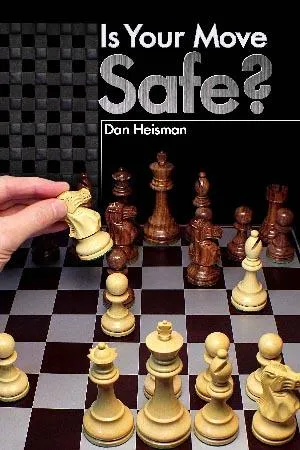
For the vast majority of amateur chess players, the story of a lost game is not one of a missed brilliancy but of a single, catastrophic oversight. A move that looked promising is met with a crushing reply that wins material or forces checkmate, unraveling an entire game’s worth of effort. While countless books drill tactical patterns, few address this root cause of defeat: the failure to ensure one’s moves are safe. This review evaluates Dan Heisman’s Is Your Move Safe?, not as a conventional puzzle book, but as a potential long-term training system meticulously designed to build this exact, indispensable skill.
Published by Mongoose Press in 2016, the book presents a radical departure from the standard “White to play and win” format, instead challenging the reader to adopt the thought process of a master: to vet every candidate move for hidden dangers before committing to it.
The core thesis of this review is to determine if Heisman’s laser-focused methodology on “move safety” provides a robust enough framework to justify months of dedicated study for the serious chess improver. To understand the book’s value as a training tool, we must first grasp the author’s underlying philosophy of chess improvement.
The Safety-First Chess
Before committing to any long-term training program, it is crucial to understand the author’s core philosophy. A training manual is not merely a collection of exercises; it is the embodiment of a specific approach to improvement. This section distills Dan Heisman’s fundamental principles as presented in the book’s comprehensive introduction, which form the bedrock of his entire system.
Heisman begins by identifying a profound source of confusion for amateurs: the very meaning of the word “safe.” He explains the critical difference between two common definitions. The first is the “material object” definition: trading two dollars for ice cream is a “safe” transaction because you receive fair value. The second is the “living being” definition: a soldier killed in a war zone is not safe, even if the enemy is killed in return. Many amateurs, Heisman argues, wrongly apply the “living being” definition to their pieces, fearing the “loss” of their queen even in an equal trade. To correct this, he establishes a clear, unambiguous chess definition for the student:
Safe: A move is safe if, in response, the opponent has no forcing sequence which wins material or checkmates.
This definition immediately elevates the concept of safety from a vague feeling to a concrete, analytical task. Heisman argues that this task must take precedence over all other considerations, including strategy. He encapsulates this hierarchy in a powerful maxim:
Strategy is the tiebreak of equally safe moves.
The implication of this principle is profound. It instructs the improving player to restructure their entire thought process: strategy generates initial candidates, but these moves only become final candidates after passing the rigorous safety test. For amateurs conditioned to hunt for brilliant attacks, this “safety-first” approach is a radical rewiring of the brain. It demands a shift away from the exciting search for combinations and toward the disciplined, professional habit of risk management—a difficult but necessary transformation for real improvement.
This philosophy leads to the book’s unique proposition. Unlike traditional tactics books that present a position where a winning combination is known to exist, Heisman’s problems mirror the reality of an actual game. As he explains:
“in a real game, you should always be asking if moves (for both sides) are safe, while you are never told that the opponent’s previous move was not safe…”
This reframes the entire purpose of tactical training. Heisman asserts that a player will have “many more opportunities to use your tactical skill to prevent making unsafe moves than you will to win material.” In his view, tactical vision is primarily a defensive tool used to filter out your own blunders, a skill exercised on nearly every move of every game.
Core Training Principles from the Heisman Method
• The Primacy of Safety Checks: The first and most important question for any move being considered must be, “Is it safe?” This habit, Heisman argues, is the key to preventing game-losing mistakes.
• Holistic Positional Awareness: A move’s safety is determined not by the landing square of the piece that moved, but by the safety of the entire position it creates. As demonstrated in problem 1-1, a seemingly innocuous pawn move like 1.b4 can fatally undermine the position, allowing a capture on the other side of the board that wins the queen.
• Analysis over Pure Pattern Recognition: Heisman warns that while pattern recognition is necessary, it is not sufficient. Even when a tactical theme seems familiar, subtle differences in the position can change the outcome entirely. Careful, concrete analysis is always required.
• Avoiding Quiescence Errors: One of the most common analytical mistakes is stopping calculation too soon. This is especially dangerous in lines involving pseudo-sacrifices, where an initial loss of material is recouped with interest. The lessons from problems 1-6 and 1-7 illustrate this danger.
This robust doctrine is not left as abstract advice; it is meticulously organized into a clear structural plan for building the student’s analytical muscles.
The Book’s Structure
An effective training manual requires a logical structure that guides the learner from foundational concepts to complex applications. This section provides a systematic walkthrough of the book’s five chapters, assessing how Heisman deliberately constructs a learning path to build the student’s analytical muscles from the ground up.
The book’s architecture is laid out across five distinct chapters, each serving a specific function in the overall training system:
1. Chapter 1: Basic Safety Issues: This chapter establishes the foundational concepts of safety analysis and introduces the most common types of errors through clear, illustrative problems.
2. Chapter 2: Openings: This section applies the safety-first mindset to the initial phase of the game, where tactical oversights can be particularly catastrophic.
3. Chapter 3: Middlegame: The book then moves to the most complex phase of the game, where deep and accurate safety calculations are paramount.
4. Chapter 4: Endgame: Here, Heisman explores the nuanced definition of safety in the endgame, where the goal shifts from pure material balance to achieving a win or securing a draw.
5. Chapter 5: How Many Safe Moves?: The final chapter introduces a distinct and highly practical question type, designed to hone a player’s skills in critical defensive or threatening situations.
The logic of this progression is clear and deliberate. The structure is designed to build a student’s “safety analysis” muscle systematically, moving from universal principles (Chapter 1) to phase-specific applications (Chapters 2-4) and finally to a specialized, practical skill (Chapter 5).
Heisman explicitly identifies the book’s target audience as players in the “1100-2400” range, clarifying that it is “not a book for beginners.” This exceptionally wide difficulty range is a key feature; it ensures the book can serve as a long-term training partner. A player can work through it, set it aside for six months, and return to find the more difficult problems just as challenging and instructive as before.
The true value of the training system lies in how this knowledge is delivered through the unique format of its problems and the depth of its answers.
Heisman’s Problem-Solving Method
The effectiveness of any training system depends on its practical application. A sound philosophy and a logical structure are prerequisites, but the learning happens in the trenches of problem-solving. This section dissects the book’s problem-and-answer format, using specific examples from Chapter 1 to reveal the depth of instruction embedded in Heisman’s method.
The core innovation is the problem format itself. Instead of the conventional prompt to find a winning tactic, the book presents one or more candidate moves and asks a simple, direct question: “Is it safe?” or “Which of the following are safe?” This forces the reader to step out of the puzzle-solver’s mindset and into the practical player’s mindset, evaluating their own potential moves for flaws.
The trilogy of problems 1-10, 1-11, and 1-12 serves as a brilliant case study in the book’s instructional power:
• Problem 1-10: This problem introduces a basic removal-of-the-guard tactic. The candidate move 1…Bxd4 is unsafe because White can play 2.Bxc6, removing the defender of the d4-bishop and winning a piece.
• Problem 1-11: Here, Heisman makes a small but critical change to the position: a White knight is now on c3. The same candidate move, 1…Bxd4, is now perfectly safe. After 2.Bxc6, Black has the desperado resource 2…Bxc3, trading pieces and restoring material equilibrium.
• Problem 1-12: A final alteration—this time to the location of Black’s queen—renders 1…Bxd4 unsafe once again. After the sequence 2.Bxc6 Bxc3, White has the decisive intermediate capture 3.Bxd7, winning a piece.
This progressive sequence teaches a far deeper lesson than a single puzzle could. It demonstrates that safety is not about recognizing a simple pattern but about deep, accurate calculation. Heisman himself notes in the answer to 1-12 that this trilogy is a benchmark for raw analytical skill, asserting that “analytical ability is the single chess skill with the greatest correlation to playing strength.” The book thus becomes a tool for developing this core faculty.
Furthermore, the instructional value of the answers is immense. They are not mere solutions but extensive discussions filled with principles, alternative lines, and explanations of common errors. The answer to the very first problem contains a lesson that defines the book’s entire approach:
“When you ask if a move is safe, you are really asking, ‘Is the position that the move would create safe?’ – which, of course, includes much more than just the piece that moved.”
To add a final layer of practical precision, Heisman adopts GM Larry Kaufman’s more nuanced piece value system (e.g., Knight/Bishop = 3.5, Rook = 5.25, with a 0.5 bonus for the bishop pair). This encourages the student to move beyond the simplistic 1-3-3-5-9 valuation and make more sophisticated judgments about material imbalances, a crucial skill in practical play.
Having analyzed the book’s philosophy, structure, and method, we can now address the central question: is this system robust enough to sustain months of dedicated study?
Can This Book Sustain Months of Study?
Is Dan Heisman’s Is Your Move Safe? a comprehensive enough system to serve as a primary training tool for a serious chess improver over several months? This is the ultimate test of its value. To answer this, we must weigh its focused strengths against its inherent limitations.
| Strengths as a Long-Term System | Potential Limitations |
|---|---|
| Skill Focus: Drills one of the single most important and underdeveloped skills in amateur chess: blunder-checking. | Narrow Scope: The relentless focus on safety does not cover other essential areas like strategic planning, positional understanding, or attacking technique. |
| Progressive Difficulty: The problems range from “relatively trivial to quite difficult,” allowing a student to grow with the book over time. | Requires External Context: To become a well-rounded player, this book must be supplemented with resources on strategy, openings, and endgames. |
| High Instructional Density: The extensive answers provide deep learning, making each problem a mini-lesson in practical calculation and evaluation. | Mental Fatigue: The intense calculation required for every problem could lead to burnout if used exclusively without variation in study. |
| Practicality: The problem format directly simulates the real-game thought process of evaluating candidate moves, unlike abstract puzzle-solving. | Author’s Admission: Heisman notes the answers are not always “black and white,” which, while practical, may frustrate students seeking definitive tactical solutions. |
Synthesizing these points, it becomes clear that Is Your Move Safe? is not designed to be a complete, all-in-one chess curriculum. Its scope is intentionally narrow, but its depth within that scope is extraordinary. Attempting to use it as one’s sole study material would neglect vital areas of chess and likely lead to mental fatigue. However, its focused, deep, and intensely practical approach to a skill that decides the outcome of most amateur games makes it an exceptional candidate for a cornerstone of a long-term study plan, rather than the entire plan itself.
With this verdict on its viability, the next logical step is to provide actionable advice on how to best implement this powerful tool.
A Practical Study Plan
To maximize the value of any training resource, especially one as dense as Is Your Move Safe?, it must be used systematically. A haphazard approach of solving a few puzzles here and there will not build the deep, ingrained habits the book aims to instill. This section provides a concrete, actionable schedule and methodology for studying the book over several months.
A recommended weekly study schedule could look like this:
• Weekly Goal: Aim to complete a set number of problems, perhaps 5 to 10. The focus should always be on the depth of analysis over the quantity of problems solved.
• The Process: For each problem, first attempt to solve it as you would in a game. Consider setting a timer for 10-15 minutes. Crucially, write down your full analysis and your final conclusion (“Safe,” “Not Safe,” “Speculative,” or the specific number of safe moves). This act of committing your thoughts to paper prevents hindsight bias when reviewing the answer.
• Deep Dive into Answers: Plan to spend significantly more time studying the provided answer than you did solving the problem. Carefully play through every line Heisman provides. The goal is to identify the key principle the problem was designed to teach and fully internalize it.
• Create a “Mistake Journal”: If your conclusion was wrong, document why it was wrong. Did you miss an opponent’s candidate reply? Did you make a quiescence error by stopping your analysis of a pseudo-sacrifice too soon? Did you fail to see a key Seed of Tactical Destruction that made the position dangerous? This process creates a powerful, personalized feedback loop for improvement.
For progression, it is highly advisable to work through the chapters in the order the author intended, from 1 to 5. This ensures that you are building skills logically, starting with the foundational concepts in Chapter 1 before moving to more specialized applications.
Finally, this training must be placed within a balanced “diet” of chess study. Heisman’s book can serve as the core workout for calculation and safety. This should be supplemented by studying annotated master games to improve strategic understanding and working with a dedicated book or course to build an opening repertoire.
With this disciplined approach, Is Your Move Safe? is transformed from a simple collection of puzzles into a powerful engine for improvement, leading to our final verdict.
Final Verdict
After a thorough examination of its philosophy, structure, and practical application, it is clear that Dan Heisman’s Is Your Move Safe? is far more than a typical puzzle book. It is a meticulously designed, comprehensive training system dedicated to forging the single most critical skill in practical chess: the ability to avoid game-losing mistakes.
The final judgment is therefore unambiguous. For any player in the 1100-2400 rating range who is serious about eliminating blunders and building a reliable thought process, this book is not just recommended—it is an essential, foundational resource. While it cannot stand alone as a complete curriculum, it excels as the cornerstone of a balanced study plan.
Committing several months to working through this book is a significant investment of time and mental energy. However, the payoff is not merely a higher rating or a few extra tournament points. The true reward is the development of a disciplined, safety-conscious, and reliable method of thinking at the chessboard—the very bedrock upon which chess mastery is built.
Rating: 4.6/5
Guest Author: Dmitri Sokolov
If you’d like to dive deeper into Heisman’s method, you can purchase the book through Forward Chess or Amazon.
Buying through these affiliate links comes at no extra cost to you.

AttackingChess Guest Contributors is a collective author profile representing chess enthusiasts, reviewers, coaches, and community members who contribute book reviews, insights, and educational material to the site.
Articles published under this profile may come from different writers with varying backgrounds in strategy, tournament experience, chess literature, and long-term training. All submissions are edited and fact-checked by the AttackingChess editorial team to ensure quality, accuracy, and practical value for readers.
This contributor profile is designed to give a voice to many chess lovers who want to share their perspectives without maintaining individual author accounts.