
For any chess player dedicated to improvement, the most formidable opponent isn’t a person across the board; it’s the plateau. It’s that flat, featureless landscape where your rating seems frozen in time, where every game feels like a repeat of the last, and the joy of discovery gives way to the grind of repetition. Breaking through these mental barriers is the very essence of getting stronger, but for a long time, I was completely, utterly stuck.
I remember the exact moment the frustration boiled over. It was the third round of a weekend tournament. I had a promising position against a similarly rated player—a solid pawn structure, active pieces, everything the engine would approve of. For twenty minutes, I calculated variations, double-checking tactics, convinced I was on the verge of a breakthrough. Then, my opponent made a quiet, unassuming move. A simple rook lift. It didn’t threaten checkmate or win a piece, but the entire character of the game shifted. My positional edge collapsed, and the position’s logic turned against me. Suddenly my pieces were clumsy, my plans felt naive, and ten moves later, I was tipping over my king in resignation.
Walking away from that board, the feeling was crushing. It wasn’t just the loss; it was the gnawing sense of incomprehension. I could solve tactics puzzles all day, memorizing patterns of forks and pins. I knew the opening theory for my favorite lines. I could see the what—the move that was good or bad—but I couldn’t grasp the why. There was a deep, strategic language being spoken on the board that I simply couldn’t hear. My play was a series of disconnected calculations, not a coherent plan.
I knew I needed more than just another openings course or tactics trainer. I needed a new way to see the board, a way to understand the story that unfolded with every move.
An Unassuming Guide to Strategy
Sometimes, the mentor you need most doesn’t come in the form of a grandmaster coach, but as a quiet voice from a dusty book. A single, well-chosen volume can reframe your entire understanding of the game, patiently explaining the timeless principles that algorithms can only hint at. This was my experience when I finally found my guide.
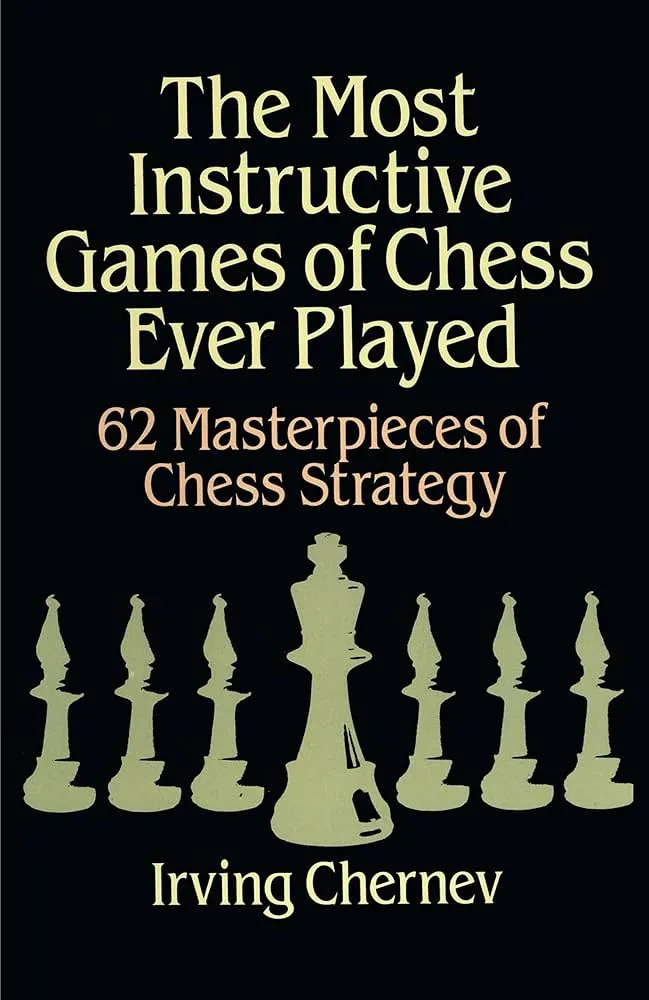
I discovered Irving Chernev’s The Most Instructive Games of Chess Ever Played not on a “must-read” list online, but on the shelf of a second-hand bookstore. The cover was simple, published by Dover Publications, with none of the glossy graphics of modern chess manuals. The title itself felt both bold and old-fashioned. As I flipped through the introduction, Chernev’s words spoke directly to the frustration I had been feeling. He wasn’t promising secret openings or tactical tricks. He was promising understanding.
The games in this book are to my mind the most instructive examples in the whole literature of the game, of position play—the strategy of winning chess.”
Reading that, I felt a flicker of hope. “Position play”—that was the language I was missing. It wasn’t about flashy combinations; it was about the subtle, cumulative pressure that leads to victory. Chernev explained that a master “knows that his pieces must be placed where they exert the utmost influence,” which stood in stark contrast to my own often-directionless development. I would bring my pieces out, but did I truly know where their “utmost influence” lay? The honest answer was no.
Holding that simple book, I felt I had found a potential roadmap off my plateau. I decided to dive in, not just to play through the games, but to let Chernev guide me through the mind of a master, one lesson at a time.
A Walkthrough of a Master’s Mind
The genius of Chernev’s book isn’t just in the games he chose, but in how he organized them. The table of contents reads like a curriculum for strategic mastery. Each of the 62 games is a self-contained lesson, illustrating a single, crucial theme with absolute clarity. Instead of just reading, I felt like I was embarking on a journey, starting with the fundamentals and building from there.
Capablanca’s “Magic Formula”
My first revelation came with Game 1, “Rook on the Seventh Rank,” featuring the legendary José Raúl Capablanca. Like many amateurs, I found endgames to be a confusing soup of pawns and pieces. The advice I’d always heard was vague—”activate your king,” “create a passed pawn.” But here, Chernev offered something beautifully concrete.
He described Capablanca’s play as providing a magic formula for conducting Rook and Pawn endings: to seize the seventh rank with your Rook, and advance your King to the sixth. That was it. A simple, actionable, two-part rule. As I played through the game, watching Capablanca execute this plan with flawless precision, it was a genuine “aha!” moment. This wasn’t a fuzzy concept; it was a clear strategic goal. For the first time, I felt like I had a real plan in a rook endgame.
Chernev quoted Richard Réti, who said, "No one has ever played these endgames with such elegant ease as Capablanca." By breaking down that elegance into an understandable formula, the book made me feel that I, too, could bring a touch of that clarity to my own games.
Tal’s Endgame Revelation
The next lesson, Game 2, “The King is a Strong Piece,” completely upended one of my core beliefs. Every beginner is taught to keep the king safe at all costs, to tuck it away behind a wall of pawns and never let it see the light of day. This game, played by the ferocious Mikhail Tal, showed me just how wrong that could be.
Chernev’s introduction to the game was a revelation in itself: "Tal realizes that the power of the King increases as the game progresses...by the time the ending has been reached, the King is truly a formidable fighting piece." This simple observation changed my entire perspective.
Watching Tal’s King "stroll nonchalantly into the heart of the enemy camp, gather up a couple of Pawns, and then prepare to escort one of his own Pawns to the Queening square" was electrifying. The king wasn’t a fragile liability to be hidden away; it was an active participant, a powerful attacking and defending piece in the endgame. My own king, which I had always treated as a mere spectator, was suddenly a potential hero waiting to enter the fray.
The Knight Outpost
After learning about the power of individual pieces, Chernev moved on to where to put them. The concept of an “outpost”—a square deep in enemy territory where a piece can be securely planted—was something I’d heard of, but never truly appreciated. Game 3 (Boleslavsky–Lissitzin) and Game 6 (Mattison–Nimzovich) made it crystal clear.
From the book’s very introduction, Chernev highlights the principle with an epigram from Savielly Tartakover: "Seize the outpost K5 with your Knight, and you can go to sleep." My initial reaction was disbelief. How could a single move be that decisive? But as Chernev’s annotations walked me through the games, I saw it. I saw how a knight on a strong outpost, supported by a pawn and immune from attack by enemy pawns, could single-handedly paralyze a position. It didn’t just attack; it restricted, it controlled, it "dominates the board."
These initial lessons on the rook, the king, and the knight gave me a new vocabulary. I was no longer just developing pieces; I was finding them a proper, powerful home. This naturally led to the next, deeper question: what creates these homes in the first place?
Understanding Pawns Anew
If major pieces are the heroes of the chess board, pawns are its soul. They are the most misunderstood pieces by amateur players—often treated as disposable or moved without much thought. Chernev’s book taught me that the pawn structure is the landscape upon which the entire strategic battle is fought. After learning about the power of individual pieces, the next stage of my journey was understanding the pawn play that unleashes that power.
The Passed Pawn’s “Lust to Expand”
Game 5 (“The Passed Pawn”) and especially Game 9 (“Passed Pawn’s Lust to Expand”) were instrumental in changing my view. The latter game, featuring a young Bobby Fischer, was particularly eye-opening. Watching Fischer masterfully create and then shepherd a passed pawn to victory was like watching a force of nature.
A quote from Capablanca, highlighted in Chernev’s notes, finally made a critical concept click for me: "A passed Pawn increases in strength," says Capablanca, "as the number of pieces on the board diminishes." This simple statement gave me a new lens through which to evaluate every trade. Before, I would trade pieces thinking only of material equality. Now, I started asking myself: “Does this trade help or hinder my potential passed pawn? Does it bring the endgame closer, where my pawn will become a monster?” It was a profound shift from a static to a dynamic evaluation of the position.
The Art of Exploiting Weakness
The way these concepts began to build on each other was perfectly illustrated when Chernev returned to Game 6, “Weak Pawns, Weak Squares and Mighty Knights.” I had already seen how Aron Nimzovich used this game to demonstrate the power of a knight outpost, but now I understood the deeper cause-and-effect. The true lesson was in how that outpost was created: by forcing pawn weaknesses.
Chernev’s commentary illuminated the deep, logical thread: "His attack on a doubled Pawn leads to a weakening of a key square. On this important square Nimzovich plants a Knight so firmly that it cannot be dislodged." I was mesmerized. This was chess on another level—a masterclass in prophylaxis. Nimzovich wasn’t just reacting or launching simple attacks; he was anticipating his opponent’s plans and subtly creating a structural defect he could exploit for the rest of the game. It taught me to look beyond immediate threats and see the long-term positional battles, where a weak pawn could become the foundation for an unshakeable fortress.
As I connected these ideas—using pawns to create weak squares, occupying those squares with powerful pieces, and understanding how that transforms the endgame—I realized that my entire thought process during games was beginning to change.
From Calculating Moves to Telling a Story
The ultimate lesson from my year with Chernev’s book was not a collection of rules, but a complete transformation of perspective. Chess, I realized, was not a math problem to be solved. It was a story to be told. Each move was a word, each plan a sentence, and a well-played game was a coherent and logical narrative with a beginning, a middle, and an end.
The cumulative effect of studying the 62 games was profound. I absorbed the quiet, crushing pressure of “Systematic Strangulation” (Game 22). I learned the importance of piece coordination by watching the “Dispatching the King’s Musketeers” (Game 35). I felt the inescapable power of “Zugzwang, the Invincible Weapon” (Game 41). Each game added a new narrative tool to my arsenal.
Before Chernev, my primary question during a game was, “What’s my best move?” After Chernev, I started asking, “What is the story of this position? What is my opponent’s plan, and how can I write a better story?” This shift from playing a series of one-move threats to executing a coherent strategic narrative was the key that unlocked the 1600s plateau.
Chernev’s own words from his introduction perfectly summarize the philosophy that the book so brilliantly imparts. He explains that the master “knows how to obtain a slight advantage, and then exploit it to the fullest.” And, as Chernev concludes, “In short, he knows the strategy of winning.” This is the true gift the book gave me: not just a set of moves, but the knowledge of what it means to build a winning plan from the ground up.
A Timeless Masterpiece for the Aspiring Player
The Most Instructive Games of Chess Ever Played is more than a collection of annotated games; it is a conversation with a master teacher who is passionate about sharing the beauty of chess strategy. Irving Chernev’s prose is clear, accessible, and free of the dense, engine-driven analysis that dominates modern texts. He is there not to overwhelm you, but to guide you.
This book is for the ambitious club player who feels stuck. It is for the player who, like me, is tired of memorizing openings without understanding the resulting middlegame plans. It is for anyone who wants to bridge the gap between knowing tactical patterns and truly understanding positional chess. It may not be for the absolute beginner who is still learning the rules, nor for the master who already thinks in this strategic language. But for the vast majority of us in between, it is an essential guide.
Its greatest strengths are Chernev’s wonderfully clear writing and the book’s impeccable structure. The thematic progression of its 62 lessons builds your understanding logically, layer by layer, from the power of a single piece to the soul of the pawn structure, until you finally begin to see the whole board and the stories it contains.
As the book’s front matter so elegantly states: "Chess, like love, is infectious at any age—Flohr". For anyone whose passion for the game is being tested by a frustrating plateau, Irving Chernev’s timeless masterpiece is the perfect way to catch that infection all over again.
Rating: 4.2/5
Guest Author: Dmitri Sokolov
If you’d like to dive deeper into those games, you can purchase the book through Forward Chess or Amazon.
Buying through these affiliate links comes at no extra cost to you.

AttackingChess Guest Contributors is a collective author profile representing chess enthusiasts, reviewers, coaches, and community members who contribute book reviews, insights, and educational material to the site.
Articles published under this profile may come from different writers with varying backgrounds in strategy, tournament experience, chess literature, and long-term training. All submissions are edited and fact-checked by the AttackingChess editorial team to ensure quality, accuracy, and practical value for readers.
This contributor profile is designed to give a voice to many chess lovers who want to share their perspectives without maintaining individual author accounts.