
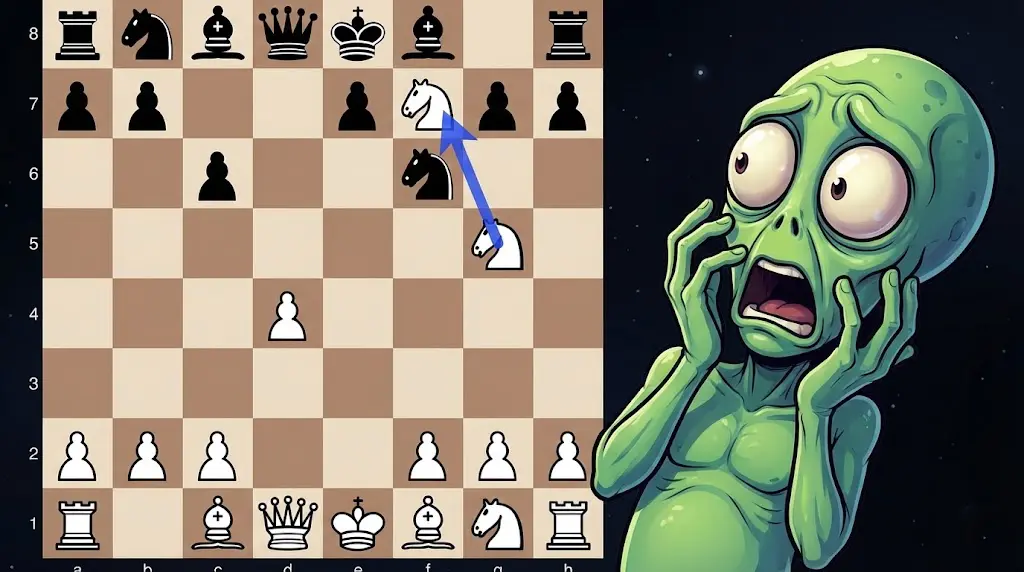
The Alien Gambit is an opening still played by thousands of people every day. While many players enjoy taking risks, it’s just as important to know how to decline or counter the risky opening when you’re on the receiving end.
In this article, we’ll unpack what the Alien Gambit is, why a player might wish to decline it (or at least avoid falling into the typical traps), and how you can handle it with confidence and clarity.
What is the Alien Gambit?
The Alien Gambit is a non-standard opening that emerges when White plays in a daring fashion against the Caro-Kann defense (or similar setups). According to online opening databases, the sequence may go: 1 e4 c6 2 d4 d5 3 Nc3 dxe4 4 Nxe4 Nf6 5 Ng5 … and then White may invite complications with 6.Nxf7
In simpler terms: White sacrifices or invites material imbalance early, aiming for a direct kingside assault while Black’s structure or king safety may be exposed. It’s exciting, but it’s not fully sound at high levels.
Why Decline or Approach with Caution
When you’re playing Black (or responding to White’s ambitious setup), you might choose not to accept the gambit style offers (in the sense of entering into the most dynamic complications) because:
- You can gain a material advantage if you play solidly. When White sacrifices, your goal is to accept the material safely and then consolidate.
- The gambit often comes with risks for White: if you defend accurately, you should end up better. In one Reddit thread, a player wrote: “Ultimately, playing the alien … is not good for white. … You just need to know what are some key ideas and moves.”
- If you “decline,” or rather avoid walking into the most dangerous lines, you reduce the chance of being surprised or “trapped” in unfamiliar territory.
- Chess is not just about accepting every challenge: sometimes the best defense is prudence.
In short: declining means you steer the game toward calmer waters where you have more control rather than wading into the shark-infested deep.
How to Decline or Handle the Alien Gambit: Step by Step
Here’s a practical guide you can use when faced with this opening. I’ll present it in steps that you can memorize and apply.
Step 1: Recognize the Setup
As soon as you see White play something like 1 e4 c6 2 d4 d5 3 Nc3 dxe4 4 Nxe4 Nf6 5 Ng5, alarm bells should ring. That appearance of the knight on g5 is a signature of the Alien Gambit-style play.
Step 2: Decide Your Strategy: Solidify, Don’t Panic
When White offers the aggressive line, your job is not to panic and start running into traps. Instead:
- Develop rapidly: get your pieces out (knights, bishops) to safe squares.
- Make sure your king is safe: either keep it in the center if it’s safe, or prepare to castle if it’s sensible.
- Avoid entering speculative lines unless you’re comfortable.
- Don’t be afraid to give up the rook if white plays Ng6, focus on developing the other pieces
Step 3: Decline the Sharpest Variations
Declining in this case doesn’t always mean refusing to take material, more often it means avoiding the ultra-sharp path White hopes for. For example, one recommended refutation line: White plays 6 Nxf7 and tries to lure your king into danger. The opening database suggests Black responds 7 … c5 and later …Nc6, …Be6-or-Bf5, etc.
So you can decline the most dangerous tactical continuation by refusing to play into it (for example by not grabbing the bait or by making a calm developing move instead of a flashy but risky one).
Step 4: Keep the Material Advantage
If White is sacrificing or offering complications, your goal is to keep the extra material (if accepted) or to avoid giving up anything when you decline. Once you have that, trade pieces when it’s beneficial to reduce White’s attacking chances.
“You just need to know what are some key ideas and moves. … you’re a full piece ahead… try to trade the queens and other pieces ASAP.”
Trading down when you’re ahead simplifies the position and reduces risk.
Step 5: Consolidate and Then Convert
Once you’ve declined the gambit or survived the sharpest parts:
- Centralize your rooks.
- Connect your pieces and improve them.
- Advance with pawn breaks when safe.
- Avoid rushing: even with material advantage, bad timing can turn the game.
- When you feel ready, convert your material advantage into a win by restricting the opponent, creating passed pawns, etc.
Example of Declining
Here’s a hypothetical simplified illustration:
- White: 1 e4 c6 2 d4 d5 3 Nc3 dxe4 4 Nxe4 Nf6 5 Ng5 h6.
- Black chooses to decline entering the ultra-sharp path by playing 6 Nxf7 Kxf7 (accepting) or maybe better: refuse the bait by 6 Nf3 (maintaining solid structure) or 6 … hxg5 (depending on variation).
- Then Black plays …Nc6, …Bf5, or …e6 consolidating and keeping the extra material/pawns while avoiding kingside chaos.
- White’s hyper-attack fizzles once Black trades queens and enters a favorable endgame.
While the exact moves depend on your variation, the core idea is: don’t let White get you into his game.
Why This Works
This method works because the Alien Gambit is unsound in the long run if Black knows what he/she is doing. According to the opening analysis:
“The Alien Gambit is… objectively speaking… unsound.”
But “unsound” does not mean automatically losing. It means if Black plays poorly they still can lose. So the job is to play well, remain calm, and let the advantage build.
Common Mistakes to Avoid
To ensure your declination is successful, be aware of these pitfalls:
- Over-reacting: Trying to punish White immediately may lead you into unknown tactical territory.
- Under-estimating the attack: Even if you have material, White may have dynamic threats, stay alert.
- Allowing counter-play: If you grab material but neglect your king’s safety, you might squander the advantage.
- Trading too early or too late: The timing of piece trades matters, trade when it stabilizes your advantage, but don’t force a trade that loses momentum.

I’m Xuan Binh, the founder of Attacking Chess, and the Deputy Head of Communications at the Vietnam Chess Federation (VCF). My chess.com and lichess rating is above 2300. Send me a challenge or message via Lichess. Follow me on Twitter (X) or Facebook.