
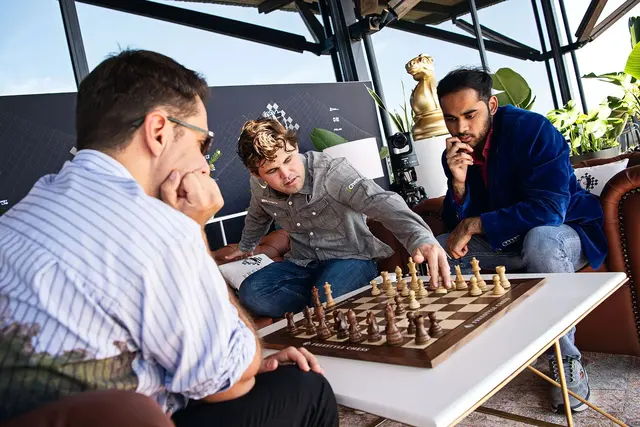
In professional chess, memorization has long been king. Grandmasters often spend hours every day memorizing computer-generated opening lines that run 20 or 30 moves deep. But Magnus Carlsen, the highest-rated player in history, grew bored with this “sheet music” approach to the game. He wanted a format where creativity and intuition mattered more than homework.
His answer was Freestyle Chess, and in December 2025, in the scenic landscape of Grootbos, South Africa, his vision came full circle. By reaching the semifinals of the season-ending tournament, Carlsen officially clinched the inaugural Freestyle Chess Grand Slam Tour title.
This is the story of how the Norwegian superstar built a new empire and then conquered it, step by step.
What is Freestyle Chess?
Before understanding Carlsen’s victory, it is essential to understand the game itself. Freestyle Chess is a rebranding of “Chess960” or “Fischer Random.” In this format, the pieces on the back row (Rooks, Knights, Bishops, King, and Queen) are shuffled randomly before the game begins.
Because there are 960 possible starting positions, players cannot memorize openings. From move one, they are on their own. As Carlsen explained, he advocated for this format because it eliminates opening theory and forces players to think independently from the very start. To make the game even more intense, the Grand Slam Tour uses slower time controls than usual for this variant, giving players time to think deeply about these chaotic new positions.
The Origin: A Meeting in Qatar
The road to the title began not on a chessboard, but in a conversation. In 2023, during the Qatar Masters Open, Carlsen pitched the idea of an elite Chess960 tour to German investor Jan Henric Buettner. Carlsen felt that while rapid Chess960 tournaments existed, the game needed a serious, high-stakes circuit with “slow” games to be taken seriously.
The result was the creation of the Freestyle Chess Grand Slam Tour. The tour was designed to be a global spectacle, with stops in Germany, France, the United States, and South Africa. With a massive investment of $12 million from venture capitalists and prize funds reaching $750,000 per event, the stage was set for a new era of chess.
The 2025 Season: A Year of Dominance
The 2025 tour consisted of five major “Grand Slam” tournaments. Players earned points based on their finishing position in each event. The player with the most points at the end of the year would be crowned the Freestyle Chess Champion.
Here is how Carlsen navigated the season to build an unassailable lead:
Leg 1: The Stumble in Weissenhaus (February)
The season opened in Weissenhaus, Germany. Interestingly, Carlsen did not win the first event. That honor went to the young German prodigy Vincent Keymer, who defeated Fabiano Caruana in the final. Carlsen finished in 3rd place, collecting 15 tour points. While a decent start, it showed that even the world number one would not have an easy path in this unpredictable format.
Leg 2: Victory in Paris (April)
The tour moved to Paris, France, where Carlsen found his stride. In the city of lights, Carlsen dominated the field, securing 1st place and the maximum 25 tour points. He defeated his longtime rival Hikaru Nakamura, who finished as the runner-up. This victory vaulted Carlsen to the top of the leaderboards.
Leg 3: Perfection in Karlsruhe (April)
Just days after Paris, the tour continued in Karlsruhe, Germany, for the Grenke Freestyle Chess Open. This tournament became the highlight of Carlsen’s season. He played with terrifying accuracy, achieving a score of 9 wins out of 9 games in the preliminary stages—a feat almost unheard of at this level. He went on to win the tournament, defeating Parham Maghsoodloo in the final. With back-to-back victories, Carlsen began to pull away from the pack.
Leg 4: The Las Vegas Detour (July)
The summer leg took the players to Las Vegas, USA. Here, the American favorite Levon Aronian took the top prize, defeating the controversial Hans Niemann in the final. Carlsen, though not the winner, remained consistent. He finished in 3rd place again, adding another 15 points to his tally.
By the time the tour headed to the final event in South Africa, the standings were heavily tilted in Carlsen’s favor:
• Magnus Carlsen: 80 points
• Fabiano Caruana: 49 points
• Hikaru Nakamura: 40 points
To win the overall title, Carlsen essentially just needed to avoid an early disaster.
The Grand Finale: South Africa (December)
The final tournament took place at the Grootbos Private Nature Reserve in South Africa, offering breathtaking ocean views as the backdrop for the final battle. The stakes were high: the winner of the South Africa tournament would receive $200,000, and the overall Tour Champion would receive a $100,000 bonus.
Because the Grand Slam Final awarded double points (50 points for 1st place), American grandmaster Fabiano Caruana still had a mathematical chance to catch Carlsen—but only if Caruana won the tournament and Carlsen crashed out early.
Fate, as it often does in sports, paired the two rivals against each other in the Quarterfinals.
The Decisive Match: Carlsen vs. Caruana
The Quarterfinal match between Carlsen and Caruana was the defining moment of the tour. If Carlsen won, the title was his. If he lost, the door was open for Caruana.
The match began with a shock. In the first game, playing with the white pieces, Carlsen suffered what he later called a “complete and utter meltdown”. In a complex position, he hallucinated that he could capture Caruana’s queen, overlooking that he was in check. He realized his mistake instantly, but it was too late—he had to resign.
Now trailing 0-1, Carlsen faced a “must-win” situation in the second game with the black pieces—a notoriously difficult task in elite chess.
However, the “Freestyle” nature of the game worked in his favor. In a game using starting position #1, Carlsen maneuvered patiently. As Caruana’s clock ticked down under one minute, Carlsen set a trap. Caruana fell for it, and Carlsen won, leveling the score at 1-1.
This forced the match into tiebreaks (faster “blitz” games). In the high-speed chaos, Carlsen’s intuition reigned supreme. He won both blitz games, eliminating Caruana and securing his spot in the semifinals.
The Aftermath: Champion of the World
By reaching the semifinals, Carlsen made it mathematically impossible for anyone to catch him in the overall standings. He had clinched the 2025 Freestyle Chess Grand Slam Tour title and the $100,000 bonus prize early, even before the South Africa tournament had finished.
I won the war and now I want to win the battle as well,” Carlsen said after the match, indicating that he wasn’t satisfied with just the tour title—he wanted to win the South Africa event too.
He continued his run in the semifinals against the young Uzbek star Javokhir Sindarov. It was a grueling match where Sindarov managed to beat Carlsen in the second game, forcing yet another tiebreak. However, Carlsen survived a “miraculous save” in the second blitz game to advance to the Grand Final.
As the season concluded, the final showdown for the South Africa trophy was set between Magnus Carlsen and Levon Aronian. Regardless of that specific match’s outcome, Carlsen had already cemented his status as the inaugural king of this new format.
Summary: Why This Matters
Magnus Carlsen’s victory is more than just another trophy for his cabinet. It is a validation of his belief that chess can evolve. He invested his own time, reputation, and money to co-found this tour, arguing that randomized positions would lead to more exciting, human games.
The tour wasn’t without drama—including a significant political dispute with FIDE (the International Chess Federation), who threatened to ban players from the World Championship cycle if they participated in this “rival” tour. Despite these threats, the world’s best players, including Caruana, Aronian, and Keymer, flocked to Carlsen’s tournament.
To use a musical analogy: If classical chess is like a piano recital where the musician must play a complex piece of Mozart perfectly from memory, Freestyle Chess is like a high-level Jazz session. The players don’t know the melody until they sit down, and the winner is the one who can improvise the most beautiful tune in the moment. In 2025, the best improviser in the world was, without a doubt, Magnus Carlsen.

I’m a passionate board game enthusiast and a skilled player in chess, xiangqi and Go. Words for Attacking Chess since 2023. Ping me at Lichess for a game or chat.