
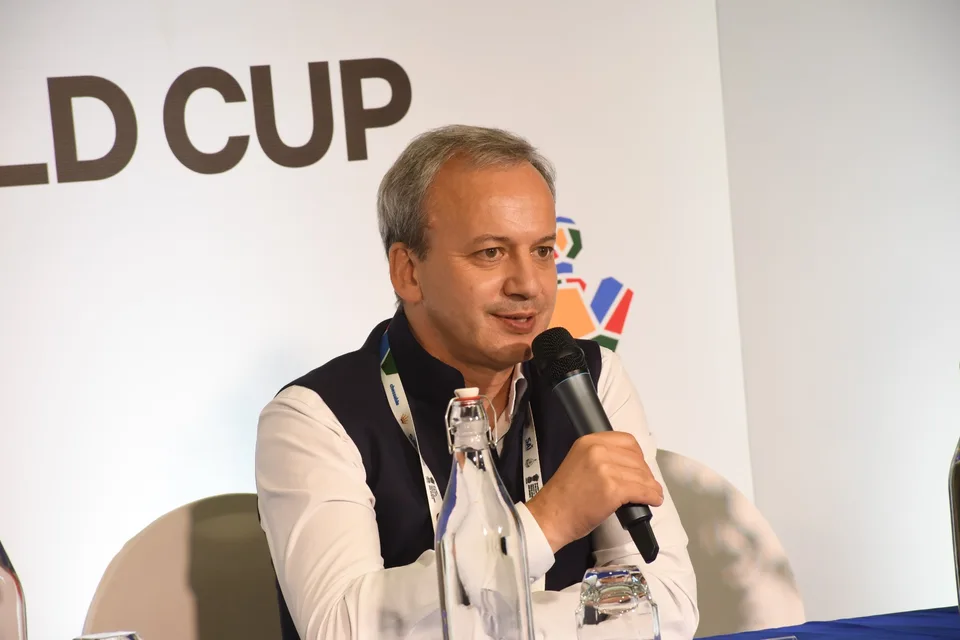
For the first time since Daniel Naroditsky’s tragic death, FIDE President Arkady Dvorkovich has publicly addressed the controversy surrounding Vladimir Kramnik — and his comments are both revealing and damning. Speaking with reporters in Goa during the 2025 World Cup, Dvorkovich confirmed that FIDE had asked Kramnik to submit proof of cheating allegations he made against several players, including Naroditsky. The response? Silence.
“I asked him to provide the full methodology — a clear scientific foundation for the statistics that he is using to air his hints or accusations. And we didn’t receive it from him,”
Dvorkovich said.
The admission marks the first official confirmation that FIDE directly sought evidence from Kramnik, contradicting the Russian ex-world champion’s repeated claim that “no one wants to look at his data.”
A Friendship Turned Fractured
Dvorkovich emphasized that Kramnik is “a good friend,” but even that long relationship could not mask his disappointment. “We all feel that it went in the wrong direction,” he said. The FIDE president revealed he had tried to privately persuade Kramnik to tone down his rhetoric long before Naroditsky’s death, warning him that his online campaign was becoming “too aggressive.”
“Not after what happened (with Daniel), but actually before the incident,” Dvorkovich said.
“I tried to persuade him that he should be less aggressive. It was a bit too much.”
That statement adds a painful new dimension to the story — the possibility that this tragedy might have been preventable if Kramnik had heeded the warnings of those around him.
The Fallout After Naroditsky’s Death
Naroditsky, who passed away at 29, was a widely respected grandmaster, commentator, and educator. His gentle demeanor and dedication to teaching made him one of the most beloved figures in modern chess. Yet in the months leading up to his death, he was repeatedly targeted by Kramnik’s online posts, which labeled his online results as “statistically suspicious.”
While Kramnik insisted he was merely “raising questions,” the tone and frequency of his comments painted a different picture. As Dvorkovich put it:
“Even if those were not direct accusations, Daniel felt like those were really accusations against him and some other players.”
Dvorkovich acknowledged that FIDE has evidence suggesting Naroditsky was affected by the campaign — though he stopped short of assigning blame, pending the results of the FIDE Ethics and Investigations Commission, which is currently reviewing the case.
“We hope that at some point, we’ll be provided with the whole methodology to look at that,” he said.
“We know for sure that Daniel was affected. There is evidence that should be checked.”
A Divided Chess World
Dvorkovich’s remarks have set off a wave of debate across online chess communities. On Reddit, one user summarized the general sentiment bluntly:
“He asked Kramnik for the evidence — which Kramnik is so vehement about having — and Kramnik couldn’t produce it. What a lying, garbage human Kramnik is.”
Others were more measured but still critical, noting that Dvorkovich’s phrasing — calling Kramnik’s posts “hints” rather than “accusations” — downplays the severity of what happened. As one Redditor put it:
“There’s really no need to sanitize the word ‘accusations’ as ‘hints.’ Kramnik’s posts inspired hundreds of others to accuse Danya directly.”
This tension highlights the larger crisis facing FIDE: how to handle high-profile players who use their platforms to publicly question others without evidence — and how to protect those unfairly targeted.
The Ethics Commission and What Comes Next
According to Dvorkovich, the Ethics Commission’s investigation will likely take between two and four months. The process is fully independent, and he insisted he has no involvement in the outcome. “I cannot preempt the findings,” he said.
This independence is crucial, especially given Kramnik’s stature as a former world champion and Dvorkovich’s own Russian background. Any perception of favoritism could further erode trust in FIDE’s handling of fair-play issues.
Still, Dvorkovich’s comments may signal a quiet shift in tone within the federation. His acknowledgment that Naroditsky “was affected” and that Kramnik’s behavior “went too far” suggests that FIDE may be laying the groundwork for disciplinary measures — if the commission’s findings support it.
A Broader Issue: Online Cheating and Responsibility
Dvorkovich also touched on the broader issue of cheating in online chess — the very topic Kramnik claims motivated his campaign. He admitted that FIDE currently does not impose over-the-board sanctions based on online cheating bans because the federation lacks full access to the platforms’ methodologies.
“We need deeper collaboration,” Dvorkovich said. “We do not transfer those sanctions to over-the-board events since we don’t know what the approach is.”
It’s an ironic twist: the same lack of transparency that Kramnik accuses online platforms of is now being turned back on him. He has refused to share his own “proofs,” leaving both FIDE and the public in the dark.
A Turning Point for Chess Ethics
The coming months will test whether FIDE can balance compassion and accountability in one of the most emotionally charged moments in recent chess history. The organization has been criticized for years for its slow response to controversies involving cheating accusations, and this case — involving a beloved grandmaster’s death — may define its reputation for a generation.
Dvorkovich’s tone was notably more personal than bureaucratic. “We’re really sorry about the tragic death of Daniel,” he said. “For me, it’s personal.”
That admission underscores the depth of this wound — not just for FIDE, but for the entire chess world.
Conclusion
Kramnik has long portrayed himself as a crusader for “fair play.” But as the dust settles, the question is no longer about cheating — it’s about accountability, empathy, and the power of words.
Dvorkovich’s revelation that FIDE sought evidence and received none has shattered Kramnik’s narrative that “nobody listens.” The silence now speaks louder than any post, any statistic, or any crusade.
For Daniel Naroditsky’s friends, fans, and colleagues, that silence is perhaps the hardest move of all to accept.

I’m the senior editor of Attacking Chess, a keen chess player, rated above 2300 in chess.com. You can challenge me or asking questions at Chess.com.