
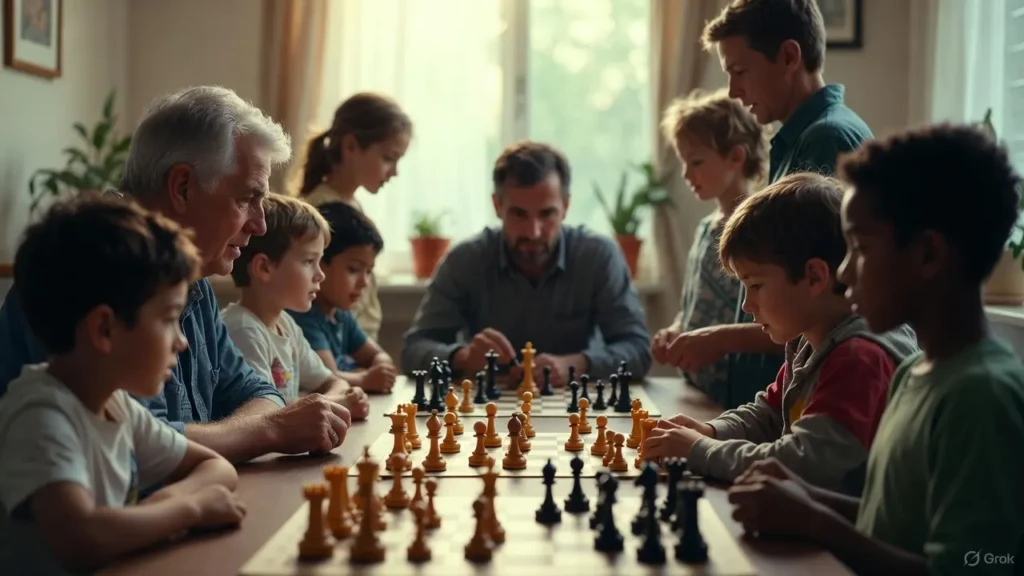
Welcome to the wonderful world of chess! This guide is designed for any parent, teacher, or mentor who wants to share the joy of this timeless game with a child. Chess is far more than a simple board game; it’s a thrilling mental workout that teaches children strategy, concentration, problem-solving, and good sportsmanship, all while having fun. Consider this your complete, step-by-step roadmap to confidently teach a child the rules, tactics, and joys of chess, using the clear and accessible lessons found in the book “Chess for Children.”
Get Chess for Children on AmazonThis guide is carefully structured to build knowledge progressively. We’ll start with the very basics—the board and the pieces—and move logically through the rules of movement, special moves, and the fundamental strategies needed to play a full and exciting game. Every concept is explained in a clear, jargon-free manner, ensuring that both you and your student can grasp the essentials without feeling overwhelmed.
Contents
Think of this as the beginning of an incredible journey of skill and imagination that you and a child can embark on together. It’s a journey that starts with learning the name of a single piece and can lead to a lifetime of enjoyment and challenge. Let’s begin.
Getting Started: The Battlefield and the Armies
Before the first move is made or the first piece is captured, a new player must get to know their tools: the 64-square chessboard and the 16 loyal pieces that make up their army. Learning these fundamentals correctly is the essential first step, as they form the foundation for every single game. Mastering the setup is the first victory on the path to becoming a chess player.
The Chessboard: Your Kingdom of 64 Squares
The game of chess is played on a board with 64 squares, arranged in an 8×8 grid of alternating light and dark colors. When setting up the board, there is one critical rule to remember:
• “White on the right.” This simple phrase means that each player must have a light-colored square in their bottom-right corner. It’s a small detail, but getting it right ensures the pieces, especially the king and queen, will be on their correct starting squares.
The Chess Pieces: Meet Your Army
Each player commands an army of 16 pieces. While many pieces look identical, there are six unique types, each with its own name and abilities.
• King: 1 per player
• Queen: 1 per player
• Rook: 2 per player
• Bishop: 2 per player
• Knight: 2 per player
• Pawn: 8 per player
The Starting Position: Arranging Your Forces
Every game of chess begins with the pieces set up in the same formation. Follow this sequence to arrange your army correctly:
1. Place the rooks in the corners. Your two rooks stand like castle towers on the corner squares of the rank closest to you.
2. Place the knights next to the rooks. The knights, which often look like horses, stand on the squares immediately beside each rook.
3. Place the bishops next to the knights. The bishops fill the squares between the knights and the center of the board.
4. Place the queen on her color. This is a key rule for correctly placing the queen and king. “The queen always starts on a square of her own color.” The white queen goes on the remaining light square, and the black queen goes on the remaining dark square.
5. The king takes the last square. The king fills the final empty square on the back rank, right beside his queen.
6. The pawns form a protective wall. The eight pawns are placed in a line on the rank directly in front of your other pieces, ready to march forward.
Once the board is set, it’s important to know that White always makes the first move in a game of chess.
The Goal of the Game
The ultimate objective in chess is to trap your opponent’s king. When a king is under attack and has no way to escape, it is called “checkmate,” and the game is won.
With the board set and the goal in mind, it’s time to learn how these brave pieces move and fight across the battlefield.
The Rules of Movement: How Each Piece Fights
Each chess piece possesses a unique personality and power, defined entirely by how it moves across the board. Understanding these individual movements is the most important step in learning to play. Once a child masters how each piece fights, they can begin to see the strategic possibilities that make chess the greatest game of strategy ever invented.
The Rook: The Straight Shooter
The rook moves in straight lines—forwards, backwards, and side-to-side—for any number of unoccupied squares. While they may look like castle towers, experienced chess players always call them rooks, not “castles.” A rook captures an enemy piece by moving to its square and removing that piece from the board. Like most pieces, a rook cannot jump over others.
The Bishop: The Diagonal Danger
The bishop moves only along the diagonals of the board, in straight lines, for as many unoccupied squares as it likes. A key characteristic of bishops is that they are bound to the color of the square they start on. Each player begins with two: one on a light square and one on a dark square. The light-square bishop will only ever travel on light squares, and the dark-square bishop will only ever travel on dark squares for the entire game.
The Queen: The Most Powerful Piece
The queen is the most formidable piece in the army. Her power comes from combining the movements of both the rook and the bishop. She can move any number of squares in any straight line—horizontally, vertically, or diagonally. Because she is so powerful and versatile, the queen is extremely valuable. A wise player protects their queen carefully, only bringing her into the fray when the time is right.
The King: The Most Important Piece
The king is a surprisingly weak piece, able to move only one single square in any direction (horizontally, vertically, or diagonally). Despite his limited movement, the king is the most important piece on the board. The entire game revolves around his safety. If you trap your opponent’s king, you win. If your king is trapped, you lose.
This leads to a critical concept: “check.” A check is a direct attack on the king. If a king is in check, it must escape the attack immediately. Furthermore, a king can never move into a square where it would be in check.
The Knight: The Tricky Jumper
The knight has the most unusual move in chess, which makes it a favorite of many players. It moves in an “L-shape”: two squares in one direction (horizontally or vertically), and then one square at a right angle to that movement.
The knight possesses a special ability that no other piece has: it is the only piece that can jump over other pieces, both friendly and enemy. This makes it excellent for surprise attacks. A helpful tip for remembering the knight’s move is that it always lands on a square of the opposite color from which it started.
The Pawns: The Soul of Chess
Though they may seem small, pawns are full of potential and have a unique set of rules for movement and capturing.
1. Forward Movement: Pawns can only move forward, never backward. They typically move one square forward at a time.
2. The First Move Option: On its very first move of the a game, a pawn has the option to advance either one square or two squares forward. After this initial move, it can only move one square at a time.
3. Capturing: Pawns capture differently from how they move. They capture enemy pieces by moving one square forward diagonally.
4. Blocking: If another piece (friendly or enemy) is directly in front of a pawn, that pawn is blocked and cannot move forward.
Teaching Tip for Parents To help children practice and master these unique movements, try playing “Mini-Chess Games.” These simplified versions of chess isolate specific pieces to build confidence. For example, start a game with only pawns (The Pawn Game) to understand their forward movement and diagonal captures. Then, add knights to play The Knight Game, allowing a child to focus on the tricky L-shaped move without the complexity of a full board.
Understanding how each piece moves is the key to playing, but to truly study the game and learn from the masters, you need to speak its language. Next, we’ll learn the “secret code” of chess: notation.
The Language of Chess: Notation and Piece Values
Learning to read and write chess moves, known as notation, is a valuable skill that elevates a player from a casual enthusiast to a serious student of the game. It’s not a chore, but rather a secret code that unlocks the ability to study games from chess books, record one’s own games for later analysis, and even play “blindfold chess” by calling out moves without looking at the board.
The Board’s Coordinates
The chessboard is a grid, and like any grid, each square has a specific coordinate.
• The vertical columns are called files and are labeled with letters from ‘a’ to ‘h’.
• The horizontal rows are called ranks and are labeled with numbers from ‘1’ to ‘8’, starting from White’s side of the board.
By combining the file letter and the rank number, every one of the 64 squares gets a unique name, such as e4, g8, or c1.
How to Read and Write Moves
To record a move, you simply state which piece is moving and which square it is moving to. The pieces are represented by a single capital letter:
| Piece | Letter |
| King | K |
| Queen | Q |
| Rook | R |
| Bishop | B |
| Knight | N |
You may wonder why Knight is ‘N’ instead of ‘K’. This is to avoid confusion with the King. Pawns are unique in that they do not get a letter in notation.
• To record a move, write the piece’s letter followed by its destination square. For example, Nf3 means a knight moves to the f3 square. A pawn move is written with just the destination square, like e4.
• To record a capture, an ‘x’ is placed between the piece letter and the destination square. For example, Bxc4 means a bishop captures a piece on the c4 square. If two identical pieces (like two rooks) can capture the same piece, you must specify which one is moving. Imagine you have one rook on square a1 and another on f1, and both can capture a piece on d1. To show which rook you moved, you would write Rad1 (the rook from the a-file captures on d1) or Rfd1 (the rook from the f-file captures on d1).
Understanding Piece Values: A Guide to Trading
To make good decisions in chess, especially when considering capturing or “trading” one of your pieces for an opponent’s, it’s crucial to know the relative value of each piece. This is measured in a simple point system, where the pawn is the baseline unit.
• Pawn: 1 point
• Knight: 3 points
• Bishop: 3 points
• Rook: 5 points
• Queen: 9 points
The King has no point value because he is priceless. If you lose your king, you lose the game.
These values are not arbitrary; they reflect each piece’s power and mobility. Knights and Bishops are known as “minor pieces,” while Rooks and Queens are the powerful “major pieces.” A rook (5 points) is more valuable than a bishop (3 points) because it can travel along both ranks and files, giving it access to all 64 squares on the board. A bishop, by contrast, is confined to diagonals of a single color and can only ever reach 32 squares.
Knowing these values helps evaluate trades. For example, trading your 3-point bishop for your opponent’s 5-point rook is a good trade that leaves you with a material advantage. Conversely, losing your 9-point queen for a 3-point knight is a disastrous trade that will likely lose you the game.
Now that you can read the board and understand the power of your army, it’s time to focus on the heart of the game: the dramatic hunt for the enemy king.
The Heart of the Game: Check, Escapes, and Checkmate
The central drama of every chess game revolves around the king. The entire contest builds towards a single goal: attacking the enemy king while fiercely protecting your own. This section covers the three most important concepts in chess combat: delivering a “check,” escaping a “check,” and winning the game with “checkmate.”
Giving and Escaping Check
A “check” is a direct threat to capture the opponent’s king on the very next turn. When a player’s king is in check, they are not allowed to make any other move on the board until the threat is resolved. It is illegal to leave one’s king in check.
Fortunately, there are three ways to get out of check. A helpful memory aid is the “ABC” method:
• A – Away: Move the king Away to a safe square that is not under attack.
• B – Block: Block the line of attack by placing one of your own pieces between the attacking piece and your king.
• C – Capture: Capture the piece that is delivering the check.
In chess notation, a move that results in a check is marked with a + symbol, such as Rd8+.
Checkmate: The Ultimate Goal
“Checkmate” is the ultimate goal of chess. It is a position where the king is in check, and there is absolutely no legal way for it to escape. None of the A, B, or C methods are possible.
Checkmate ends the game immediately, and the player who delivers it is the winner. It’s important to remember that in chess, the king is never actually captured; the game ends the moment checkmate is achieved. A classic example of how quickly checkmate can occur is the “Fool’s Mate,” a trap where a player can lose in just two moves if they make very poor opening choices.
Practical Advice for Young Players While it can be fun to say “check” out loud in a friendly game at home, it’s not customary in serious competitions. At a tournament, announcing check can be distracting to other players or may even be seen as impolite, as if you’re assuming your opponent didn’t see the threat.
You now understand the central drama of the game—the attack on the king. But chess has a few more tricks up its sleeve. Let’s learn the three special moves that can turn the tide of a battle in an instant.
Advanced Rules: The Three Special Moves
Beyond the standard movements, chess has three unique “special moves” that every player must know. These are not everyday actions but powerful, situational tools that can dramatically change the course of a game when used at the right moment.
Castling: The King’s Great Escape
Castling is a remarkable defensive move that accomplishes two crucial things at once: it moves the king to a safer position and brings a powerful rook into the game more quickly. It is the only time in chess that a player can move two pieces in a single turn. Moving the king away from the center is vital because the center is where most piece activity and attacks occur early in the game. Tucking the king into the corner, behind a protective wall of pawns, is a cornerstone of good defense.
There are two types of castling:
• Kingside (Short) Castling: The king moves two squares toward the kingside rook, and that rook then jumps over the king to the square right next to it. The notation for this move is 0-0.
• Queenside (Long) Castling: The king moves two squares toward the queenside rook, and that rook then jumps over the king to the square right next to it. The notation is 0-0-0.
However, castling is governed by a strict set of rules. It is not allowed if:
• The king has already moved.
• The rook involved has already moved.
• There are any pieces between the king and the rook.
• The king is currently in check.
• The king must pass through a square that is under attack by an enemy piece.
• The king would land on a square where it would be in check.
Pawn Promotion: A Soldier Becomes a General
When a humble pawn marches all the way across the board and reaches the other side (the eighth rank for White or the first rank for Black), something magical happens: it gets a promotion! The pawn must be immediately transformed into a more powerful piece.
The player can choose to promote the pawn into a Queen, Rook, Bishop, or Knight of the same color. Because the queen is the most powerful piece, promoting to a queen is the most common choice. This means a player can have more than one queen on the board at the same time. On rare occasions, a player might choose “underpromotion”—promoting to a piece other than a queen. For example, promoting to a knight might be the only way to deliver an immediate checkmate.
En Passant: The “In Passing” Capture
This special pawn capture, whose name means “in passing” in French, is often the trickiest rule for beginners to grasp because it can only happen in a very specific situation.
Here is the exact scenario for an en passant capture:
1. Your opponent moves one of their pawns two squares forward from its starting position.
2. This two-square move lands their pawn directly beside one of your pawns on an adjacent file.
3. On your very next turn, and only on that turn, you have the option to capture that enemy pawn as if it had only moved one square. To do this, your pawn moves diagonally to the empty square behind the enemy pawn, capturing it in the process.
Mastering these special moves completes your knowledge of the rules. Now, let’s explore a crucial part of the game that often surprises beginners: what happens when a game ends without a clear winner.
When No One Wins: Understanding Draws
Not every hard-fought game of chess ends with a triumphant checkmate. Sometimes, a game ends in a “draw,” which is a tie. In tournament play, both players receive half a point for a draw. Understanding how draws happen is a crucial part of chess, as it can help a player save a game they are about to lose or prevent an opponent from escaping a losing position.
Here are the three most common ways a game can be drawn:
Draw by Agreement
The simplest way a game can end in a draw is if both players agree to it. If the position on the board seems completely equal and neither player sees a path to victory, one player can offer a draw, and if the other accepts, the game ends immediately.
Draw by Stalemate
This is a critical concept for all players to learn, especially beginners. A stalemate occurs when a player whose turn it is to move is not in check but has no legal moves available for any of their pieces. A stalemate is an automatic draw. This is a common trap for new players who have a winning advantage. In an effort to checkmate their opponent, they might accidentally take away all of their opponent’s legal moves without actually putting the king in check, thus allowing them to escape with a draw.
Draw by Three-Fold Repetition
If the exact same position on the chessboard occurs three times during a game, with the same player to move each time, a player can claim a draw. This rule prevents games from going on forever. It often happens in situations of “perpetual check,” where one player can repeatedly check the opponent’s king, but the king can always escape to another square, only to be checked again, leading to an endless loop.
Two less common ways a game can be drawn are the “50-move Rule” (if 50 consecutive moves pass without a capture or a pawn move) and “Insufficient Material” (if neither player has enough pieces left to force a checkmate).
Understanding how a game can end in a draw is vital for any player. But our goal is victory! Let’s turn our attention from avoiding defeat to actively achieving checkmate with fundamental tactics and patterns.
From Rules to Victory: Basic Checkmates and Tactics
Knowing the rules is the first step, but applying them to win is the essence of chess. Winning requires a blend of long-term strategy and short-term, forceful moves called “tactics.” Tactics are sequences of moves that create threats and can win material or lead to checkmate. This section covers the most fundamental checkmating patterns and introduces the three most important tactical ideas every budding player should know.
Fundamental Checkmating Patterns
The core principle of checkmating a lone king is to use your remaining pieces—supported by your own king—to methodically force the enemy king to the edge of the board. At the edge, the king has fewer squares to escape to, making it easier to trap.
• Checkmate with a Queen and King: This is a common endgame scenario. The basic method is to use your queen to systematically shrink the area where the enemy king can move, creating a smaller and smaller “box” for it. By placing your queen a knight’s-move away from the king, you take away ranks and files, forcing it towards a corner. Once the king is trapped on the edge, your own king advances to provide support and help deliver the final checkmate.
• Checkmate with Two Rooks: This pattern is often called the “lawnmower” or “staircase” checkmate. The two rooks work together on adjacent ranks or files, taking turns to cut off the king’s escape routes and drive it step-by-step to the edge of the board for a straightforward checkmate.
The Big Three Tactics: Forks, Pins, and Skewers
Mastering these three tactical motifs will quickly improve a player’s game.
The Fork
A fork is a double attack where a single piece attacks two or more enemy pieces at the same time. The opponent can only save one of their pieces, meaning you will capture the other. The knight, with its unique L-shaped move, is a famously powerful forking piece.
The Pin
A pin is a situation where a defending piece cannot move without exposing a more valuable piece behind it to attack. For example, a bishop might pin a knight to a king. The knight is “pinned” to the spot because moving it would be illegal, as it would put its own king in check.
The Skewer
A skewer is the opposite of a pin. In a skewer, a valuable enemy piece is attacked and forced to move, exposing a less valuable piece behind it on the same line of attack. For instance, a rook might attack an enemy queen, and when the queen moves away to safety, the rook captures a bishop that was positioned behind the queen.
These tactics are the building blocks of a winning combination. But how do you create the opportunities to use them? It all starts with a strong opening, where you position your army for success from the very first move.
The First 10 Moves: Opening Strategy and Planning
The first phase of a chess game is called the opening. A good opening sets the stage for the rest of the game, positioning your army for the main battle that will take place in the middlegame. The goal of the opening is not to memorize a long sequence of moves, but rather to follow sound principles that get your pieces developed and your king safe.
The Three Golden Rules of the Opening
For a successful opening, focus on achieving these three core objectives:
1. Control the Center: The central squares (e4, d4, e5, d5) are the most important territory on the board. Pieces placed in or aimed at the center have greater mobility and influence over the entire game.
2. Develop Your Pieces: “Developing” simply means moving your pieces—especially your knights and bishops—off their starting squares and into more active positions where they can participate in the action.
3. Castle Your King to Safety: As we’ve learned, castling is a special move that protects your most important piece. Castling early gets the king out of the center, where many attacks occur, and helps “connect” your rooks so they can work together.
A Trap to Avoid: Scholar’s Mate
Beginner players will often encounter a quick attacking attempt known as Scholar’s Mate. This is a four-move checkmate where White uses the queen and bishop to attack the opponent’s weakest square, f7. While it can be dangerous if you’re unprepared, it’s very easy to defend against.
Simple moves like ...g6 (to block the queen’s path) or ...Nf6 (to block the attack) will stop the threat immediately. In fact, if you defend properly, the player who tried the Scholar’s Mate will often end up in a worse position. They have brought their queen out into the open too early, where it can be easily attacked by your developing pieces.
Planning for the Middlegame and Endgame
• Middlegame: After the opening, the focus shifts. This is the time to look for tactical combinations and launch attacks. However, always remain vigilant and keep your own king safe.
• Endgame: Once most of the powerful pieces have been traded off, the nature of the game changes again. In the endgame, the king should no longer hide. It becomes an active and powerful fighting piece, often marching into the center to help support the remaining pawns.
From opening principles to endgame strategy, you now have a complete picture of a chess game’s flow. All that’s left is to put this knowledge into practice and begin the real adventure.
Conclusion: Your Chess Adventure Begins
You have now journeyed through the complete rules and foundational strategies of chess, from setting up the pieces for the first time to understanding complex tactics like pins and skewers. You have the knowledge not only to play the game but, more importantly, to teach it to a child in a clear, confident, and encouraging way.
Remember that the key to improvement in chess is practice. Encourage the young players in your life to play many games, and be sure to play with them. The goal should always be to have fun and learn from every game, regardless of who wins or loses. Chess is a game of pure skill, not luck, and every loss is an opportunity to discover something new.
You now have all the tools you need to open the door to this incredible world for a child. Chess is a lifelong source of enjoyment, intellectual challenge, and connection. By teaching it, you are sharing a gift that can be enjoyed for years to come and beginning your own family chess legacy.
Get Chess for Children on Amazon
I’m Xuan Binh, the founder of Attacking Chess, and the Deputy Head of Communications at the Vietnam Chess Federation (VCF). My chess.com and lichess rating is above 2300. Send me a challenge or message via Lichess. Follow me on Twitter (X) or Facebook.