
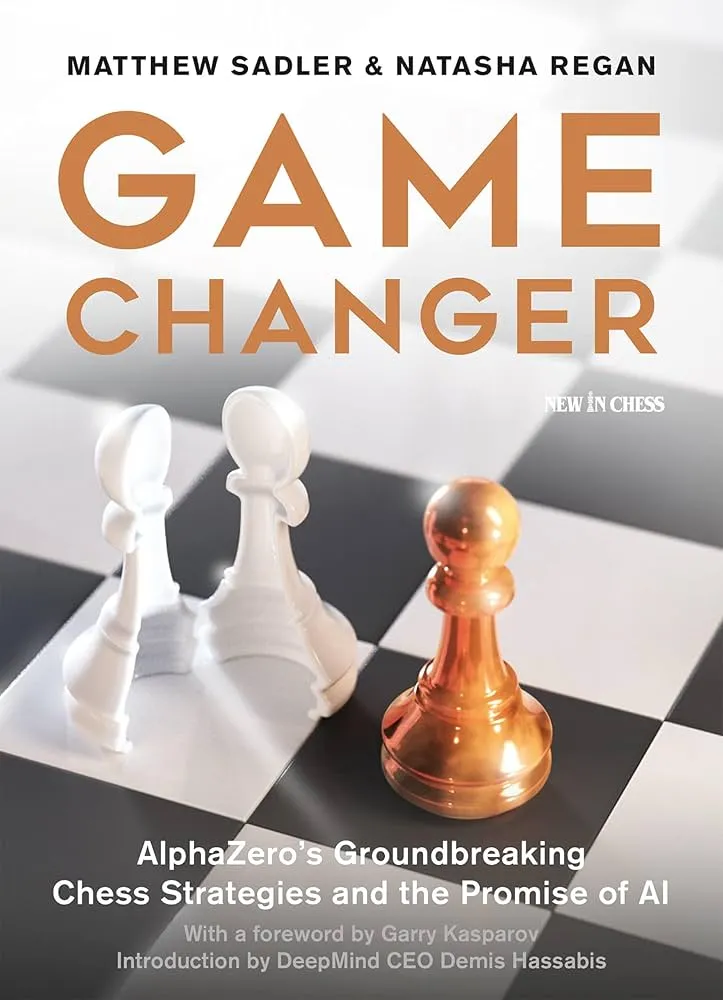
The arrival of AlphaZero on the chess scene was electric. For decades, the chess world had grown accustomed to the relentless, “brute force” calculation of engines like Stockfish. They were tactical monsters, but their play often felt alien, a product of silicon crunching billions of positions per second. Then came AlphaZero, a self-taught neural network from DeepMind that learned chess from scratch simply by playing millions of games against itself. The mystique was immense, and the praise, particularly from DeepMind CEO Demis Hassabis, set a new standard for what we could expect from a chess-playing machine, heralding its “fluid, human-like attacking play.”
As a dedicated club player who spends countless hours studying and competing in tournaments, I’ve seen countless “revolutionary” training tools come and go. The hype surrounding AlphaZero and the book chronicling its rise, Game Changer, was on another level. But for all the talk of paradigm shifts in artificial intelligence, my interest boils down to a single, practical question: Will reading this book help a regular, rating-focused player like me win more actual games over the board? This review aims to move beyond the AI headlines and provide an honest answer for the ambitious amateur.
First Impressions: More of a Grandmaster’s Notebook Than a Textbook
For a club player with limited study time, the format of a chess book is almost as important as its content. We don’t have the luxury of spending weeks deciphering dense opening manuals or memorizing endless endgame treatises. I was therefore relieved to find that Game Changer is not a textbook. The authors themselves describe it not as instructional material first, but as “a collection of fascinating games of astonishing quality.”
The book feels less like a course and more like a privileged glimpse into the mind of a genius. Co-author and Grandmaster Matthew Sadler perfectly captures this feeling, comparing the experience to “uncovering the lost notebooks of a great attacking player of the past, such as his hero Alexander Alekhine, and finding hundreds of hitherto unpublished ideas.” This approach is reflected in the book’s structure. The authors explicitly state that the content is “arranged in discrete chapters and designed to be read out of sequence” with an “emphasis on explanations rather than variations.” For the practical player, this is a godsend. It means the book is a wellspring of strategic ideas and inspiration, not a tool for rote memorization. You can pick a theme that interests you—attacking the king, piece mobility, a specific opening structure—and dive in. This structure invites you to explore the foundational concepts that make AlphaZero’s style so unique and powerful.
The Core Lesson: Why a “66% Chance of Winning” is More Human Than +1.00
To truly learn from AlphaZero, you must first understand why it is fundamentally different from the engines we use for analysis every day. This isn’t just a technical detail; it’s the key that unlocks all the strategic lessons in Game Changer. The book does an excellent job of distilling this core difference, which can be broken down as follows:
• Traditional Engines (e.g., Stockfish): These engines evaluate a position by assigning it a numerical score equivalent to a material advantage. A score of +1.00 is roughly like being a pawn ahead. While useful, this can be misleading. As the book notes, these engines frequently produce 0.00 evaluations in highly complex positions, suggesting equality where a human player can clearly sense that one side has far better practical chances.
• AlphaZero: This AI takes a probabilistic approach. Instead of calculating a material equivalent, it “evaluates by estimating its expected score from the position.” This is expressed as a percentage chance to win. For instance, “An AlphaZero evaluation of 50% would mean a win is as likely as a loss.” In one key position where Stockfish saw only 0.00, AlphaZero evaluated it as a 66.5% expected score for White—a significant edge.
The practical implication for a club player is profound. AlphaZero’s method feels more intuitive and human. We don’t think in terms of hundredths of a pawn; we think in terms of promising positions, initiative, and the “relative balance of chances.” When a traditional engine gives a position a +1.00 score based on a 20-move tactical line no human could ever find, the evaluation is practically useless. AlphaZero’s percentage-based assessment, as the book concludes, “better captures the relative balance of chances” in a way that aligns with human intuition. This fundamental difference in perspective is what gives rise to the concrete, on-the-board strategies that fill the book.
A Practical Tour of AlphaZero’s Big Ideas for the Club Player
This is where the theory from the silicon world translates into potential rating points. Game Changer is organized around several key strategic themes that recur in AlphaZero’s games. By isolating these concepts, a club player can begin to integrate them into their own thinking and play.
Theme 1: The King Is a Weapon, Not Just a Target
AlphaZero’s play is defined by its relentless focus on the kings. It constantly seeks to maximize the opponent’s king’s vulnerability while simultaneously increasing the safety and mobility of its own.
• The Rook’s Pawn March: A signature AlphaZero strategy is the relentless rook’s pawn march. The book highlights Danish great Bent Larsen as the player most associated with this idea, noting he used his h-pawn “as the first wave of his attack to soften the black kingside.” AlphaZero executes this concept, also seen in the games of Kasparov and Karpov, with unparalleled force.
• Sacrificing for Initiative: AlphaZero’s evaluation method allows it to sacrifice pawns and pieces to increase the scope of its pieces. The book makes a compelling comparison to the 19th-century master Mikhail Chigorin, stating that both “disregard the material balance completely” in pursuit of the attack. The ultimate goal is almost always to open lines and create threats against the enemy king.
• King Mobility as a Metric: One of the most striking statistical findings in the book is that when playing as White from the starting position, AlphaZero’s king has, on average, “10-20% more choice each move from early in the opening right into the endgame” than Stockfish’s king. This suggests AlphaZero “is considering optionality… when steering the game towards its preferred positions,” a subtle but powerful concept that values king safety not just as a static feature, but as a dynamic one.
Theme 2: Mobility Over Material—Making Your Pieces Work
The book effectively teaches a club player to re-evaluate their relationship with material. AlphaZero consistently demonstrates that an active piece with scope and purpose is worth far more than its static point value.
• The “Knight on the Rim” Myth: We are all taught that “a knight on the rim is dim.” Yet, the book’s analysis shows AlphaZero frequently playing moves like ♘h4 and ♘a4. This isn’t just an impression; the book provides compelling data. In 80 games as White from the starting position, AlphaZero played the ‘rim’ move ♘h4 seven times, whereas Stockfish played it only three times in its 30 games as White. It does so not out of ignorance, but to achieve specific strategic goals—controlling key squares or repositioning for an attack. It’s a powerful lesson that any rule can be broken for a good reason.
• Restricting the Queen: A recurring theme is AlphaZero’s almost sadistic ability to render the opponent’s most powerful piece useless. In one memorable game example, Stockfish’s queen is “completely imprisoned,” trapped on the edge of the board, unable to participate in the game. The book reinforces this point with a brilliant historical parallel to a game by Judit Polgar, who used a stunning queen move (♕f6!) to completely paralyze her opponent’s forces. This illustrates a profound strategy: a queen off the board is a 9-point loss, but a queen on the board that can’t move is arguably worse.
Theme 3: A New Look at Old Openings—The Carlsbad
To prove that these ideas aren’t just for wild, unfamiliar positions, the book devotes a fantastic chapter to the Carlsbad structure, a common setup arising from the Queen’s Gambit Declined that is known for its slow, positional nature.
Here, AlphaZero’s style is thrown into sharp relief. The authors note that AlphaZero “doesn’t adopt the classical plan of the Minority Attack.” For the uninitiated, the Minority Attack is a slow, grinding plan where White uses queenside pawns to create a long-term pawn weakness on c6, which is often only exploitable in a lengthy endgame. Instead, AlphaZero consistently seeks dynamic, attacking chances, often involving piece play aimed at the kingside.
The book captures this spirit perfectly with a memorable quote from the famous Russian trainer Mikhail Shereshevsky:
“If you spend your best years attacking the pawn on c6, what on earth are you going to do when you get old and past it?”
This quote leads co-author Natasha Regan to characterize AlphaZero’s style as that of a “headstrong young player, burning with ambition to deliver checkmate.” For any player who has felt bored by the slow maneuvering in such positions, this chapter is a revelation.
These themes provide a powerful framework for improving one’s chess, but applying such dynamic and often risky concepts in a real, pressure-filled tournament game is another matter entirely.
Honest Criticism: Where the AI’s Logic is Hard to Follow
For all its inspirational value, it would be dishonest to suggest that the lessons in Game Changer are easy to apply. Translating the play of a flawless, superhuman AI into a practical repertoire for a fallible human presents significant challenges that any club player should be aware of.
1. Knowing When to Sacrifice: AlphaZero’s sacrifices are breathtakingly beautiful and almost always correct. However, the book cannot provide a simple checklist for when a sacrifice is sound and when it’s a game-losing blunder. For a human player, the risk of miscalculating a sacrificial attack is immense, and the engine’s “intuition” is backed by a level of calculation we can only dream of.
2. The Abstract Nature of “Initiative”: The book rightly celebrates AlphaZero’s focus on long-term initiative over short-term material gain. In a practical game, however, it can be terrifying to pursue an abstract plan when your opponent is making concrete threats. It’s made even harder during post-game analysis, where traditional engines often disagree with AlphaZero’s assessments, giving a position a dreaded 0.00 evaluation and leaving the human player unsure of whether to trust their newfound intuition.
3. The Missing Human Element: AlphaZero plays without fear, greed, or fatigue. It is the ultimate cold-blooded killer. As the authors note, AlphaZero “never has to worry about running out of calculating energy, unlike human players!” This psychological chasm is perhaps the biggest barrier to emulating its style. Playing a long, complex game with the uncompromising aggression of AlphaZero is mentally exhausting and requires a level of self-belief that is hard to maintain under the stress of a tournament clock.
The Verdict: Will “Game Changer” Change Your Game?
So, we return to the central question. Will this book help you win more games? The answer is a qualified, but resounding, yes. Game Changer is not a quick fix or a simple recipe for success. It will not give you a set of easy-to-memorize lines that guarantee an advantage out of the opening. What it will do is far more valuable: it will fundamentally reshape the way you think about chess. It will encourage you to be more ambitious, to value dynamic potential over static advantages, and to always, always be on the lookout for ways to attack the enemy king.
The book succeeds brilliantly as a source of inspiration and a guide to a more dynamic, purposeful way of playing chess.
Who should buy this book: Players who feel stuck in a positional rut and want to inject dynamism and creativity into their games. If you want to learn to value the initiative, attack the king, and are looking for inspiration rather than a set of rules, this book is a masterpiece.
Who should think twice: Absolute beginners who need to learn fundamental principles first, or players looking for a straightforward, easy-to-learn opening repertoire. The ideas here are profound but require a solid chess foundation to apply effectively.
In the end, you will likely never play exactly like AlphaZero. But after reading Game Changer, you will see the board through a new, more dangerous lens. This change in perspective has tangible, over-the-board benefits: it helps you spot hidden attacking chances, find more ambitious plans, and better punish an opponent’s passive play—the very things that lead to rating points. You become more aware of the dynamic possibilities lurking in every position. That shift in thinking, more than any single move, is what truly changes your game, and it is absolutely worth the price.
Rating: 4.3/5
If you’d like to dive deeper into AlphaZero method, you can purchase the book through Forward Chess or Amazon.
Buying through these affiliate links comes at no extra cost to you.

I’m Xuan Binh, the founder of Attacking Chess, and the Deputy Head of Communications at the Vietnam Chess Federation (VCF). My chess.com and lichess rating is above 2300. Send me a challenge or message via Lichess. Follow me on Twitter (X) or Facebook.