
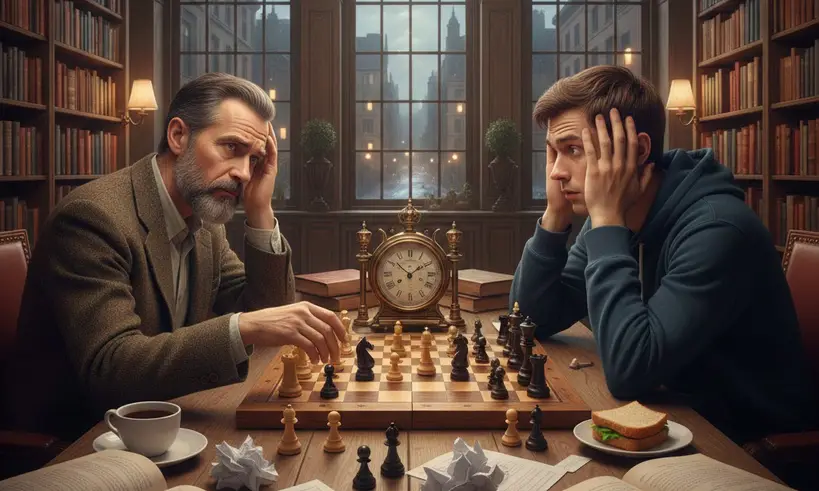
You play tournament after tournament.
You study openings.
You analyze your games.
Yet your USCF rating barely moves. Or worse, it goes down.
If this sounds familiar, you are not alone.
Many American chess players. From scholastic competitors to adult improvers. Ask the same frustrating question:
“Why is my USCF rating not going up?”
The short answer is that USCF ratings don’t work the way most players think they do. Improvement at the board does not always translate immediately into rating gains. And in many cases, players are unknowingly stuck in rating traps that slow or completely block progress.
Let’s break this down in a simple, practical way.
First, Understand What a USCF Rating Really Measures
Your USCF rating is not a measure of how strong you are in absolute terms.
It is a relative number that estimates how you perform against other USCF-rated players under tournament conditions.
This means:
- You can be improving but still not gaining rating.
- You can play “better chess” and still lose points.
- You can feel stuck even when your understanding has grown.
Ratings respond to results, not effort, study time, or subjective improvement.
That reality explains much of the frustration.
1. You Are Playing Mostly Higher-Rated Opponents
This is one of the most common scenarios.
If you consistently play players rated 100–300 points above you, your rating may barely move even when you score decent results.
Here’s why.
- Losing to higher-rated players costs you very little.
- Drawing them gains you a small amount.
- Beating them helps. But those wins are rare.
So you might feel like you’re “holding your own,” yet your rating stays flat.
Example:
- You score 2.5/5 against players rated 200 points higher.
- From a chess perspective, that’s solid.
- From a rating perspective, it may barely move the needle.
This situation is common in:
- Strong local clubs.
- Adult sections with wide rating ranges.
- Weekend Swiss tournaments.
2. You Are Beating Lower-Rated Players, But Losing One Key Game
Another classic rating killer.
You beat three lower-rated players.
Then lose one game to someone rated 150 points below you.
That single loss can wipe out all the gains from your wins.
Why?
Because USCF ratings are risk-weighted:
- You are expected to beat lower-rated players.
- When you don’t, the penalty is large.
This creates the feeling of:
“I played well all weekend and still gained nothing.”
From the rating system’s point of view, however, you underperformed expectations.
3. Your Rating Is Near a “True Level Plateau”
Every player has rating plateaus.
This happens when:
- Your strengths and weaknesses are balanced.
- You beat players below you.
- You lose to players above you.
- You split games with peers.
At this stage, your rating is accurately describing your current competitive level, even if your chess knowledge feels deeper.
Breaking through a plateau usually requires:
- Fixing a specific recurring weakness.
- Not general studying.
- Not more games.
- But targeted correction.
4. You Are Improving the Wrong Things
This is extremely common.
Many players spend time on:
- Memorizing opening lines.
- Watching grandmaster games passively.
- Solving random puzzles.
But their actual rating losses come from:
- Time trouble.
- Simple endgames.
- Poor calculation under pressure.
- Psychological collapses after one bad move.
If your study does not address why you are losing rating points, your rating will not go up.
Improvement must be diagnosis-driven, not habit-driven.
5. You Are Playing Too Few Rated Games
USCF ratings need data.
If you only play:
- One or two tournaments per year.
- Or mostly unrated events.
- Or casual online chess.
Then your rating will move very slowly.
Ratings stabilize when:
- You play enough games.
- Against a variety of opponents.
- Under consistent conditions.
If you want your rating to reflect improvement, you must give the system enough information.
6. You Are Affected by the Rating Floor
Many USCF players don’t realize this exists.
A rating floor prevents your rating from dropping below a certain level once you’ve reached a higher peak.
This sounds helpful, but it can also create confusion.
For example:
- Your true playing strength declines.
- Your rating is artificially protected.
- When you later improve again, gains are slower.
The rating system is trying to reconcile:
- Your protected floor.
- Your current results.
- Your historical peak.
This can delay visible progress.
7. You Play Different Time Controls With Different Strengths
USCF ratings are time-control specific.
Your strength in:
- Classical.
- Quick.
- Blitz.
May be very different.
If you:
- Train mostly blitz.
- But compete in classical.
- Or vice versa.
Your rating gains will lag behind your perceived skill.
Classical chess rewards:
- Endgame technique.
- Time management.
- Calculation discipline.
Not just tactics or opening tricks.
8. You Tilt After One Bad Game
This is rarely discussed, but extremely important.
Many players:
- Lose one painful game.
- Carry emotional baggage into the next round.
- Make uncharacteristic mistakes.
Rating stagnation is often psychological, not technical.
Consistent performance across rounds matters more than occasional brilliance.
9. You Expect Linear Progress. Ratings Are Not Linear
This is perhaps the biggest misunderstanding.
Chess improvement looks like this:
- Long flat periods.
- Sudden jumps.
- Temporary drops.
- Another plateau.
If you expect your rating to steadily rise every tournament, you will always feel disappointed.
USCF ratings move in steps, not slopes.
10. You Are Stronger Than Before. But So Is Everyone Else
This is uncomfortable, but real.
The overall level of club players has increased due to:
- Online resources.
- Databases.
- Engines.
- Training content.
Improving today often means maintaining your rating, not increasing it.
A stable rating over several years can actually represent real growth.
What Actually Makes a USCF Rating Go Up?
In practical terms, rating gains usually come from:
- Reducing blunders, not adding brilliance.
- Winning games you are supposed to win.
- Converting equal endgames.
- Managing time better.
- Avoiding emotional collapse after losses.
- Playing enough rated games.
- Targeted study based on lost games.
Not from memorizing more openings.
Final Thought: Ratings Lag Behind Reality
Your USCF rating is like a slow-moving mirror.
It reflects what you have already proven, not what you are becoming.
If you:
- Keep losing the same type of games.
- You are not unlucky.
- You are not cursed by the system.
You have simply found the next wall you must break.
And once that wall falls, ratings often jump faster than you expect.
I’m Xuan Binh, the founder of Attacking Chess, and the Deputy Head of Communications at the Vietnam Chess Federation (VCF). My chess.com and lichess rating is above 2300. Send me a challenge or message via Lichess. Follow me on Twitter (X) or Facebook.