
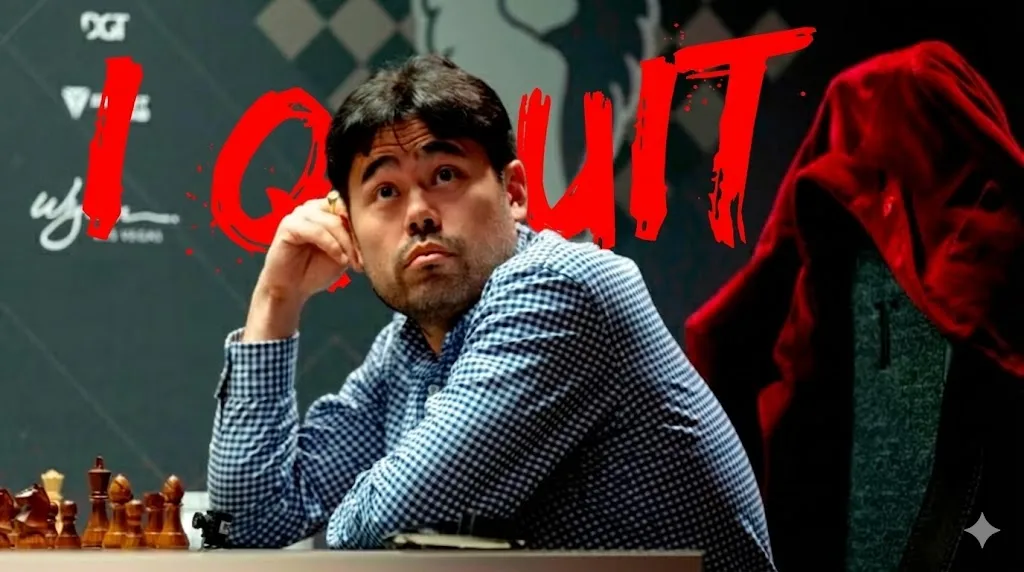
In December 2025, the chess world turned its eyes toward Cape Town, South Africa, for the season finale of the Freestyle Chess Grand Slam Tour. The event promised breathtaking ocean views, a $660,000 prize pool, and a clash of the world’s frantic creative minds. However, as the pieces were set up at the southern tip of Africa, one massive presence was notably missing: Hikaru Nakamura.
Currently ranked world number two and a dominant force in modern chess, Nakamura’s absence from the lineup – which featured rivals like Magnus Carlsen, Fabiano Caruana, and Hans Niemann – was notable. While fans speculated on social media, the reasons for his withdrawal were neither sudden nor singular. Nakamura’s decision to skip the South Africa Finals was the culmination of a months-long professional rift with the tournament’s organizers, compounded by a life-changing personal milestone: the arrival of his first child.
A Fracture in the “Freestyle” Vision
To understand Nakamura’s absence in December, one must look back to the sweltering heat of Las Vegas in July 2025. It was there, during the U.S. leg of the tour, that Nakamura’s relationship with the Freestyle Chess organization began to fracture publicly.
Nakamura had been a central figure in the tour’s earlier stages, securing a 5th place finish in Weissenhaus and a runner-up spot in Paris. However, following the Las Vegas event, where he finished fourth, Nakamura released a blistering critique of the tournament’s structure and integrity.
His grievances were fundamental, striking at the very philosophy of the event. Foremost among them was the issue of competitive integrity. Nakamura argued that the organizers failed to distinguish between a high-stakes professional sporting event and an entertainment exhibition. He cited the presence of a live audience in close proximity to the players as a major disruption. During critical moments of calculation, players could hear gasps, snoring, and cell phones ringing.
From a general standpoint of integrity and fairness, that should not happen,” Nakamura stated, noting that he and Fabiano Caruana were distracted by audience reactions during their games. He argued that with first-place prizes reaching $200,000, the playing conditions required absolute silence, a standard the event failed to meet.
The organizers’ attempt to mitigate this with noise-canceling headphones only deepened the conflict. Nakamura described the headphone policy as “pure theater” and inconsistent. He reported that rules regarding whether players could listen to music or merely white noise were changed on the fly, leading to confusion and frustration among the participants. “The headphones… did absolutely nothing at all to protect the integrity of the game,” he lamented.
The Identity Crisis: Freestyle vs. Fischer Random
Beyond the physical environment, Nakamura took issue with the intellectual branding of the tour. The tournament features “Freestyle Chess,” a variation where the pieces on the back rank are shuffled randomly. However, this game has existed for decades as Fischer Random or Chess960.
Nakamura viewed the “Freestyle” rebranding as disrespectful to chess history. The reality is it’s Fischer Random chess or it’s Chess960. Pick your poison,” Nakamura said. “Don’t suddenly pretend… [it] is suddenly Freestyle Chess, like rebranding something that you really don’t have the right to, that wasn’t your invention”.
This critique suggested a deeper philosophical disconnect. Nakamura felt the organizers were prioritizing marketing novelty over sporting tradition, a sentiment that alienated him from the tour’s long-term vision. He suggested that the format was struggling to attract viewership compared to traditional chess, noting that casual fans found the randomized positions confusing rather than exciting.
The “Magnus” Factor and Structural Chaos
Perhaps the most damning reason for Nakamura’s professional withdrawal was his perception that the tour was not an open competition, but rather a vehicle designed around one man: Magnus Carlsen.
In August 2025, Nakamura hinted that the tour’s flexibility and constantly shifting rules were designed to accommodate the preferences of the former World Champion. “It feels like the event is for one person, and that person calls all the shots,” Nakamura implied. This sentiment was exacerbated by what Nakamura called a “busted” tournament bracket and erratic time controls that shifted from rapid to classical formats without logic, leading to 11-hour playing days that left players exhausted.
By August 5, 2025, four months before the South Africa finals, Nakamura had seen enough. On his stream, he announced, “Will I play the Freestyle Chess Grand Slam in South Africa? Very unlikely… I don’t think I’ll be playing any more Freestyle Chess events”.
The Personal Milestone: “Mini Hikarus”
While professional disagreements provided the justification for leaving the tour, Nakamura’s personal life provided a compelling reason to stay home.
On July 13, 2025, during the same Las Vegas trip where his professional frustrations boiled over, Nakamura shared joyful news with his fans. During a livestream with his wife, Woman Grandmaster Atousa Pourkashiyan, the couple announced they were expecting their first child. “We are, of course, expecting a baby! Mini Hikarus, yes!” Nakamura beamed.
The timing of this pregnancy is crucial to understanding his absence in South Africa. The couple announced the news in mid-July 2025. While the exact due date was not publicized in the provided records, a standard pregnancy timeline suggests the baby would arrive in late 2025 or very early 2026.
The South Africa Finals were scheduled for December 8–11, 2025. This placed the tournament squarely in the window where Pourkashiyan would be in the final, most critical weeks of pregnancy, or the couple would be navigating the immediate challenges of caring for a newborn.
Traveling from the United States to Cape Town involves long-haul intercontinental flights and significant time zone changes. For a new father or a husband supporting a heavily pregnant wife, such a trip is logistically and emotionally prohibitive. Nakamura has frequently spoken about the shifting priorities of older professionals, and this life event aligned perfectly with his decision to step back from a tournament circuit he already viewed with skepticism.
Interestingly, Nakamura was not alone in this life stage; his rival Magnus Carlsen also announced in 2025 that he and his wife were expecting their first child, marking a unique parallel between the world’s top two players. However, while Carlsen chose to attend the South Africa event, Nakamura exercised his option to bow out.
A Community Divide
Nakamura’s refusal to play in South Africa was not merely a silent withdrawal; it sparked a broader conversation within the chess community. His critiques of the Las Vegas event were corroborated by fans and attendees, who validated his claims about the noise and chaotic organization. One attendee noted it was “absolutely insane” that fans were not explicitly told to be quiet and that the environment undermined the professionalism of the sport.
Furthermore, the “Attacking Chess” outlet noted that Nakamura’s departure signaled a potential crisis for the Freestyle Chess tour. As one of the game’s biggest content creators, his absence meant a significant dip in viewership and hype. “Freestyle Chess is at a crossroads,” the outlet reported. “Without buy-in from players like Nakamura, its long-term credibility could be at stake”.
Hikaru Nakamura’s absence from the 2025 Freestyle Chess Finals in South Africa was the result of a perfect storm. Professionally, he had lost faith in the organization, viewing the “Freestyle” brand as a chaotic, marketing-driven attempt to repackage Fischer Random Chess that prioritized entertainment over competitive fairness. He refused to tolerate inconsistent rules, audience distractions, and a format he felt was biased toward Magnus Carlsen.
Personally, the timing of the Cape Town event conflicted directly with his entry into fatherhood. With his wife Atousa Pourkashiyan expecting their first child around the time of the tournament, the choice to remain in the United States was a move that prioritized family over a paycheck.
When the first pawn was pushed in Cape Town on December 8, the field included grandmasters like Levon Aronian, Vincent Keymer, and Hans Niemann. Yet, the shadow of the world number two loomed large. Nakamura’s empty chair was not just a vacancy in the bracket; it was a statement that for the American superstar, the integrity of the game and the needs of his growing family outweighed the spectacle of the tour.
Watch the 2025 Freestyle Chess Grand Slam Finals here

I’m a passionate board game enthusiast and a skilled player in chess, xiangqi and Go. Words for Attacking Chess since 2023. Ping me at Lichess for a game or chat.