
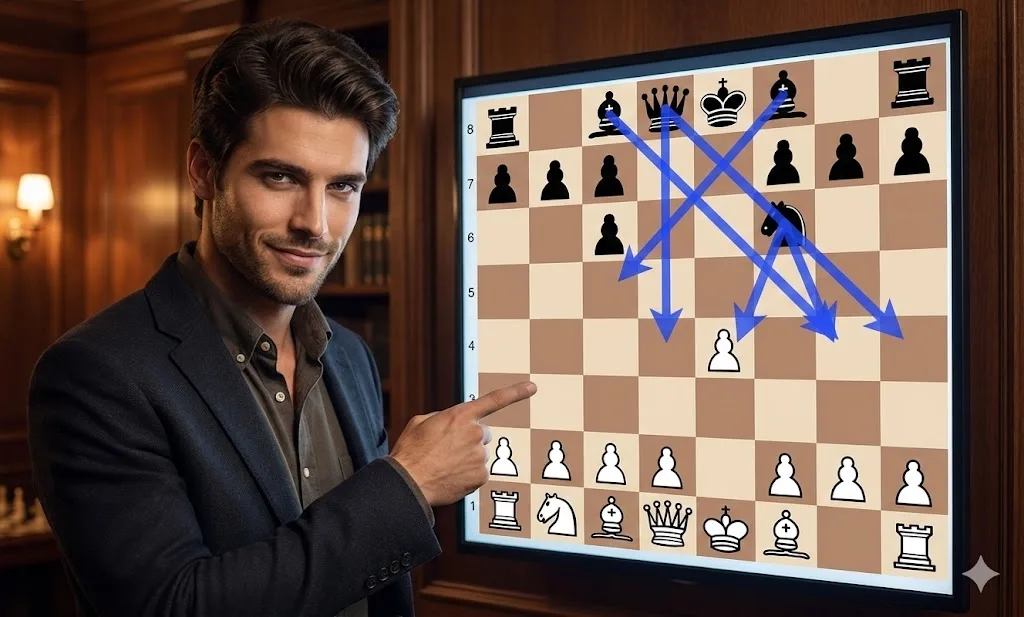
Imagine this: you’re five moves into a standard game of chess, and suddenly your opponent sacrifices a knight. Then a bishop. Your king is flushed into the open, enemy pieces are swarming, and your “safe, solid” position has become a tactical minefield. This isn’t a chess fantasy; it’s a typical Tuesday for anyone facing the Stafford Gambit, the internet’s favorite “unsound” opening.
Table of Contents
This guide will serve as your complete introduction to this electrifying weapon. We’ll explore its explosive rise in online chess culture, break down its core ideas, and honestly assess its reputation as a fun, tricky, but theoretically flawed opening that can win you games in spectacular fashion.
So, what exactly is the Stafford Gambit? In simple terms, it’s a hyper-aggressive pawn sacrifice for Black that arises from the Petroff Defense (also known as the Russian Game). After the standard opening moves 1. e4 e5 2. Nf3 Nf6, White captures Black’s pawn with 3. Nxe5. Instead of following the traditional, solid path of the Petroff, Black immediately lashes out with 3... Nc6!?, offering up a pawn to create immediate chaos and launch a blistering attack.
The gambit’s recent surge in popularity can be traced directly to the culture of online blitz and bullet chess. Its fame has been amplified by chess content creators, most notably International Master Eric Rosen, whose thrilling victories with the gambit have inspired thousands of players to try it themselves. The opening is packed with “meme-worthy” traps and tactical shots that are perfect for the fast-paced, high-pressure environment of online play.
But make no mistake, the Stafford Gambit is a double-edged sword. At the highest levels, and against a well-prepared opponent, it is considered objectively unsound. Black willingly accepts a technically worse position—a pawn down with a damaged structure—in exchange for creating complex, tricky situations. The entire strategy hinges on the idea that White, even when playing “seemingly solid moves,” can easily fall into one of the many tactical traps Black has prepared. This article will equip you with the knowledge to wield this weapon effectively, whether you’re setting the traps as Black or carefully defusing them as White.
Let’s dive in and see how these first few moves set the board on fire.
The Opening Moves: Setting the Board on Fire
In any chess opening, the first few moves are critical; they set the stage and define the character of the entire game. In the Stafford Gambit, this is especially true. Black’s third move is a deliberate provocation, a declaration of war that steers the game away from quiet strategic waters and into a tactical maelstrom. Understanding this initial sequence is the first step to mastering the gambit.
Here is the core move sequence that brings the Stafford Gambit to life:
- 1. e4 e5: The game begins with the most common and classical opening moves, leading to what is known as an “Open Game.” Both sides place a pawn in the center, fighting for control and opening lines for their pieces.
- 2. Nf3 Nf6: This is the Petroff Defense, or Russian Game. Instead of defending the e5 pawn, Black counter-attacks White’s e4 pawn. The Petroff has a long-standing reputation as one of the most solid and reliable defenses for Black.
- 3. Nxe5: This is White’s most popular and principled response. White accepts the challenge and captures the pawn on e5, temporarily going up a pawn and asking Black to prove their counter-attacking concept.
- 3… Nc6!?: This is the moment the game transforms. This surprising and aggressive move is the heart of the Stafford Gambit. Instead of the standard Petroff plan (
3...d6), which aims to regain the pawn methodically, Black immediately challenges White’s knight. This move offers a pawn sacrifice to accelerate development and radically unbalance the position.
The most common and critical continuation is for White to accept the gambit.
4. Nxc6 dxc6
This exchange defines the strategic landscape for the rest of the game. It’s essential to understand the trade-offs for both sides:
- For White: The situation looks promising on the surface. White is officially up a pawn, which is a significant material advantage. Furthermore, Black’s pawn structure has been damaged; the doubled c-pawns are a long-term weakness.
- For Black: The compensation for the pawn is purely dynamic. By capturing with the d-pawn, Black has opened the d-file for the queen and the c8-h3 diagonal for the light-squared bishop. This translates into a dangerous lead in development and immediate attacking potential aimed directly at the white king.
From this position, Black is no longer playing for equality. The goal is to checkmate, and the next section will break down the specific plans Black uses to achieve this.
Black’s Game Plan: Creating Chaos and Attacking Chances
After sacrificing a pawn on move four, Black’s strategy is clear and direct: attack, attack, attack. There is no time for slow maneuvering or quiet positional play. Black’s play is all about leveraging a temporary initiative to create decisive, game-ending threats before White can consolidate their extra pawn and claim a winning endgame. Every move must contribute to the assault on the white king.
Here are the core strategic pillars of Black’s game plan.
- Unleash the Pieces The open lines created by the
4...dxc6capture are the highways for Black’s pieces. The primary goal is to get the minor pieces into the game as quickly as possible. The light-squared bishop almost always flies to c5, the knight on f6 prepares to leap to g4, and the queen is ready to join the fray from d8. This rapid mobilization puts immediate pressure on White, who can easily get overwhelmed while trying to complete their own development. - Targeting the Weakest Point (f2) In the opening, the f2 square (and f7 for Black) is the most vulnerable point in the position, as it is defended only by the king. The Stafford Gambit is built almost entirely around exploiting this weakness. The bishop on c5 stares directly at f2, and the knight often jumps to g4 to add a second attacker. This simple, two-piece threat forces White to react immediately and is the basis for many of the gambit’s most devastating traps.
- The Roaming Queen The semi-open d-file is a perfect launching pad for the black queen. Unlike in many other openings where the queen develops later, in the Stafford, she is an active participant from the very beginning. From d8, the queen can swing over to the kingside via h4 to create direct mating threats, or move to d6 or d4 to attack weak pawns and support the advancing pieces. This early queen activity is a constant headache for White and a key feature of Black’s attacking formula.
- The Power of the Bishop Pair In many of the main lines, Black will sacrifice the knight on g4. After a common sequence like
...Ng4, White often playsBxg4, which is met by...Qh4, forcing White to move their king or bishop. Black then recaptures with...Bxg4. The result of this skirmish is that Black has traded a knight for a bishop, securing the long-term strategic advantage of the bishop pair. In the open, chaotic positions typical of the Stafford, two bishops working together can be far more powerful than a bishop and a knight, giving Black excellent practical chances even if the initial attack is repelled.
With these aggressive ideas in mind, it’s time to switch perspectives. How should White deal with this onslaught without falling into a trap?
White’s Counter-Strategy: How to Refute the Gambit
Playing against the Stafford Gambit can be intimidating. Black’s attack comes quickly, and one wrong step can lead to a swift and brutal checkmate. However, it’s crucial to remember that White is objectively better. With an extra pawn and a solid position, a well-prepared player can systematically neutralize Black’s threats and convert their advantage. The key is not to panic, but to follow a clear and logical plan.
Here are the essential defensive and counter-attacking principles for White.
- Solidify the Center In the last section, we saw that Black’s entire plan hinges on the power of their light-squared bishop on c5. Your primary mission, therefore, is to neutralize that piece. The most effective plan involves the moves
d3followed byc3. The moved3immediately defends the e4 pawn and blunts the c5 bishop’s scope. The follow-upc3prepares to playd4, building a powerful pawn center that seizes space and effectively kills Black’s most active piece. Thisc3-d4setup is widely considered the main refutation of the gambit. - Prevent Knight Hops Black’s most common and dangerous attacking pattern involves the
...Ng4jump to attack f2, as we discussed. The simple prophylactic moveh3is the direct antidote to this entire plan. This simple pawn move takes the g4 square under control, preventing the knight from landing there and forcing Black to find a different plan. Playingh3early is one of the hallmarks of a well-prepared anti-Stafford player. - Safe Development It’s tempting for White to develop pieces to their “natural” squares, but in the Stafford, this can be a fatal mistake. For example, developing the light-squared bishop to
Bc4orBg5often walks directly into one of Black’s classic traps. The safest and best square for this bishop isBe2. From e2, the bishop defends the crucial g4 square, prepares to castle kingside, and doesn’t expose itself to the tactical tricks that arise from more ambitious placements. - An Unorthodox but Viable Defense: The
f3System A surprising but effective way to fight the Stafford is the move5. f3!?. This move shores up the kingside and defends the e4 pawn, but it does take away a natural developing square for the g1 knight. It can lead to an awkward position for White if not handled with care, but it’s a legitimate surprise weapon against a Stafford player who might only be familiar with the more common lines. - Trade Pieces, Not Pawns This is a classic principle of chess: the player with a material advantage should seek to trade pieces. Each trade simplifies the position and reduces the attacker’s power. In the Stafford, White is up a pawn. By methodically trading off Black’s most active attacking pieces (like the knight on f6 or the bishop on c5), White can neutralize the initiative. Once the storm has passed, the game enters a quieter phase where White’s extra pawn becomes the decisive factor, often leading to a winning endgame.
Theory is one thing, but seeing these ideas in practice is another. The following section provides a deep dive into the specific tactical lines and brutal traps that make this opening so famous.
A Catalogue of Carnage: 20 Key Lines and Traps
Welcome to the heart of the Stafford Gambit. This section is a practical guide to 20 of the most important tactical patterns, common blunders, and winning ideas for both sides. Each line tells a story of attack and defense, showcasing the critical moments where games are won and lost. Study these examples to arm yourself for your next online battle.
Line #1: The Classic Bg5 Blunder (more than 150,000 people falled for this) 1. e4 e5 2. Nf3 Nf6 3. Nxe5 Nc6 4. Nxc6 dxc6 5. d3 Bc5 6. Bg5? Nxe4! 7. Bxd8?? Bxf2+ 8. Ke2 Bg4#
This is the trap that built the Stafford’s reputation. White’s 6. Bg5? seems like a perfectly normal developing move, pinning the knight to the queen. The practical challenge here is psychological; your opponent thinks they are restricting you, but you are about to spring the trap. Black ignores the pin and unleashes the stunning 6...Nxe4!. If White greedily takes the queen with 7. Bxd8??, it’s a forced checkmate.
Line #2: The Safer Response to the Bg5 Trap 1. e4 e5 2. Nf3 Nf6 3. Nxe5 Nc6 4. Nxc6 dxc6 5. d3 Bc5 6. Bg5? Nxe4! 7. dxe4 Bxf2+ 8. Ke2 Bg4+ 9. Kxf2 Qxd1
After you play 6...Nxe4!, a more careful opponent will realize taking the queen is a disaster. Instead, they might capture your knight with 7. dxe4. From White’s perspective, they’ve won a piece and avoided mate. But the attack continues with 7...Bxf2+, forcing the king into the open. The follow-up skewer with 8...Bg4+ wins the white queen, leading to a completely winning position for Black.
Line #3: White’s Best Escape from the Bg5 Trap 1. e4 e5 2. Nf3 Nf6 3. Nxe5 Nc6 4. Nxc6 dxc6 5. d3 Bc5 6. Bg5? Nxe4! 7. Be3 Bxe3 8. fxe3 Qh4+ 9. g3 Nxg3 10. hxg3 Qxh1
The most experienced opponent, upon seeing 6...Nxe4!, will try to bail out with 7. Be3, offering a trade of bishops. While this avoids immediate loss, you are still much better. The key is to keep the pressure on. After 7...Bxe3 8. fxe3, your queen immediately jumps in with 8...Qh4+, and the follow-up 9...Nxg3 shatters White’s kingside. White has survived, but their position is in ruins.
Line #4: The h3?!Double Sacrifice 1. e4 e5 2. Nf3 Nf6 3. Nxe5 Nc6 4. Nxc6 dxc6 5. d3 Bc5 6. h3?! Bxf2+! 7. Kxf2 Nxe4+ 8. Kf3 O-O
The move 6. h3?! looks like a reasonable attempt to stop ...Ng4, but it’s slightly inaccurate and allows for a brilliant demonstration of Black’s attacking potential. You sacrifice the bishop on f2, then the knight on e4, forcing the white king on a terrifying walk into the center of the board. The practical challenge for White is immense; their king is now a permanent target for all of your pieces.
Line #5: The 5. e5Fork Trick 1. e4 e5 2. Nf3 Nf6 3. Nxe5 Nc6 4. Nxc6 dxc6 5. e5 Ne4 6. d3? Bc5! 7. dxe4?? Bxf2+ 8. Ke2 Bg4+
When White pushes 5. e5, they are trying to kick your knight and consolidate. The move 6. d3? seems like a logical way to attack your knight on e4, but it’s a fatal mistake. You punish this with 6...Bc5!, creating an unstoppable threat against f2. If White gets greedy and takes the knight, it leads to the same queen-winning skewer we’ve seen before.
Line #6: White’s Correct Handling of 5. e5 1. e4 e5 2. Nf3 Nf6 3. Nxe5 Nc6 4. Nxc6 dxc6 5. e5 Ne4 6. d4 Qh4 7. Qe2
This is how a prepared opponent will handle the 5. e5 line. Instead of the weak d3, they play 6. d4 to support their center. Your most dangerous try is 6...Qh4, threatening mate on f2. The practical test for White is not to panic with a weakening move like g3?. The calm 7. Qe2 defends everything and leaves White with a clear advantage.
Line #7: The Bc4?Blunder 1. e4 e5 2. Nf3 Nf6 3. Nxe5 Nc6 4. Nxc6 dxc6 5. Nc3 Bc5 6. Bc4? Ng4 7. O-O Qh4
Developing the bishop to c4 is one of the most common and natural-looking blunders. An opponent playing this thinks they are developing aggressively, but they are walking into a classic trap. It allows 6...Ng4, creating a double attack on f2. If White castles, 7...Qh4 creates an unstoppable mating attack. However, a tricky White player might try the surprising sacrifice 9. Bxf7+!?. The idea is to deflect your king. A greedy recapture with 9...Kxf7? actually loses for Black after 10. d4!. You must correctly sidestep with 9...Kf8! to continue the attack.
Line #8: White’s Safest Setup: 5. Nc3with h3 1. e4 e5 2. Nf3 Nf6 3. Nxe5 Nc6 4. Nxc6 dxc6 5. Nc3 Bc5 6. h3
This is one of the most practical and effective ways for White to combat the Stafford Gambit. The prophylactic move 6. h3 is essential, as it prevents all of your ...Ng4 ideas before they can even start. If your opponent plays this, they are signaling that they know the theory. This setup allows White to safely develop and focus on converting their extra pawn.
Line #9: Black’s Qd4Response to Be2 1. e4 e5 2. Nf3 Nf6 3. Nxe5 Nc6 4. Nxc6 dxc6 5. Nc3 Bc5 6. Be2?! Qd4 7. O-O Nxe4
While Be2 is generally a solid developing move, it can be slightly inaccurate here. It allows you to play the clever 6...Qd4!, putting immediate pressure on f2 and forcing White to castle into your attack. After they castle, you can immediately play 7...Nxe4, winning back the gambited pawn and completely equalizing the game. This shows how even a “safe” move can be problematic against the Stafford’s tricks.
Line #10: The Main Refutation (The ‘Hafu Variation’) 1. e4 e5 2. Nf3 Nf6 3. Nxe5 Nc6 4. Nxc6 dxc6 5. d3 Bc5 6. Be2 h5 7. c3 Bb6 8. Nd2
This is the line that prepared players will use to shut you down. They aren’t trying to out-calculate you in a tactical brawl; they are methodically building a fortress in the center with c3 and preparing d4. The goal is to make your star piece, the bishop on c5, bite on granite. If you see this setup as Black, you must understand your initial attack has been parried, and you need to find a new plan.
Line #11: The ...h4!!Sacrifice (Schrantz vs. Stockfish) 1. e4 e5 2. Nf3 Nf6 3. Nxe5 Nc6 4. Nxc6 dxc6 5. d3 Bc5 6. Be2 h5 7. c3 Ng4 8. d4 Qh4 9. g3 Qf6 10. f3 h4!!
Even against the main refutation, Black has wild resources. This line, famously used to challenge a top engine, involves sacrificing even more material. The stunning 10...h4!! shatters White’s kingside. The practical challenge for White is almost impossible to solve over the board. Even if a computer can defend it, a human opponent is likely to collapse in the ensuing tactical nightmare.
Line #12: The 6. e5??Blunder 1. e4 e5 2. Nf3 Nf6 3. Nxe5 Nc6 4. Nxc6 dxc6 5. Nc3 Bc5 6. e5?? Ng4 7. Ne4 Nxf2
After the solid 5. Nc3, an opponent might think they can push the pawn with 6. e5??. This is a catastrophic mistake. From a practical standpoint, White is trying to gain space but has completely misjudged the position’s dynamic nature. This move gives you the extra tempo needed to launch a winning attack with 6...Ng4, leading to a decisive material advantage.
Line #13: The ...Nxh2!Tactical Shot 1. e4 e5 2. Nf3 Nf6 3. Nxe5 Nc6 4. Nxc6 dxc6 5. d3 Bc5 6. Be3?! Bxe3 7. fxe3 Ng4 8. Qf3 Qg5 9. Kd2? Nxh2!
Offering to trade bishops with 6. Be3?! is a common but imprecise move. After a few moves, the white king is often forced to d2. Here, you can unleash the brilliant tactic 9...Nxh2!. The trap is set. If White greedily captures the knight with 10. Rxh2??, the queen fork 10...Qe5 wins the rook on h2 and the pawn on b2, completely crushing White’s position.
Line #14: Queenside Castling Attack 1. e4 e5 2. Nf3 Nf6 3. Nxe5 Nc6 4. Nxc6 dxc6 5. d3 Bc5 6. Be2 Ng4 7. Bxg4 Qh4 8. O-O Bxg4 9. Qe1 O-O-O
Here, you sacrifice the knight on g4 to gain the long-term advantage of the bishop pair. By castling queenside, you create a highly aggressive opposite-side castling scenario. The game becomes a race to see who can checkmate the other king first. With two powerful bishops slicing across an open board, your practical chances are excellent.
Line #15: Declining the Gambit with 4. d4 1. e4 e5 2. Nf3 Nf6 3. Nxe5 Nc6 4. d4 Qe7 5. Nxc6 Qxe4+ 6. Qe2 Qxe2+ 7. Bxe2 dxc6
Sometimes an opponent will get scared and decline the gambit. Playing 4. d4 is a reasonable but un-ambitious approach. Your key response is the intermediate move 4...Qe7!. This forces a series of trades where you regain the pawn. The practical result is that you’ve bypassed White’s preparation and steered the game into a simple, roughly equal endgame.
Line #16: Declining the Gambit with 4. Nf3 1. e4 e5 2. Nf3 Nf6 3. Nxe5 Nc6 4. Nf3 Nxe4 5. Nc3 Nxc3 6. dxc3
This is the safest way for White to decline, almost too safe though. They simply retreat the knight with 4. Nf3. Your opponent is signaling that they want a quiet game and are giving up any claim to an opening advantage. The game transposes back into a standard, quiet Petroff Defense position where the game is perfectly equal.
Line #17: The Tricky ...b5Pawn Push 1. e4 e5 2. Nf3 Nf6 3. Nxe5 Nc6 4. Nxc6 dxc6 5. Nc3 Bc5 6. h3 b5!? 7. d3 b4 8. Ne2? Nxe4!
After White correctly plays 6. h3, you can try this tricky sideline. The idea of 6...b5!? is to harass the c3 knight. An unsuspecting opponent will often retreat it to the natural e2 square, but this is a mistake that runs into the beautiful 8...Nxe4! sacrifice, which wins material or checkmates.
Line #18: The “Fishing Pole” Trap 1. e4 e5 2. Nf3 Nf6 3. Nxe5 Nc6 4. Nxc6 dxc6 5. Nc3 Bc5 6. h3 h5 7. d3 Qd6
When your opponent correctly plays 6. h3 to stop ...Ng4, you can switch gears and set up this “Fishing Pole” style trap with 6...h5. The plan is simple: put your queen on d6 and dare White to castle kingside. If they do, your knight can now jump to g4, and the attack on the h-file will be overwhelming. A smart player will recognize this and castle queenside instead.
Line #19: The Queen Trap after g3? 1. e4 e5 2. Nf3 Nf6 3. Nxe5 Nc6 4. Nxc6 dxc6 5. e5 Ne4 6. d4 Qh4 7. g3? Nxg3 8. fxg3 Qe4+
In the 5. e5 line, the move 7. g3? seems like a natural way to kick your active queen. In reality, it’s a fatal error. Your opponent thinks they are driving you back, but they are weakening their own position. You sacrifice the knight with 7...Nxg3!, and after 8. fxg3, the queen delivers a fork with 8...Qe4+, winning the rook on h1.
Line #20: The High-Level Refutation: Give Back the Pawn 1. e4 e5 2. Nf3 Nf6 3. Nxe5 Nc6 4. Nxc6 dxc6 5. Nc3 Bc5 6. h3 Qd4 7. Qf3 Bb4 8. a3 Bxc3 9. dxc3 Qxe4+ 10. Qxe4+ Nxe4 11. Bf4
This is how a very strong player might approach the position. Instead of desperately clinging to the extra pawn, White allows you to win it back with 9...Qxe4+. Why? Because the resulting trade of queens completely kills your attack. The game then enters an endgame where, despite equal material, White has a clear, long-term advantage due to the bishop pair and constant pressure on your weak c7 pawn.
With these tactical patterns in your arsenal, you’re ready to tackle the final question: should you actually play this opening?
The Verdict: Is the Stafford Gambit Right for You?
We’ve explored the opening moves, dissected the strategic plans for both sides, and witnessed a catalogue of tactical carnage. Now, it’s time to synthesize this information and deliver a final verdict on the Stafford Gambit’s practical value. Is this explosive, tricky opening the right choice for your repertoire?
To make an informed decision, let’s weigh the pros and cons in a clear, concise format.
| Strengths (Why to Play It) | Weaknesses (Why to Avoid It) |
| Excellent surprise weapon in online blitz/bullet. | Objectively unsound against a prepared opponent. |
| Creates immediate, complex tactical situations. | If the initial attack fails, Black is often simply down a pawn in a bad position. |
| Fun, aggressive, and leads to decisive games. | Not a suitable opening for building a fundamentally sound repertoire. |
| High psychological pressure on the opponent. | A well-prepared player can follow a clear refutation path to a winning advantage. |
Who Should Play the Stafford Gambit?
This opening is tailor-made for a specific type of player. It is best suited for aggressive, tactical players who thrive in chaos and enjoy “swindling” their opponents in fast time controls. If you are a player who isn’t afraid to take risks, who enjoys calculating sharp lines, and whose primary goal is to have fun and create memorable games, the Stafford Gambit could be a perfect fit. It’s a fantastic choice for blitz and bullet, where opponents have little time to recall specific theory and are more likely to fall for the traps.
Conversely, this opening should be avoided by beginners who are trying to learn solid, fundamental chess principles. Because the gambit relies so heavily on tricks and short-term initiative, it doesn’t teach the core strategic concepts of pawn structure, piece activity, and endgame technique. It’s also not recommended for serious tournament play in classical time controls, where an opponent will have ample time to find the correct defensive moves and convert their extra pawn.
A Final, Balanced Perspective
Ultimately, the Stafford Gambit exists in a fascinating gray area of chess. A grandmaster or a well-prepared club player armed with modern theory can refute it with clinical precision. They will follow the safe lines, build their central pawn wall, neutralize the attack, and grind out a win with their extra material.
However, for the vast majority of online chess games, the Stafford Gambit is “sound enough.” Its immense practical power, surprise value, and the sheer number of ways for White to go wrong often outweigh its theoretical defects. It forces your opponent to solve difficult problems from the very beginning of the game, and under the pressure of the clock, most will crumble. If you’re looking for an exciting, dangerous, and incredibly fun weapon to add to your online arsenal, the Stafford Gambit is waiting. Just be prepared for a wild ride.
I’m Xuan Binh, the founder of Attacking Chess, and the Deputy Head of Communications at the Vietnam Chess Federation (VCF). My chess.com and lichess rating is above 2300. Send me a challenge or message via Lichess. Follow me on Twitter (X) or Facebook.