
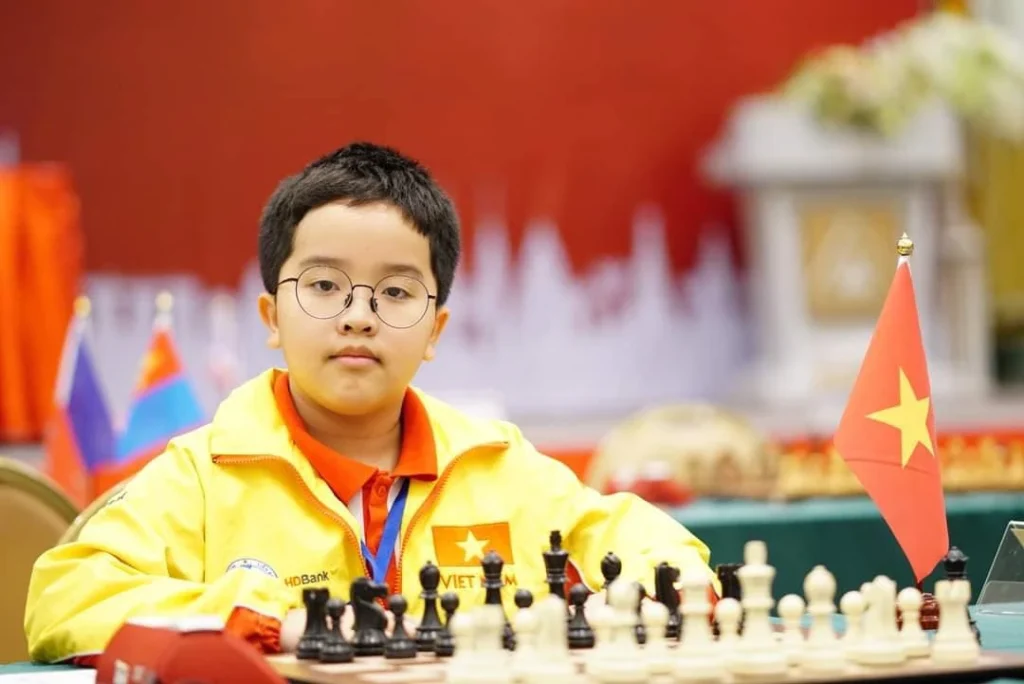
FIDE’s rating system gives young players certain advantages. Under current rules, players under 18 and below 2300 Elo receive a K-factor of 40, allowing them to gain rating points faster. But ever since this rule was introduced, the federation has faced criticism that the system favors youth too heavily, creating cases of inflated ratings that do not reflect true playing strength.
Meanwhile, late starters, who picked up chess as an adult, only get K=40 for their first 30 rated games before dropping to K=20 like every other sub-2400 player. That is a massive disadvantage compared to juniors who can keep K=40 for years.
As abuses and anomalies appeared, FIDE gradually began “patching the rulebook” to control rating inflation.
The First Major Red Flag: Gasimov’s 567-Point Surge
The earliest and most famous example after the K=40 rule came from Parviz Gasimov of Azerbaijan (not the late GM Vugar Gashimov). Between late 2014 and early 2015, Gasimov’s rating jumped from 1949 to 2516 in just three monthly lists—a mind-blowing 567 Elo points. At the time, this was likely a world record for any player rated 2000+.
FIDE initially treated this as an outlier and took no immediate action.
When the System Broke Again: Burke’s Explosion to 2600
The next case pushed FIDE to finally react. In July 2015, American junior Christopher Burke was rated 2258. By September, he had skyrocketed to 2603, after gaining:
- +281 Elo in August
- +64 Elo in September
This made him the youngest player ever to cross 2600, a record only recently broken by Erdogmus. Even more remarkably, Burke achieved 2600 without holding any official title, a unique case in chess history.
This time, FIDE recognized that the rating mechanics were being stretched far beyond reasonable limits.
FIDE’s First Patch: The 700 Rule
To curb runaway gains, FIDE introduced a new constraint:
In any given month, the total K-factor multiplied by the number of rated games may not exceed 700.
For example, if a player competes in two open tournaments (18 games in total), their effective K becomes:
K = 700 / 18 = 38
This rule directly affects players who pack many rounds into one rating period.
The Velpula Case: When K=40 Was Cut Mid-Sprint
A recent case involved Indian junior Velpula, who entered June 2023 with an Elo of 1844. Her surge was dramatic:
- July: +206 Elo
- August: +336 Elo
- September: reached 2386
At the end of August/beginning of September, Velpula played a tournament with a starting Elo of 2050. Under K=40, she would have gained 114 more points, enough to reach 2500 and become the world’s #1 girl.
But FIDE applied K=20, arguing that her September rating (2386) placed her above the youth threshold. This is different from how Burke’s case was handled—Burke still received K=40 even though his previous list showed him above 2530.
This ruling left Velpula ranked #2 instead of #1.
Back to Vũ Anh: How the Rules Helped (and Almost Hurt)
In November, the Vietnamese Candidate Master Dương Vũ Anh played 18 games, so his effective K was reduced to 38 instead of 40.
By chance, the U.S. Masters was not included in the December list. Otherwise, with 27 total games, the K-factor would have dropped to 25, significantly slowing his progress.
In December his rating stands at 2290, just 10 points below the 2300 threshold. Because he hasn’t crossed 2300:
- He still qualifies for K=40 in January 2026.
- He avoids the Velpula situation where K is cut mid-run.
- With +118 Elo, he will rise to 2408 in January, skipping the painful 2300–2400 climb that blocks many IM hopefuls for years.
Why Doesn’t FIDE Use “Live Ratings” Like Chess.com or Lichess?
Many fans ask why FIDE can’t simply update ratings instantly after each game.
Because FIDE ratings rely on verified administrative documents, not automated algorithms. Every event must submit formal reports, which staff must validate:
- Eligible players
- Valid games
- Licensed arbiters
- Anti-cheating controls
- Rating compliance
If FIDE used instant updates, they would constantly need to “return Elo” when events are invalidated, rules violated, players caught cheating, or results rejected. The entire database would become unstable.
Online platforms can instantly adjust ratings. FIDE cannot, not without chaos.
All three explosive cases—Gasimov (now 2328), Burke (2569), Velpula (2296)—eventually dropped far below their temporary peaks. Their rating spikes exceeded their true strength, and reality later corrected the numbers. What will happen to Vũ Anh now?

I’m Xuan Binh, the founder of Attacking Chess, and the Deputy Head of Communications at the Vietnam Chess Federation (VCF). My chess.com and lichess rating is above 2300. Send me a challenge or message via Lichess. Follow me on Twitter (X) or Facebook.