
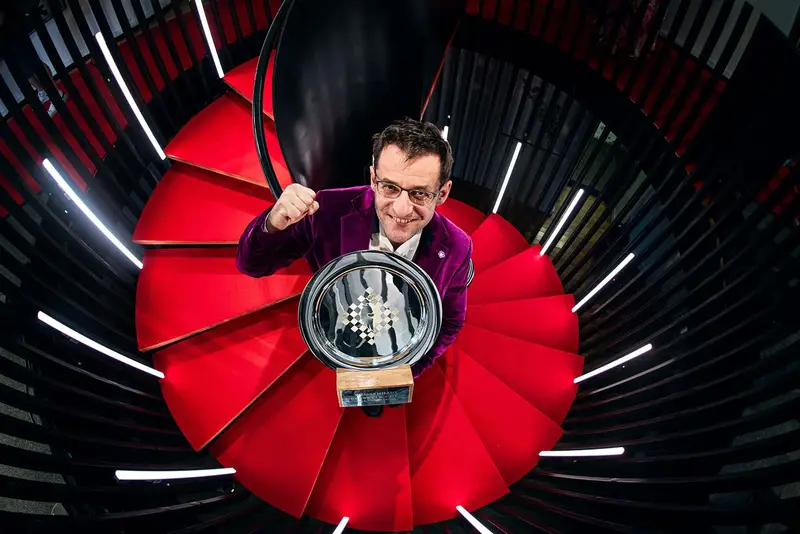
Grandmaster Levon Aronian, at 43 years old, was the oldest competitor by a margin in the 2025 Freestyle Chess Grand Slam Finals in South Africa, yet he concluded the year by claiming the $200,000 first prize. His victory over Magnus Carlsen in the title match, secured with a 1.5–0.5 score, marked his second consecutive Grand Slam win. This triumph was not just a competitive achievement; it was the culmination of a significant internal shift, one that Aronian traced back to a painful, candid admission of humiliation earlier in the year.
Playing “Embarrassingly Badly”
Aronian pinpointed the exact moment when his career trajectory changed: a loss against Vincent Keymer in Weissenhaus. Reflecting on that pivotal match, Aronian confessed that he lost “like a complete idiot”. The experience was deeply unsettling, forcing him to confront his performance honestly. He stated that he was “playing so embarrassingly badly against him” that it made him “question a lot of things” within himself.
The self-questioning was existential, extending beyond a single game. Aronian recalled pondering: “Is this what I want to do? Is this how I play chess?”. This low point, however, served as an unexpected trigger. Aronian noted that immediately following that poor performance, the “shift started”. He observed that “after that match, I think everything else I played was very good”.
Letting Go of Image
The career shift was accompanied by a noticeable change in attitude toward competition and public image. Aronian arrived at the South Africa event without high expectations, admitting he was unsure if he was in good shape, especially after starting the event with poor play. He recalled making “some blunders” and “playing terrible”.
He even lost against one of the streamers during the preliminary events. In the past, Aronian admitted he would have been “more concerned with my image, not losing against the streamers”. However, the philosophical change brought clarity. Aronian explained that, possibly with age, he started “differentiating what’s important and what’s not”. He declared, “Now I don’t care” about his image, accepting the losses as part of the game.
This new, relaxed approach did not diminish his competitiveness; rather, it allowed his quality of play to resurface. When the actual tournament matches began, Aronian reported that he realized he was “in a good shape”. He played well in the rapid section, “seeing things” and avoiding “too many blunders”.
Aronian acknowledged, however, that the road through the tournament was paved with tension and luck. His matches sometimes demanded intense defense, such as the second game against Hans Niemann, where he “should have lost” due to very bad opening play. Aronian noted that the blitz portions of the Freestyle Chess format were incredibly unpredictable, comparing them to bullet in a regular game, describing the experience as “total chaos and panic” where players are “blundering pieces. Despite the volatile nature of the rapid and blitz, Aronian advanced, securing his spot in the final stage.
In the quarterfinals, his wife, Anita Ayvazyan, played a direct role in his success. Aronian gave her the choice of opponent, and she selected Hans Niemann, explaining her decision was motivated by Niemann being “one of the most arrogant players,” and that it would “feel good to show off a little bit in front of him!. Aronian won that match 3-1.
A Proper Win Against Carlsen
Aronian’s journey led him to the Grand Final against Magnus Carlsen, the world number-one who had already clinched the overall 2025 Freestyle Chess Tour title. Aronian’s victory in the title match was described as “surprisingly smooth,” starting with a win in game one and sealing the title with a critical draw in game two.
Game one saw Carlsen, with the black pieces, struggling early in the difficult starting position #454. Carlsen spent nearly 10 minutes on his second move, 2…e5, and by move six, was already far behind on the clock. Aronian’s game plan was clear: to develop and capitalize on the pawn Carlsen sacrificed. Carlsen was unable to gain compensation for the pawn, and after Aronian converted the advantage with “zero mercy,” the match went to Aronian.
Game two was a demonstration of defensive excellence. Carlsen pushed hard, hoping to leverage his reputation for “notorious endgame sorcery”. Aronian admitted he was nervous, knowing he had to “watch out not to make even a single inaccuracy against Magnus”. Despite the pressure and tension, Aronian held the draw with high accuracy, earning the match victory. The drawing technique, particularly finding moves like B6, showed Aronian’s sharpness under stress.
For Aronian, this victory held unique emotional significance compared to his previous success in Las Vegas. While he had beaten Carlsen there, he felt that winning only two blitz games “didn’t count as like properly beating Magnus”. The South Africa win, a major final decided in classical/rapid time controls, provided true validation. Reflecting on the final, Aronian stated, “Now I actually feel like I beat him”.
Earning the Prize and Refuting Doubts
The victory confirmed Aronian’s successful year, both competitively and financially. He won the $200,000 first prize in South Africa, plus a $50,000 bonus from the tour, contributing to nearly half a million dollars earned from Freestyle Chess events between July and December. Aronian emphasized that the significance of the prize money lay in the difficulty of achieving it. He stressed that the money is not found on a tree, but rather, “You have to earn it by beating Mangus and all other good players”.
A significant aspect of Aronian’s success at 43 years old is his continuous refutation of the belief that age sets limits in chess. He recalled that when he was young, people told him, “Oh, if you’re not 2,700 by the age of 20, it’s it’s too late”. Aronian has spent his career challenging such notions. His success in South Africa proved that the idea of “it’s too late” is a lie, and he enjoys the “interesting challenge” of continuing to prove the doubters wrong.
Aronian credits the support of his family—his wife Ani and daughter Zabelle—for giving him strength and making a difference in his concentration. With this profound win serving as a testament to his renewed focus, competitive spirit, and ability to use failure as a catalyst for self-improvement, Aronian closed out the 2025 tour having achieved what he called a “very special” victory.

I’m a passionate board game enthusiast and a skilled player in chess, xiangqi and Go. Words for Attacking Chess since 2023. Ping me at Lichess for a game or chat.