
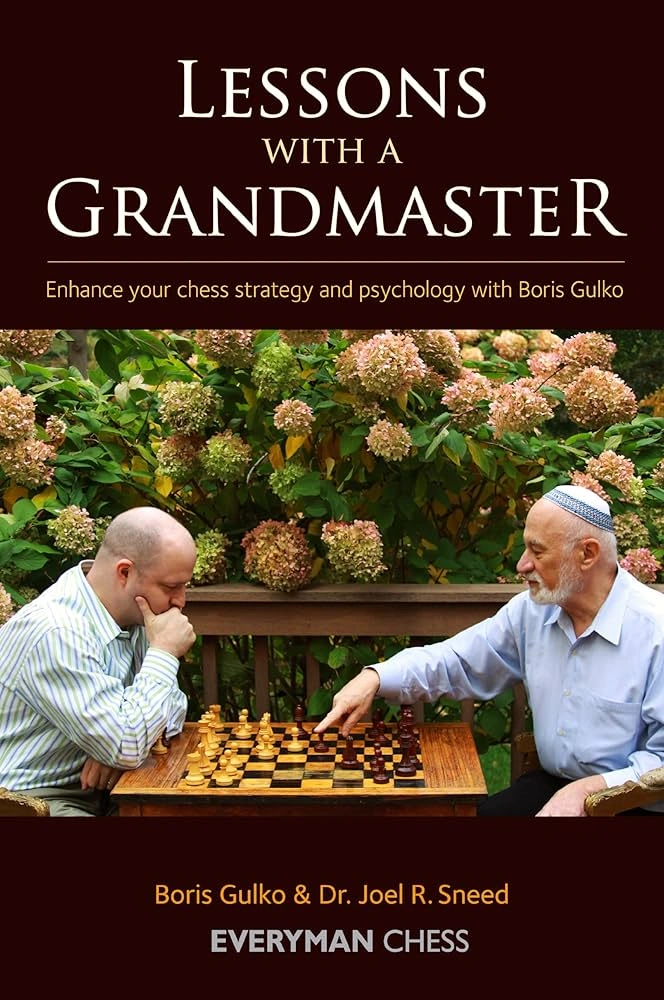
Most improving chess players today face the same problem: they rely too much on engines, yet struggle to truly understand positions over the board. Calculation improves, but clarity does not.
Lessons with a Grandmaster by Boris Gulko offers a completely different path. Instead of teaching you what move to play, it reshapes how you think about chess itself.
In this review, I break down how this book transformed my approach. From escaping the “analytical trap” to finally understanding piece harmony, planning, and prophylaxis, this is less about learning moves and more about learning how to think like a grandmaster.
The Analytical Trap: Why Engine-Based Thinking Holds You Back
In the silent, rigorous world of competitive chess, self-reflection is not merely a psychological luxury; it is a strategic imperative. For years, my progression was halted by what I now identify as the “Analytical Trap”—a narrow, almost suffocating reliance on engine-led calculation. In my “pre-Gulko” mindset, the sixty-four squares were less a battlefield of ideas and more a series of fragmented tactical puzzles. I would sit before my screen, watching the evaluation bar of Stockfish or Leela Chess Zero flicker, and mistake their cold, multi-million-node-per-second depth for actual chess wisdom. I could calculate a five-move forcing sequence, yet I remained fundamentally blind to the subtle, underlying coordination of pieces that makes such sequences possible. My understanding was atomized; I saw the moves, but I did not see the game.
This amateur struggle—the frantic search for a “best move” without a “best plan”—is the very malaise that Joel Sneed brings to the table in his collaboration with Grandmaster Boris Gulko. Sneed’s initial questions mirror the confusion of any dedicated student: “Can I win a pawn here?” or “What happens if I take on d5?” These inquiries treat chess as a sequence of isolated, material transactions. By viewing the game through this lens, the amateur fails to grasp the continuous narrative—the thread of logic that binds the opening’s first pawn push to the final resignation in the endgame. Discovering the dialogue format of Lessons with a Grandmaster felt like finding a Rosetta Stone. It promised a bridge between my chaotic, engine-dependent confusion and the crystalline, strategic clarity that defines a Grandmaster’s intuition.
Inside the Book: The Power of the Grandmaster–Amateur Dialogue
The pedagogical effectiveness of the Socratic method remains unmatched for the adult learner. Unlike a dry manual of variations, Lessons with a Grandmaster functions as a simulated apprenticeship. For those of us who came to the game later in life, the brain does not absorb patterns with the effortless plasticity of a child prodigy. We require logic; we require a “why.” This book provides exactly that by allowing us to eavesdrop on a conversation between two distinct archetypes. Joel Sneed serves as our “everyman proxy,” the brave amateur whose questions are often tactical and concrete. He represents the voice of our own calculating anxiety. Boris Gulko, conversely, is the “philosopher-warrior,” a man who survived the Soviet chess machine and emerged with a style defined by strategic depth rather than brute force.
Gulko’s role is to dismantle Sneed’s (and by extension, our) obsession with “finding the move” and replace it with “understanding the position.” This is not a subtle shift; it is a total cognitive restructuring. One particular exchange from Game 1 (Gulko vs. Bareev, 1991) illustrates this beautifully. Sneed, eyeing a tactical opportunity, pushes for a concrete variation involving 23…Nxd5, hoping to exploit a perceived weakness. Gulko’s response is a masterclass in the “understanding over calculation” philosophy:
Sneed: “I’m looking for a tactical solution here. Is there a sequence that wins a pawn or gains an advantage?”
Gulko: “You are looking for a result before you have created the conditions for it… In chess, the most important thing is the harmony of your pieces. If your pieces are in harmony, the tactics will find themselves. You must not look for a move; you must look for the right way to place your pieces.”
This interaction represents the core of Gulko’s ethos. He does not refute Sneed with a twenty-move variation; he refutes him with a principle. This realization forced me to reconsider my own habit of “fishing” for tactics in positions where my pieces were scattered and my coordination was lacking. The methodology of the book moves the reader away from the “what” and toward the “how” of Grandmaster thinking, shifting the focus to the broader thematic arcs of the game.
Opening to Middlegame: Finding a Plan Instead of Moves
In my earlier play, the transition from the opening to the middlegame was a bridge to nowhere. I would diligently follow theoretical lines—perhaps a Main Line Catalan or a standard Nimzo-Indian—reaching move twelve or fifteen with a “theoretically equal” position, only to find myself utterly adrift once the “book” ended. I realized that I was treating the opening as a memorized sequence rather than a “preparation for battle.” Gulko insists on the “So What?” factor: if you play 1. d4 and 2. c4, you must understand the specific middlegame tension you are inviting. You are not just putting pawns in the center; you are defining the geometry of the coming struggle.
Nowhere is Gulko’s sense of “piece harmony” more evident than in his game against Jóhann Hjartarson (Biel, 1987). In this encounter, Gulko utilizes a refined English/Catalan setup. The technical maneuver that reshaped my thinking occurred around move 11. While an amateur (and Sneed) might look for immediate contact, Gulko played the prophylactic 11. Nd2!, followed by 12. Nc4. This rerouting of the Knight from f3 to d2 and then to c4 wasn’t about an immediate threat; it was about the long-term control of the d6 and e5 squares. By rerouting the piece, Gulko harmonized his entire army, turning a “good” square (f3) into a “vital” one (c4). This shifted my thinking from “finding the best move” to “finding the right plan.” Through this lens, I identified three Opening Errors that had plagued my play:
- The Error of Theoretic Blindness: Memorizing 15 moves of the Gruenfeld without understanding the “So What?” of the resulting d-pawn tension.
- The Error of Premature Tension Release: Trading a Bishop for a Knight just to “do something,” thereby surrendering the long-term advantage of the Bishop pair.
- The Error of Static Piece Placement: Leaving a Knight on f3 because it “looks right,” rather than rerouting it to d2-c4 to exert pressure on a specific pawn structure.
Middlegame to Endgame: How Strong Players Convert Advantages
As the game deepens, Gulko introduces a concept that is often neglected by amateurs: “the endgame begins in the middlegame.” We often view the endgame as a separate phase—a dry, technical exercise—but Gulko demonstrates that the seeds of a technical win are sown much earlier. He distinguishes between a “technical win,” which might involve a theoretical knowledge of the Lucena position, and a “practical struggle,” which involves converting a structural advantage into a win.
A prime example is Gulko’s game against Alonso Zapata (1988). Here, Gulko demonstrates the art of conversion in a complex transition. He emphasizes the role of the active King and the integrity of the pawn structure. In my “pre-Gulko” days, I would have traded pieces indiscriminately, hoping a simplified position would be easier to play. Gulko teaches the opposite: one must be mindful of which pieces remain. In the transition phase, the King must cease being a liability and become a protagonist. In the Zapata game, the way Gulko uses his King to support the pawn advance, while simultaneously restricting the opponent’s counterplay, illustrates a level of foresight I previously lacked. I learned to stop seeing the endgame as an afterthought and started seeing it as the logical culmination of a superior middlegame structure.
Prophylaxis Explained: Thinking About Your Opponent’s Plans
If there is one concept that defines high-level chess, it is prophylaxis—the art of preventative thinking. This was the most significant change in my cognitive approach. Gulko demands that the player constantly ask: “What does my opponent want?” This sounds simple, but in the heat of a struggle, the amateur is usually too busy asking “What do I want?”
Analyzing the concept of “preventing the opponent’s ideas” transformed my play style from reactive to “actively restrictive.” I began to look for moves like Kh1 or a3—not because I had nothing else to do, but because those moves removed the tactical oxygen from my opponent’s plans. I stopped waiting for my opponent to play …d5 or …f5 and started making moves that made those breaks structurally impossible.
| Active Strategy (Prophylaxis) | Passive Reaction |
|---|---|
| Identifying Potential Breaks: Analyzing if the opponent can achieve …d5 or …f5 and positioning pieces to neutralize the impact of those moves. | Ignoring Structure: Focusing only on your own attacks until the opponent’s pawn break suddenly collapses your center. |
| Improving the “Worst Piece”: Recognizing that a Knight on a1 or a Bishop blocked by its own pawns is the biggest threat to your safety. | Tactical Fishing: Searching for a “miracle” sacrifice in a position where your coordination is fundamentally broken. |
| Consolidating Before Attacking: Using moves like Kh1 or Re1 to remove your King from a potential check or a diagonal before launching an offensive. | Premature Aggression: Launching an h-pawn storm while your own center is unstable and your King is uncastled. |
| Maintaining Tension: Keeping the pieces in contact to force the opponent into a decision they are not ready to make. | Simplifying Early: Releasing the tension because the complexity of the position causes psychological discomfort. |
Tactics Reframed: Why They Come from Good Positions
One of the most profound realizations Gulko offers is that tactics are often the “symptoms” of a strategic disease. Amateurs treat tactics like lightning bolts—random, unpredictable events. Gulko argues that a tactical blow is the natural consequence of well-placed pieces. If your pieces are in harmony and your opponent’s are not, the tactics will inevitably appear. This changed my destructive habit of “fishing” for combinations in equal or inferior positions. I learned that if the strategy is sound, I do not need to “force” a tactic; I only need to wait for the position to ripen.
Gulko speaks eloquently of the “aesthetic beauty” of a tactical finish, but he always grounds that beauty in logic. He notes:
“A combination is not a lightning bolt from a clear sky; it is the natural consequence of a healthy position. The beauty of chess is the triumph of logic over chaos.”
In studying his tactical finishes, I noticed they were never “lucky.” They were the final punctuation marks on long, reasoned strategic arguments. This shift in perspective meant that I stopped looking for “magic” and started looking for “harmony.” When I finally found a tactical shot in my own games—such as a thematic exchange sacrifice on c3 to shatter a King’s cover—it felt less like a discovery and more like an inevitability.
The Psychological Battle: Fear, Pressure, and the Will to Win
Chess is a human struggle, and Boris Gulko’s background as a Soviet Champion and political dissident informs his “chess-as-life” philosophy. His life was defined by resilience against a repressive system, and he carries that same “will to win” to the board. He understands the psychological “weight” of the move—the way the clock and the ego can distort a player’s judgment.
The book helped me diagnose several psychological errors. I realized I was “playing the rating”—deferring to higher-rated opponents and playing with a reckless arrogance against lower-rated ones. Most importantly, I identified the “fear of the win.” This is the paralysis that sets in when you finally achieve a winning position and the pressure of not “messing it up” becomes greater than the pressure of the game itself. Gulko’s stoicism taught me to focus on the objective requirements of the position rather than my emotional state. Whether winning or losing, the question remains the same: “What is the best move for the pieces?”
What Changed in My Game After This Book
Synthesis is the final stage of any true transformation. Looking back at my play before I absorbed the lessons of Gulko and Sneed, I see a player who was essentially speaking a foreign language without knowing the grammar. I had the vocabulary of moves—I knew what a “Skewer” was, I knew the “Fried Liver Attack”—but I lacked the syntax of strategy. I was calculating variations like an old engine, brute-forcing my way through sequences without understanding the soul of the position.
The transformation I have experienced is not one of raw calculating power; if anything, my brain tires more easily now than it did in my twenties. Instead, it is a transformation of perspective. I have moved from a frantic, tactical search to a calm, conversational engagement with the board. When I sit down for a tournament game now, the “cacophony” of move-searching has been replaced by a quiet, central inquiry: “What is the nature of this position, and how can I bring my army into a state of harmony?”
The impact of this book is most evident in the way I handle the transition from the opening. I recently played a game where, following Gulko’s logic, I opted for a quiet rerouting of a Knight—Nf3-d2-c4—instead of a more aggressive-looking pawn push. My opponent, focused on tactical threats, ignored the maneuver. Ten moves later, my Knight sat on c4, paralyzing their entire queenside development. The tactic that eventually won the game was a simple “symptom” of that Knight’s strategic placement. I didn’t have to calculate twenty moves ahead to see the win; I only had to trust the principle of piece harmony.
However, the struggle remains. Chess is inherently difficult, and my tactical blind spots have not vanished. I still miss the occasional “hanging piece” or misjudge the speed of a pawn race in a time scramble. But these are now isolated errors rather than systemic failures. My love for the game has deepened; it is no longer just an adrenaline-fueled search for a “gotcha” moment, but an intellectual appreciation for the logic of the struggle. Boris Gulko and Joel Sneed didn’t just teach me how to play better chess; they taught me how to think better chess.
Key Lessons from Lessons with a Grandmaster (Transformation Log)
Fundamental Shifts:
- Prophylaxis over Reaction: Transitioning from “What do I do about this check?” to “How can I prevent my opponent from ever giving this check?” Using moves like Kh1 to pre-emptively remove tactical targets.
- Piece Harmony over Isolated Strength: Evaluating a piece not by its theoretical value (the “3 points” of a Knight), but by its functional relationship to the rest of the forces. The Nd2-c4 maneuver as a paradigm for coordination.
- Understanding over Calculation: Prioritizing the “feel” and logic of a position over the brute-force search for variations. Moving away from the Stockfish-dependency trap.
- The Continuous Narrative: Viewing the game as a single, unfolding story where the opening dictates the middlegame, and the middlegame dictates the endgame.
- The “So What?” Factor: Every move must serve a specific strategic intention. If you play a3, you must know exactly what it achieves for your structure ten moves later.
Constants:
- The Will to Win: The fundamental drive to overcome the opponent remains the engine of the game.
- Tactical Vulnerability: The inherent human limitation in seeing every single concrete possibility remains part of the human struggle.
- Psychological Weight: The tension of the clock and the pressure of the tournament hall are ever-present realities that must be managed.
- Aesthetic Appreciation: The joy found in a clean, logical conversion or a perfectly executed prophylactic move continues to be the primary motivator for study.
Final Verdict: Is Lessons with a Grandmaster Worth It?
Lessons with a Grandmaster is a singular resource in the vast library of chess literature. It stands as a stand-alone resource for the “thinking player” rather than the “memorizing player.” By inviting us into the dialogue between an inquisitive amateur and a philosophical master, it strips away the mystery of the Grandmaster’s thought process. It teaches us that the secret to high-level chess is not more calculation, but better conversation—a deeper, more disciplined dialogue with the sixty-four squares. For any player trapped in the cycle of engine-led confusion, this book offers a path toward a more profound, narrative-driven understanding of the game. It transformed my play by fundamentally changing my mind.
Rating: 4.6/5
Guest Author: Dmitri Sokolov
If you’d like to dive deeper into Lessons with a Grandmaster, you can purchase the book through Forward Chess or Amazon.
Buying through these affiliate links comes at no extra cost to you.

AttackingChess Guest Contributors is a collective author profile representing chess enthusiasts, reviewers, coaches, and community members who contribute book reviews, insights, and educational material to the site.
Articles published under this profile may come from different writers with varying backgrounds in strategy, tournament experience, chess literature, and long-term training. All submissions are edited and fact-checked by the AttackingChess editorial team to ensure quality, accuracy, and practical value for readers.
This contributor profile is designed to give a voice to many chess lovers who want to share their perspectives without maintaining individual author accounts.