
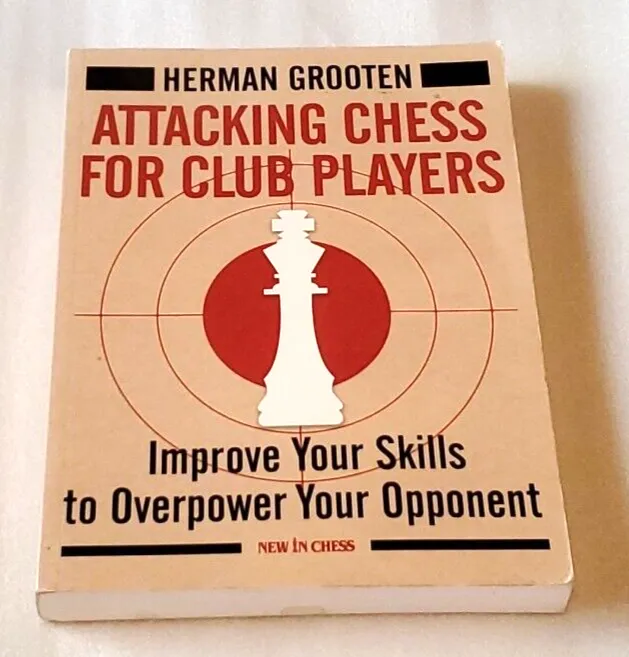
For any club player, the dream is the same: to craft a brilliant, decisive attack that leaves an opponent stunned and the scoresheet a work of art. We spend hours studying tactics and memorizing opening lines, all in pursuit of that moment when our pieces converge on the enemy king. It was with this familiar hope that I picked up Herman Grooten’s Attacking Chess for Club Players. This isn’t just another puzzle collection; Grooten, an experienced International Master and trainer, sets out with a more ambitious goal. He aims to forge not just a knowledgeable player, but a skilled one.
This review is the result of a cover-to-cover journey through Grooten’s work. My objective was to answer a single, critical question: Does this book truly live up to its promise of enhancing the skills – visualization, calculation, and strategic thinking – that transform a club player into a fearsome attacker? Or is it simply another volume of chess knowledge to be passively consumed? The answer, I discovered, lies in the book’s fundamental teaching philosophy, a philosophy that shapes every chapter and example.
The Grooten Philosophy
The true value of any chess instruction book lies in its underlying philosophy. Grooten establishes his from the outset, arguing that in chess, “knowledge has to be put into practice.” He directly challenges the common belief among players that improvement is a simple matter of accumulation. As he puts it, “Many chess players think that if they accumulate enough knowledge, they will automatically play better. If only that were true!” Grooten posits that this is a fallacy and that genuine progress comes from honing practical skills.
He grounds his approach in a respected pedagogical tradition, acknowledging the influence of the famous “Step-By-Step Method” developed by IM Cor van Wijgerden and Rob Brunia, a system renowned for its focus on skill development. For Grooten, abilities like visualizing a position several moves deep are paramount. A player with a “blurred image” in their mind has little chance of success, while one with a “sharper the image” will find the correct path. This skill-based philosophy is the foundational premise of Attacking Chess, and it provides the essential lens through which the book’s content and structure must be judged.
Deconstructing the Attack: A Systematic Review
Instead of presenting a disjointed collection of tactical fireworks, Grooten constructs a systematic and logical curriculum. The book is structured to build a player’s understanding from the ground up, moving from the foundational DNA of an attack to its complex application in real-world scenarios. This layered approach is the core of his method; he is not just showing you attacks, but forcing you to build the mental framework required to find them yourself, thus turning abstract knowledge into a replicable skill.
Building with Motifs and Cooperation
Grooten begins his instruction in Chapter 1, “Attacking motifs,” by stripping patterns down to their essential elements. He uses endgame studies and simplified problems to demonstrate tactical ideas in their “pure form.” His logic is compelling: if you can recognize a motif on a nearly empty board, it becomes far easier to spot it in a “more crowded position.
A perfect illustration is the beautiful mating pattern involving a bishop and knight where the enemy king is trapped by its own pieces. Grooten first presents this concept in a study, culminating in 6.♗e6#. He then shows a direct application in the game Goncalo Vasquez vs. Joao Matos, which ends in a nearly identical mate with 24.♗xd5#. Only after this foundation is laid does he present the more complex Kuzminykh-Taimanov position, where achieving the same pattern requires a brilliant queen sacrifice: 3.♕xd8+!!, leading to 4.♗xe6#. This pedagogical sequence is incredibly effective. Similarly, he introduces the concept of “breaking open the position” with the classic “Anastasia’s Mate,” demonstrating how a stereotypical queen sacrifice 1.♖1xd4! exd4 2.♕xh7+ ♔xh7 3.♖h5# can smash through the king’s pawn shield.
Exploiting Lines and Weaknesses
Having established the fundamental patterns, the book transitions in Chapters 3 and 4 to the strategic preconditions for an attack. Grooten methodically explains how to create and exploit the necessary weaknesses to launch an offensive. He dedicates significant analysis to the strategic value of open files, with a detailed discussion of the “attack on the king along the (half-)open h-file,” a concept familiar to every club player but rarely explained with such clarity. It’s the kind of chapter that makes you reconsider dozens of your own past games.
Furthermore, the section on exploiting weaknesses is exceptionally practical. Grooten provides a detailed breakdown of how to target the dark-square vulnerabilities that arise after a move like ...g7-g6. This focus on tangible, recurring pawn structures gives the reader a clear strategic roadmap to follow in their own games.
Stereotypes in the Opening
Perhaps the most valuable section for the tournament player is Chapter 5, “Stereotypical motifs in opening variations.” This chapter masterfully bridges the gap between abstract attacking theory and concrete, practical application. By grounding the book’s concepts in openings like the Sicilian Defense and the Evans Gambit, Grooten provides immediate, actionable takeaways. For a club player, seeing how a thematic sacrifice or mating pattern arises directly from an opening they play is invaluable. It transforms theoretical knowledge into a practical weapon.
Grooten’s systematic presentation of attacking concepts is impeccable, but the book’s ultimate value hinges on whether its training method can effectively forge these ideas into practical skills at the board.
The Training Method in Practice: An Honest Appraisal
A chess book can have a brilliant structure and fascinating content, but its true test is its effectiveness as a training tool. Does Grooten succeed in his mission to build practical skills and enhance a player’s ability to think at the board? For the most part, the answer is a resounding yes, though not without some minor qualifications.
Strengths: A Masterclass in Clarity and Engagement
The book’s greatest strength is the exceptional clarity of its explanations. Grooten understands that dumping long, computer-generated variations on a reader is counterproductive. He makes a conscious effort to “`translate’ [computer variations] into chunks that are understandable for the human mind.” His prose is a perfect companion to the moves on the board, providing the crucial “why” behind the “what” and guiding the reader’s thought process.
This clarity is amplified by Grooten’s wonderfully engaging, narrative writing style. He doesn’t just present games; he tells stories. The prime example is his detailed account of the Garry Kasparov vs. John van der Wiel game from 1981. He vividly recounts Kasparov’s intense psychological pressure, from flinging his opening novelty (8.Nc3!! and 9.e4!) onto the board “with a lot of ballyhoo” to the infamous “J’adoube!” incident where Kasparov adjusted the pieces on his opponent’s time. He even includes Kasparov’s witty retort to later criticism: “bad dancers always have problems with their balls.” This storytelling makes the chess lessons unforgettable. Similarly, the anecdote of the “Van Gelder trick” – a clever pin used by a wily club champion – embeds a practical tactical lesson within a memorable and relatable story. This is complemented by well-structured exercises at the end of each chapter, which are perfectly designed to train the skills of visualization and calculation that the book champions.
Potential Weaknesses and Limitations for the Club Player
In the spirit of a balanced review, it’s important to note a few potential limitations. Grooten himself admits, “we sometimes cannot avoid the occurrence of a multitude of variations.” While these dense lines are always instructive and relevant, they could be overwhelming for a player at the lower end of the club rating spectrum. In these moments, the book can feel more like a reference work for a stronger player than a step-by-step instructional guide for a developing one.
Furthermore, while the long anecdotes are a major strength in making the material engaging, a reader focused purely on cramming as many tactical patterns as possible in a short time might find them tangential. This is a minor point of taste, however, as for most, the stories will be a welcome and effective teaching device.
A Training Manual, Not a Puzzle Book
In the vast landscape of chess literature, Attacking Chess for Club Players carves out a unique and valuable niche. It is fundamentally different from the two most common types of attacking books: the puzzle collection and the dense theoretical manual. Unlike a puzzle book that presents tactical problems without context, Grooten’s work is a comprehensive training course.
His focus is not on just finding the right move, but on understanding the entire process of an attack. By emphasizing “search strategies,” visualization, and the methodical creation of weaknesses, he teaches the reader how to think like an attacker. It is a more holistic and demanding approach, but one that promises deeper, more lasting improvement for the player willing to put in the work.
The Final Verdict: An Essential Addition to the Club Player’s Library
Attacking Chess for Club Players is a remarkable achievement. Herman Grooten has crafted a book that delivers on its ambitious promise to build skills, not just impart knowledge. It is an indispensable guide for the serious club player who is no longer satisfied with merely memorizing patterns and wants to truly understand the art and science of the attack.
The ideal reader is the ambitious club player (roughly 1400-2200 Elo) who is serious about improvement and understands that true attacking prowess comes not just from memorizing patterns, but from learning how to think like an attacker. It is for the player who seeks not just knowledge, but the tangible skills that lead to immediate success at the board. The book’s primary strength is its systematic, skill-focused instruction, brought to life through crystal-clear explanations and wonderfully engaging examples. The minor caveat remains the density of some variations, which may require extra effort from players still solidifying their foundations. However, this is a small price to pay for the depth of wisdom contained within.
Rating: 4.5 / 5
This book has earned a permanent and prominent place on my shelf. It is more than an instruction manual; it is a true companion for any player on the quest to master the attack. I cannot recommend it highly enough.
Guest Author: Ethan Doyle
If you’d like to dive deeper into attacking play, you can purchase the book through Forward Chess or Amazon.
Buying through these affiliate links comes at no extra cost to you.

AttackingChess Guest Contributors is a collective author profile representing chess enthusiasts, reviewers, coaches, and community members who contribute book reviews, insights, and educational material to the site.
Articles published under this profile may come from different writers with varying backgrounds in strategy, tournament experience, chess literature, and long-term training. All submissions are edited and fact-checked by the AttackingChess editorial team to ensure quality, accuracy, and practical value for readers.
This contributor profile is designed to give a voice to many chess lovers who want to share their perspectives without maintaining individual author accounts.