
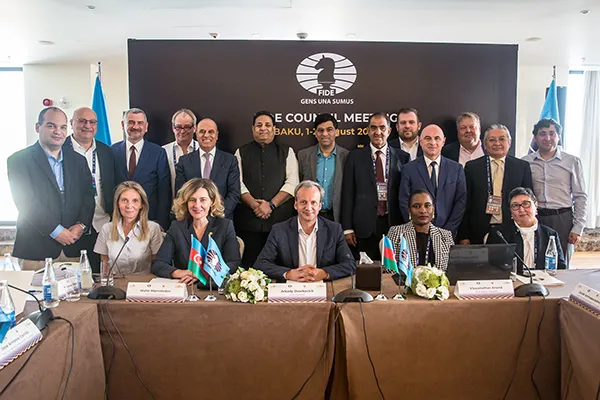
In December 14, 2025, the International Chess Federation (FIDE) General Assembly (GA) voted to lift sanctions against Russia and Belarus, allowing their national teams to return to international competition starting in 2026,. This decision has been met with significant procedural confusion and deep moral division within the global chess community, raising questions about FIDE’s role as an “ethical arbiter” of world events,.
The Original Sanctions Against Russia and Belarus
The initial exclusion of Russian and Belarusian national teams from FIDE events followed the start of Russia’s military action in Ukraine in 2022,.
The rationale for the initial sanctions was to align FIDE with the policies established by other major international sporting bodies. Specifically, the restrictions were set in accordance with the guidelines of the International Olympic Committee (IOC). These IOC guidelines generally recommend that Russian and Belarusian national teams should not be allowed to participate in international competitions.
Following the imposition of sanctions, FIDE had initially prohibited the hosting of tournaments in both Russia and Belarus. While the full exclusion applied to national teams and the use of national symbols, FIDE later permitted athletes from Russia and Belarus to compete in individual tournaments starting in March 2022, provided they participated under a neutral status. Critics noted that banning only the Russian flag while allowing individual players meant the initial response was the “most milquetoast action possible.
The December 14, 2025 General Assembly Decision
The possibility of lifting sanctions against Russia and Belarus was discussed and put to a vote during FIDE’s digital General Assembly on Sunday, December 14, 2025,. Ahead of the vote, the FIDE Council had already recommended that some restrictions be lifted,.
The vote at the General Assembly resulted in a narrow majority supporting the readmission of Russian teams. The final tally showed 61 delegates voting for acceptance (54.46%) and 51 delegates voting against (45.54%). An additional 14 countries abstained, and 15 countries did not participate or had their votes invalidated.
The sources indicate that the GA supported both a “full” and “partial” lifting of restrictions. The resolution that passed allows Russian teams to participate in team events beginning in 2026. One interpretation of the decision suggests the vote was to “lift all existing restrictions” and “allow players from the above-mentioned countries to participate in all FIDE events, both individual and team, using all national symbols”. However, it was also reported that after the vote to remove all restrictions, a majority also voted to allow Russians into all competitions under a neutral flag, suggesting potential ambiguity or a lack of finality,.
In the period leading up to the GA, the FIDE Council had made several recommendations for partial readmission, including allowing the return of adult men’s and women’s teams under a neutral flag, allowing FIDE tournaments to be held in Belarus, and allowing youth athletes and athletes with disabilities from Russia and Belarus to compete using their national symbols (flag, hymn, and coat of arms) without restrictions,. The Russian Chess Federation (FSHR), however, proposed a broader agenda item seeking the removal of all restrictions immediately, including the full return of national symbols for all players and the permission to hold FIDE tournaments in Russia,.
Controversies Surrounding the Vote
The decision to readmit Russian teams was immediately embroiled in controversy, primarily concerning procedural violations and general “chaos” during the assembly.
Claims of Illegality and Procedural Chaos
A primary source of friction was the use of a secret ballot. Critics claimed that FIDE breached its own statutes by holding the vote in secret. According to FIDE Statute 17.5, “All other decisions will be taken by open vote”. While the GA apparently voted to conduct the readmission vote by secret ballot, it was unclear if the assembly had the authority to override constitutional statutes through an ad hoc vote.
The situation was described as a “freaking clown show,” with the speaker for the council reportedly ignoring questions from two federations who pointed out that secret votes were unconstitutional. Furthermore, the outcome was muddled by the GA approving “two competing motions” to allow Russia to return, leading to confusion among officials on how to resolve the resulting contradictions.
Lack of Justification for Reversal
Opponents questioned the reversal of the ban, arguing that the underlying conflict—Russia’s invasion of Ukraine—had not ended,. Critics asked what had fundamentally changed since the initial expulsion to justify readmission, stressing that Russia has neither paid reparations nor apologized for the damage caused.
Diverse Interpretations and Perspectives
The FIDE decision brought forward several competing arguments regarding the intersection of sports, politics, and global conflicts.
Russian and Pro-Readmission Viewpoints
Those who supported the readmission felt that “justice was served”. A key argument was that international sporting organizations should not act as “ethical arbiters” of global conflicts,. This viewpoint maintains that all countries engaged in human rights violations should either be banned, or none should be banned, insisting on a categorical policy,. If FIDE bans Russia but not other nations like Israel or China, it is implicitly making a political “value judgement” about which conflicts are worse, which an ostensibly “apolitical” governing body should avoid.
The decision was seen by some as long overdue, arguing it was “about time we stop punishing chess players for things they have no control over”. Advocates for readmission stressed that athletes should not have their careers ruined for actions committed by their respective governments,. They argued that war has innocent victims, and creating more innocent victims—such as sanctioned athletes—out of spite is illogical, especially since banning chess players does “absolutely nothing of substance” to help Ukraine.
The Russian Chess Federation itself sought the complete removal of all “discriminatory restrictions,” appealing directly to the GA delegates rather than relying on the FIDE Council’s “half-heartedness”.
Criticisms Opposing the Reinstatement
Opponents of the decision condemned the move as “spineless” and “disappointing”,. They viewed the decision as potentially enabling Russian propaganda, allowing the government to use the move as proof that “world accepts everything they do”.
Critics argued that exclusion serves as a necessary “weapon against infinite war crimes”. They insisted that the situation involving Russia is clear-cut—an “unprovoked ongoing war of aggression, genocide and territorial expansion”—and should be treated accordingly. Furthermore, opponents noted that regimes often use sports to create an image of normalcy and push propaganda, justifying the need to “ostracize” nationals from the aggressor state,. Some worried about the possible propaganda leverage, such as a Russian team winning the Olympiad and posing for a photo with President Putin in an occupied territory.
The Norwegian and Nordic Chess Federations explicitly urged delegates to vote against the proposal, asserting that FIDE must protect the integrity of chess by following IOC guidelines that reject the participation of national teams. They suggested the proposal was an effort led by “Russian actors and their supporters”.
The Debate on Punishing Athletes
A persistent thread in the debate concerns whether individual athletes should be held accountable for the political actions of their country. Those against punishing athletes contend that most players are not responsible for the war and that opposing the government in Russia can endanger them and their families.
Conversely, some argued that not all athletes are innocent victims, noting that many are “regime supporters,” citing one prominent Russian player as an example of an “active supporter of Putin’s nazi regime”. Proponents of sanctions argue that even if it is not the athletes’ fault that the regime uses them for propaganda, they must still be denied the opportunity to provide that propaganda.
Comparisons with Other Global Conflicts
A central element of the controversy was the perception of selectivity and bias in FIDE’s sanctions, particularly in comparison to other world conflicts. Many participants questioned why FIDE had banned Russia but continued to allow countries such as Israel and the USA to participate in events,.
The Israel Comparison: The inclusion of Israel was repeatedly used to argue that FIDE’s stance was “morally ambiguous”. Some argued that if FIDE permits Israel, it must allow Russia, with one commenter stating, “You either had to reinstate Russia, or ban Israel”. Critics characterized the conflict involving Israel as a “clear cut case of genocide”,, and demanded that if FIDE is going to sanction based on geopolitics, Israel must also be excluded,,. However, some tried to differentiate the conflicts, arguing that while Russia’s invasion was “completely unprovoked,” Israel could “at least argue provocation”. This distinction itself was heavily debated and challenged,.
The USA Comparison: Several sources invoked historical US conflicts, particularly the invasion of Iraq, asking why American chess players were never banned following “brutal unprovoked wars” by the US,. The US was criticized for its actions in Iraq, Afghanistan, and potentially Venezuela, with critics suggesting that if FIDE sanctions Russia, it should also sanction the US,. One opinion posited that international institutions are often “run by western countries,” meaning condemnation will “always be political,” and the US will not face bans. This comparison highlights the concern that FIDE only shows outrage when conflicts affect North America or Europe.
The debate concluded that FIDE must decide whether sports authorities should be involved in political matters at all, and if so, when and how consistently they should apply sanctions across all countries engaged in conflicts or human rights violations,. The act of banning Russia while maintaining diplomatic silence toward other nations involved in conflict created an untenable position for the organization.

I’m a passionate board game enthusiast and a skilled player in chess, xiangqi and Go. Words for Attacking Chess since 2023. Ping me at Lichess for a game or chat.