
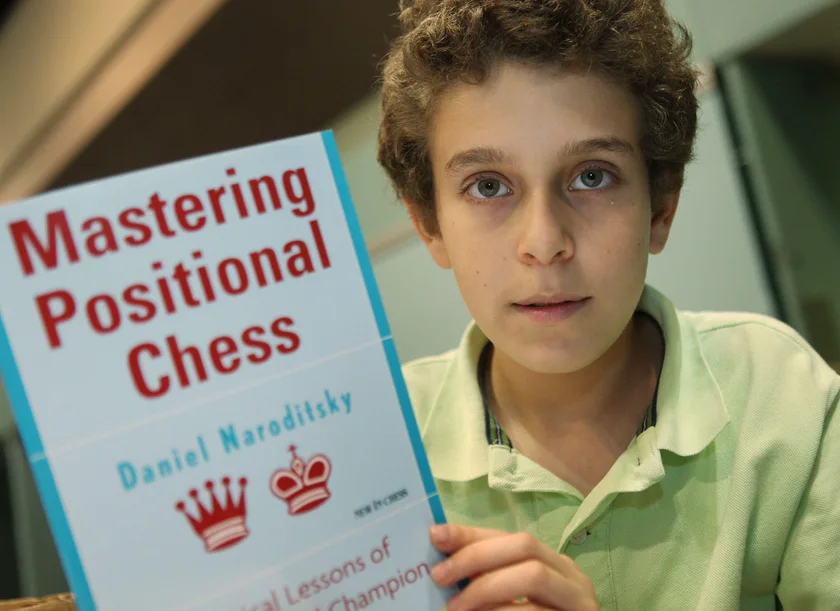
Few chess books gain new meaning with time, but Mastering Positional Chess has done exactly that. What once felt like the confident voice of a rising prodigy now carries a deeper resonance – an echo of a brilliant mind taken from the chess world far too soon.
To appreciate this book is to understand its extraordinary context. Daniel “Danya” Naroditsky was just 14 years old when it was published in 2010, making him one of the youngest authors in the long history of the game. He was a prodigy, a Junior World Champion, who chose to pause his own ascent to turn and share what he had learned. This act of generosity, captured in these pages, provided the world with its first glimpse of a pedagogical gift that, though tragically cut short, continues to influence and inspire players today.
Revisiting this work today carries a deeper and more painful weight. Since his passing, Danya is remembered not only as the young author of this book but as the beloved grandmaster. Reading these early pages now feels like hearing a brilliant voice preserved in time.
This book is not merely the foundation stone of that legacy; it is the philosophical blueprint, the Rosetta Stone that deciphers the entire teaching methodology that would later captivate millions. It is here, in his teenage prose, that we discover the DNA of his teaching philosophy: clarity, empathy, and an infectious passion for the game’s hidden beauty.
This review, therefore, is not merely an assessment of a chess manual. It is an exploration of the book’s pedagogical soul, an analysis of its emotional resonance, and a reflection on why, more than a decade later, it remains an essential and deeply human guide, made even more meaningful by the knowledge that it stands as one of the earliest chapters in a life and career that ended far too soon.
Wisdom Beyond His Years
To unlock the true value of Mastering Positional Chess, one must first appreciate the unique perspective of its author. The book’s instructional power is inextricably linked to the remarkable character of the young man who wrote it. It is his voice that transforms a series of lessons into a compelling narrative.
In the Foreword, IM John Donaldson makes a crucial observation: despite coming of age in a computer-centric era, Daniel’s approach was “decidedly ‘old school’, learning as much from books as from computers.” This choice is the key to the book’s enduring appeal. Where many modern texts can feel like a dry recitation of engine lines, Naroditsky’s work is rooted in human understanding. He prioritizes explanations over variations, logic over raw calculation. He is not teaching you to mimic a machine; he is teaching you how to think for yourself.
This empathy for the reader shines through in his own words. In the Introduction, he states his simple but profound goal:
“Apart from packing this book with a multitude of great positional ideas, I have tried to make it as enjoyable and readable as possible. After all, the purpose of reading a chess book is not only to learn from it, but to enjoy it as well!
This single sentence reveals a maturity far beyond his 14 years. It is a promise to the reader that their time and effort will be respected, that the journey of learning will be a shared and pleasurable one. This candor and humility, a refreshing counterpoint to the dogmatic tone of many classic manuals, create an immediate bond of trust.
It is impossible not to draw a direct line from the skills on display here, the structured thinking, the accessible language, the engaging narrative style to the celebrated commentator he later became, and whose absence the chess world still feels profoundly. This book was the first public flowering of his immense teaching gift, an early and definitive statement of his ability to make the complex clear and the difficult beautiful. The author’s unique voice is the thread that weaves the entire work together, guiding the reader through its thoughtful structure.
A Guided Tour Through the Positional Landscape
The book is structured not as a dry encyclopedia but as a progressive journey through the most sophisticated and often misunderstood elements of positional play. Each chapter builds logically upon the last, taking the reader from the foundational art of prevention to the creative heights of strategic sacrifice. We will now walk through this curriculum, exploring the core of Naroditsky’s instruction.
Chapter 1: Prophylaxis – The Art of Thinking Ahead
Naroditsky begins with prophylaxis, the concept he correctly identifies as the cornerstone of positional mastery. He defines it as the crucial skill of anticipating and neutralizing an opponent’s plans before they can even materialize. It is the art of asking not just “What is my best move?” but “What does my opponent want to do?”
He illustrates this with a classic example from Fischer-Donner (Varna Olympiad, 1962), where he distills the grandmaster’s thought process into a single, revolutionary question for the developing player:
“If it were Donner’s move, what would he do?”
This simple query is a paradigm shift. It forces the student to see the board from both sides, to move beyond their own ego and engage with the logic of their opponent. It is the most important question in positional chess, and Naroditsky places it on a pedestal in the opening pages.
If one didn’t know Black’s threat, this move would seem winning. White’s rook will be deadly if it goes to g4. However, after Black’s next move, the tables will be turned.
Instead, White could have played the instructive 1.Qg3+ Kh7 2.h5!. Now, 2…f5 is impossible because of 3.Qg6 mate. Only after 2.h5 will White play Rd4–g4, and his attack will probably be unstoppable.
In the brilliant Karpov-Timman game, we see this principle in action with the “quiet” but devastating move 22. Qd2-c2!!, a subtle repositioning that completely demolishes Black’s plan.
While the concept is foundational, the examples are deep and require concentration. This is not a chapter to be skimmed lightly. It demands patient study, but the reward is a fundamental rewiring of one’s chess intuition, moving from reactive play to proactive control. This focus on preventing threats provides a natural transition to the next topic: how to react when they’ve already appeared.
Chapter 2: Defense in Worse Positions – Finding Hope in the Darkness
This chapter is perhaps the book’s most human and valuable contribution. While countless manuals celebrate the art of attack, very few give proper attention to the grim reality of defense. Naroditsky addresses not just the technical, but the emotional and psychological challenge of playing a difficult position. He understands that defense is a test of character as much as a test of calculation.
His approach is marked by a powerful vulnerability. He doesn’t just show examples from the great masters; he includes his own painful losses and difficult struggles. By sharing his own moments of doubt and error, he makes the lessons intensely relatable. He is not a distant authority figure, but a fellow traveler who understands the sinking feeling of a worsening position.
At the end of the chapter, he summarizes the key lessons. One rule, in particular, captures the spirit of his instruction:
“Never give up; even in completely losing positions, look for moves that create the biggest practical difficulties for your opponent.”
This is not just chess advice; it is a lesson in resilience. It teaches the reader that even in the bleakest circumstances, there is value in making your opponent work for the victory. This philosophy of stubborn resistance connects directly to the next theme: the art of creating a position so resilient it becomes unbreakable.
Chapter 3: Building and Breaking Fortresses – The Art of the Impasse
Here, Naroditsky explores the concept of the fortress, a strategic impasse where a player with a material disadvantage can secure a draw by creating an unbreakable defensive perimeter. It is a critical saving resource in endgames and a strategic goal that requires immense precision from both sides.
His pedagogical method is wonderfully balanced. He begins with clear, study-like endgame positions to introduce the core mechanics before moving to complex, practical examples, including a tense battle from his own career (Schemm-Naroditsky). This blend of the theoretical and the practical ensures the reader understands both the “how” and the “when” of fortress play.
He also delves into the psychological warfare involved – the patience required to probe a fortress for weaknesses, and the mental fortitude needed to avoid becoming demoralized when defending one. A key takeaway from his summary highlights the creative thinking required, noting that sacrificing the queen for a few minor pieces is a great technique for saving a game. This counter-intuitive advice perfectly encapsulates the theme. From the defensive ingenuity of the fortress, the book logically pivots to a more proactive and aggressive strategic weapon: the positional sacrifice.
Chapter 4: Positional Sacrifice – Giving to Get More
This chapter tackles one of the most profound and difficult subjects in chess. Naroditsky carefully differentiates the positional sacrifice from a standard tactical combination that leads to immediate material gain or mate. He demystifies this high-level concept by providing a clear and accessible framework.
He proposes that the usual goals of a positional sacrifice are threefold:
“A. Acquire a significant space advantage and simultaneously cramp your opponent’s pieces; B. Create a position in which the opponent’s pieces and pawns will be inefficiently placed; or C. Achieve dynamic compensation in various forms.”
This simple structure is a godsend for the club player. It provides a logical checklist for evaluating a potential sacrifice, turning a seemingly mystical art into a practical strategic tool. The chapter is filled with stunning examples where a small investment of material unlocks a long-term, decisive advantage.
The sheer volume and complexity of the examples, however, make this one of the most challenging sections of the book. The variations can be long and demanding, requiring a high level of calculation to fully appreciate the author’s points. It is a chapter that rewards deep study and is best absorbed over multiple readings. Ultimately, the goal of many such sacrifices is to induce the state of ultimate positional dominance discussed next.
Chapter 5: Paralysis in the Middlegame – Winning Without a Fight
Naroditsky presents paralysis as the pinnacle of positional chess. It is a state of total domination where the opponent, though not in checkmate, is strategically dead. They have pieces on the board but no useful moves to make. Every potential action either worsens their position or is impossible to execute.
He wisely opens the chapter with the immortal Sämisch-Nimzowitsch game from 1923, the quintessential demonstration of paralysis in action. This classic example grounds the reader in the theme before exploring its more subtle applications. In his annotation, Naroditsky’s literary flair comes to life. Describing the position after just sixteen moves, he imagines a mural titled “The Triumph of the Black Forces”, observing that every single white piece is already located in the worst possible place. This vivid description captures the essence of brewing paralysis long before the final move is played.
The brilliance of this chapter lies in its subtlety. It teaches the player not just to execute a final paralyzing blow, but to recognize the subtle signs of its development. Naroditsky trains the reader’s eye to see the long-term potential in restricting enemy pieces, transforming paralysis from a happy accident into a deliberate strategic objective. From this state of static dominance, he transitions to the dynamic art of achieving it.
Chapter 6: Maneuvering – The Quiet Dance of the Pieces
The final chapter is dedicated to maneuvering—the patient, quiet, and often subtle art of improving the placement of one’s pieces. Naroditsky presents it as the engine that drives every other positional concept. Without skillful maneuvering, a player cannot prepare a prophylactic defense, consolidate after a positional sacrifice, or build the pressure that leads to paralysis.
This chapter serves as a masterful conclusion, tying together all the preceding themes. It is through the slow dance of maneuvering that small advantages are accumulated, gradually building towards a position ripe for one of the decisive strategic blows covered in earlier chapters. Mastering the art of doing “nothing” productive—of simply improving one’s position move by move while awaiting the opportune moment—is what separates the master from the amateur.
This chapter feels like a fitting end, as it perfectly embodies the patient, profound, and “old-school” approach to chess improvement that the author himself so clearly championed. It is a final reminder that in chess, as in life, the most powerful results often come not from sudden bursts of action, but from quiet, consistent, and thoughtful preparation.
Why This Book Endures
A great chess book does more than teach moves; it reshapes a player’s entire thought process. Mastering Positional Chess is such a book. Its lasting impact is not just in the specific knowledge it imparts, but in the new lens through which it teaches you to see the game.
This book is best suited for the intermediate to advanced player—someone who has a solid grasp of tactics but finds themselves adrift in the middlegame, unsure of how to formulate a long-term plan. For this audience, Naroditsky’s work is a revelation. It provides a structured way of thinking about strategy that feels both intuitive and revolutionary.
Reading this book changes one’s perception of chess. The game is transformed from a frantic search for tactical tricks into a deeper appreciation for logic, psychology, and art. One begins to find beauty in a quiet defensive move, to feel the power in a patient maneuver, and to understand the slow accumulation of advantages as a creative act. It fosters a more mature and profound relationship with the game.
In a crowded field of excellent strategy manuals, Mastering Positional Chess stands apart. It possesses a unique and irreplicable combination of a prodigy’s raw insight, a master’s clarity, and a teenager’s earnest and relatable voice. The book is infused with the brilliant, generous, and deeply human spirit of its young author, and that is why it remains not just instructive, but inspirational.
Conclusion: A Five-Star Masterpiece
Mastering Positional Chess is a triumph of chess pedagogy. Its primary strengths lie in the profound accessibility of its lessons, the author’s uniquely empathetic and brilliant voice, and its timeless relevance to any player seeking to deepen their strategic understanding. It takes complex, master-level concepts and renders them intelligible and actionable for the aspiring student.
The gentle critiques – the density of some chapters and the occasional high calculational demands – are not flaws but rather indicators of the book’s ambition and depth. This is a serious work for the serious student, and it rewards the effort it demands with a genuine and lasting improvement in one’s play and appreciation of the game.
Ultimately, this book is a five-star achievement because it succeeds on every conceivable level. It is a first-rate practical guide to improvement. It is a work of profound chess instruction that stands with the classics. And most importantly, a beautiful and lasting testament to the mind of a young genius who gave so much to the game he love and whose legacy continues to shape players even after his untimely passing.
Rating: 5/5.
Guest Author: Ethan Doyle
By purchasing this book, you’re not only enriching your own chess understanding but also directly supporting Daniel Naroditsky’s family and helping preserve his legacy.

AttackingChess Guest Contributors is a collective author profile representing chess enthusiasts, reviewers, coaches, and community members who contribute book reviews, insights, and educational material to the site.
Articles published under this profile may come from different writers with varying backgrounds in strategy, tournament experience, chess literature, and long-term training. All submissions are edited and fact-checked by the AttackingChess editorial team to ensure quality, accuracy, and practical value for readers.
This contributor profile is designed to give a voice to many chess lovers who want to share their perspectives without maintaining individual author accounts.