
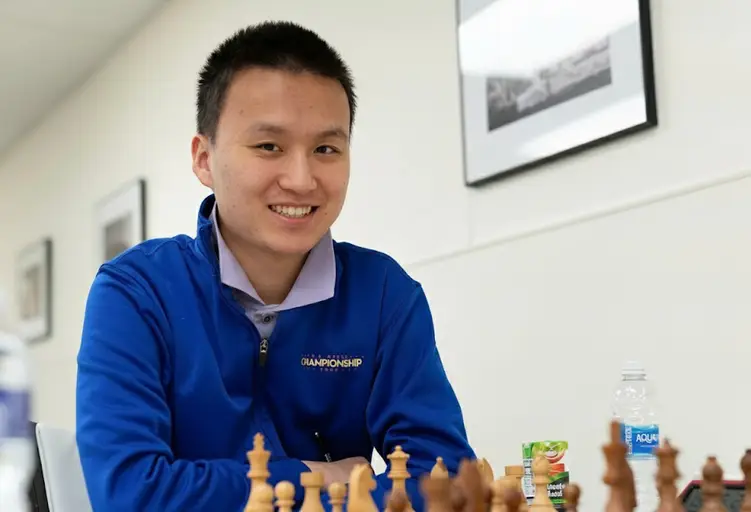
On January 17, 2026, American grandmaster Christopher Woojin Yoo officially becomes eligible to return to FIDE-rated tournament play, marking a significant and closely watched moment in modern chess. The 19-year-old prodigy’s comeback follows more than a year of suspensions, investigations, and disciplinary proceedings related to serious violations of the FIDE Ethics and Disciplinary Code.
Yoo enters this day with his chess credentials firmly established. Born in December 2006 in Fremont, California, he rose at an extraordinary pace. He became the youngest International Master in U.S. history at age 12 in 2019, a record later surpassed, and secured the grandmaster title in 2021 after earning his final norm and crossing the 2500 rating threshold. By his late teens, Yoo had won the U.S. Junior Championship, the U.S. Masters, and defeated elite players including Wesley So in classical competition. As of January 2026, his FIDE rating stands at 2607, placing him among the strongest junior players in the world.
Yet Yoo’s career trajectory was abruptly derailed in 2024 and 2025 by a series of disciplinary cases. In October 2024, during the U.S. Chess Championship in St. Louis, Yoo was disqualified after physically assaulting a female member of the broadcast team following a loss. The incident led to a one-year suspension by the U.S. Chess Federation, later recognized and enforced internationally by FIDE, along with a longer probationary period. That sanction alone sidelined him from top-level competition through November 2025.
A second, separate case emerged in 2025, when a female player filed a complaint with the FIDE Ethics and Disciplinary Commission (EDC). She alleged repeated harassment and inappropriate conduct by Yoo during international tournaments in Germany and Italy in 2024. According to the EDC’s findings, Yoo followed the complainant persistently at tournament venues, made unwanted physical advances, waited outside her hotel room, and shared a misleading image on social media suggesting a romantic relationship. Multiple witnesses corroborated her account, and private messages submitted as evidence included demeaning and inappropriate language.
On July 17, 2025, the EDC ruled Yoo guilty of multiple violations, including harassment, psychological abuse, and sexually inappropriate behavior. He was handed an 18-month ban from FIDE-rated events, with 12 months suspended. As a result, Yoo was required to serve six months immediately, while the remaining 12 months were converted into a probationary period. Crucially, the EDC specified that any further misconduct of a similar nature during probation would activate the full suspended sanction.
Because this six-month active ban ran concurrently with the tail end of his earlier suspension, January 17, 2026, became the first date on which Yoo could legally return to international competition. Today’s eligibility therefore represents the formal end of all active playing bans imposed by FIDE.
In its ruling, the EDC emphasized a key principle that continues to resonate today: in cases of harassment, intent is less important than impact. The commission stated clearly that harm is measured by the effect on the victim, not by whether the accused intended to cause distress. The panel also highlighted the particular vulnerability of competitive chess environments, where psychological safety is essential to fair play and performance.
The commission acknowledged mitigating factors presented by Yoo’s defense, including his age, cooperation with the investigation, expressions of remorse, and medical documentation indicating that he has been diagnosed with autism. However, it concluded that these factors did not negate responsibility for the conduct itself. The EDC further noted that this was the second instance in which Yoo had been found guilty of misconduct involving a female individual, treating the earlier 2024 incident as an aggravating factor when determining sanctions.
As Yoo returns today, he does so under strict probationary conditions. For the next year, any breach of the FIDE Ethics and Disciplinary Code—particularly involving harassment or inappropriate conduct—could result in the immediate activation of the remaining 12-month ban. FIDE officials have made clear that the sanctions and probation periods are designed not only to punish past behavior but also to prevent future harm.
Reactions to Yoo’s return are mixed. Some within the chess community focus on his undeniable talent and potential, noting that he remains one of the strongest American juniors and a player capable of competing at elite levels. Others emphasize that his reinstatement does not erase the seriousness of the findings against him. For the complainant in the 2025 case, the decision represented acknowledgment of wrongdoing, even if the timing of the sanction was disappointing. She expressed hope that the disciplinary process would help prevent more severe consequences in the future.
Organizations such as the Women in Chess Foundation have also played a visible role in this chapter, supporting the complainant and underscoring the importance of safe play policies. Their involvement reflects a broader shift within chess toward more structured responses to misconduct, particularly in international tournament settings.
Today, January 17, 2026, Christopher Yoo is once again a legally eligible competitor. Whether he chooses to return immediately to tournament play or takes additional time away remains to be seen. What is clear is that his comeback unfolds under unprecedented scrutiny.

I’m a passionate board game enthusiast and a skilled player in chess, xiangqi and Go. Words for Attacking Chess since 2023. Ping me at Lichess for a game or chat.