
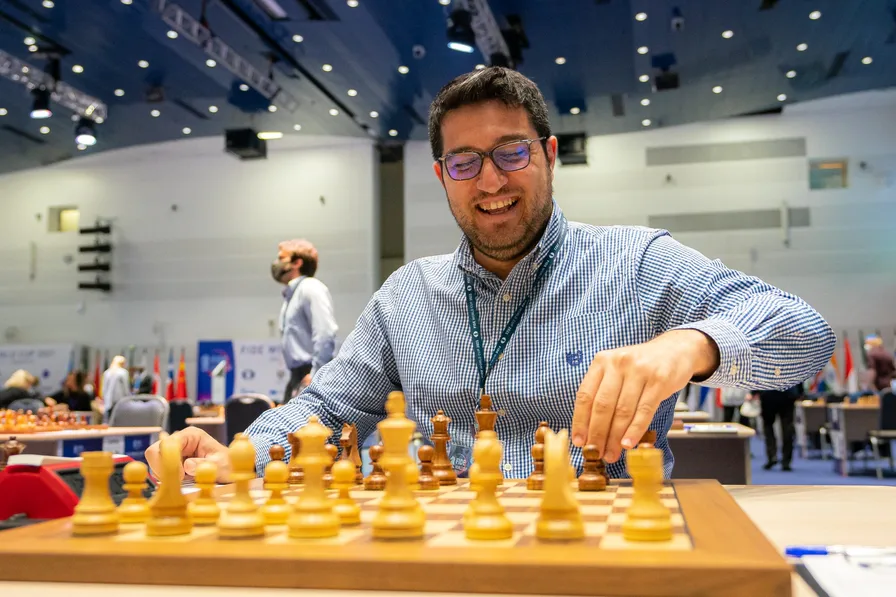
In December 2025, I came across a post by GM Vasif Durarbayli that stood out from the usual chess discourse. In the post, he was talking about the state of chess apps and open-source platforms, offering a perspective that was both direct, slightly unpopular and thought-provoking.
For this interview for AttackingChess, I sent him a series of questions on chess, technology, and the future of the game. His responses are presented below in his own words.
Table of Contents
First things first, a quick introduction to him.
Who is Vasif Durarbayli?
Vasif Durarbayli is a two-time Azerbaijani National Champion, a top-16 finisher at the FIDE World Cup, and a grandmaster with a peak rating of 2638.
His Chess Career
Over two decades, he rose through the ranks of Azerbaijani chess, no minor achievement in a country where the game holds deep cultural significance.
He is still the youngest player to represent Azerbaijan at the Chess Olympiad, debuting at age 14, and has since secured two national titles.
Pausing Chess to Build a Company
In a move uncommon among elite players, Durarbayli stepped away from a full-time competitive chess career during his peak years to focus on broader initiatives beyond the board.
Rather than signaling a departure from the game, the decision reflects an effort to explore how chess is experienced by audiences, particularly in an increasingly digital and broadcast-driven landscape.
Aside from chess coaching, he is currently involved with ChessEver, a platform centered on live chess event coverage.
As a direct result, he is now the CEO of ChessEver, an app that aims to be the go-to chess broadcast app for serious chess fans.
The Interview
The conversation covers his playing career, perspectives on elite competition, and his views on the growing structure of professional chess.
Early Life & Chess Origins
Growing up in Azerbaijan, how much do you think your environment shaped the player you became?
I strongly believe in environmental factors. If that wasn’t the case, how come Azerbaijan, with a population of 10 million, reached the top 5 countries on FIDE’s list in 2010 and has been around the top 10 for much longer?
Every household has a chess set. People play chess in the street. I remember whenever I went to my aunt’s apartment, there was a street vendor nearby. I would approach him and play chess until I became too strong for him.
Who were the biggest influences on your chess development, and is there a game or moment that defined your career?
My biggest influence was my father, who was critical of me and always pushed me to my limits. He also did everything in his power to get me external support. Traveling for events is expensive, and our financial situation wasn’t there.
Luckily, my government had programs that supported upcoming talents, which my father kept pursuing, and it helped me a lot.
I think my second-place finish in the Azerbaijan Championship in 2006 was the defining moment. I qualified for the national Olympic team at 14, which is a record that still hasn’t been broken.
The experience on the team helped me immensely, and within six months, I became an International Master and went up from there.
The Mind of a Grandmaster
What does it feel like to sit across from the world’s best players? Is there a mental dimension to elite chess that outsiders rarely appreciate?
You must believe that you are capable of beating the person sitting across from you. Without belief, it is hard to compete.
I feel like Magnus Carlsen’s domination has something to do with this, as most of his opponents often don’t believe they can beat him.
Though, to be fair, you must have the necessary skills. Without skills, belief is nothing.
What separates a good player from a truly great one? Is it talent, work ethic, or something else entirely?
Actually, between good and great players, there isn’t some mind-blowing difference. It’s simple.
A great player just does everything a bit better than a good one. Becoming a great player is extremely hard, and it needs a combination of everything.
Work ethic (probably the biggest talent), environment, good coaches, parents, and monetary support. Basically, all the necessary pieces should be landing on the right squares.
Chess has exploded in popularity in recent years, driven largely by streaming and social media. As a Grandmaster, how do you feel about the direction the game is heading culturally?
I am happy to see this. Chess deserves this attention. The only thing I don’t like is that open events are not getting better overall.
Prize funds haven’t kept up with the growth in popularity, and sponsorship money mostly flows to the top.
If broadcasting becomes profitable, which is what we’re building at ChessEver, that revenue can flow back into the events themselves. That’s how you make professional chess sustainable.
You were quite vocal recently about Hikaru Nakamura’s chances in the Candidates, something few Grandmasters will do publicly. What prompts you to speak up on topics like this?
I always speak my mind and don’t care about the public reaction. That’s why I’ve said quite a few more controversial things than just about Nakamura’s chances.
I don’t know what prompts it, but I regularly get an idea I feel I must share; otherwise, it doesn’t let me off the hook.
Do you think top players have a responsibility to be honest about what is good and bad for chess, even when it means criticizing popular figures?
I like to follow a simple rule: say what you think, do what you say. I think chess professionals should be more active in sharing their thoughts. Unfortunately, most of them shy away from doing it.
Chess and Business
You are now both a Grandmaster and a founder. How does that dual perspective shape how you think about chess as a product and a brand?
I think this gives me an unfair advantage. Spending thousands of hours learning chess and talking to others helps me understand what a customer would like.
I believe that chess businesses need to grow, which will help the game overall.
What does a typical day look like for you now, balancing chess and running a company?
I have paused my professional career. I play here and there for enjoyment only.
I still do teaching, in addition to running the company, but the company takes 80% of my time during the week.
What distinguishes your platform from others?
We specialize in broadcasting and tournament following. Chess.com and Lichess offer broadcasting as a feature, but it’s a small part of what they do.
There was Take Take Take, and it seems they pivoted to the game’s educational aspect.
We are the only app fully dedicated to the experience of following live chess; that’s our entire product.
When a tournament is happening, we want to be the best place to watch it.
Advice and Perspective
What advice would you give to a young chess player who has ambitions outside the board?
The chess world won’t hand you opportunities outside the board.
You have to create them yourself. I would also say, “Write.” Share your thoughts publicly. It builds an audience and sharpens your thinking at the same time.
Outside of chess, what drives you? What are you passionate about that people might not expect?
Writing and being impactful. Inspiration comes to me, and I want to share it with others.
I also want to have a positive impact and take action instead of just writing.
Many of my pieces were critical about playing conditions, and I was like, you know what, I have to change it. We are working on it.
Ten years from now, how do you want people to remember Vasif Durarbayli?
As a visionary.
Final Words
Durarbayli’s career is one that is not commonly taken among the world’s best players: balancing high-level chess experience with involvement in broader structural aspects and growth of the game.
His perspective illustrates the ongoing questions about sustainability in professional chess, particularly around tournament funding, media, and audience engagement.
As the chess landscape continues to grow, voices like his contribute to the wider conversation on where the game is headed.
He also highlights the many chess career paths that can be explored by chess professionals.
ChessEver is currently available on major mobile platforms.
Guest Author: Boluwatife Durojaiye
Durojaiye Boluwatife is a chess writer, player, and marketer passionate about telling the stories that shape the game. From elite tournaments to breakout talents, his writing highlights both the moves on the board and the moments that define them. He is actively involved in growing chess through digital media and community engagement

AttackingChess Guest Contributors is a collective author profile representing chess enthusiasts, reviewers, coaches, and community members who contribute book reviews, insights, and educational material to the site.
Articles published under this profile may come from different writers with varying backgrounds in strategy, tournament experience, chess literature, and long-term training. All submissions are edited and fact-checked by the AttackingChess editorial team to ensure quality, accuracy, and practical value for readers.
This contributor profile is designed to give a voice to many chess lovers who want to share their perspectives without maintaining individual author accounts. You could submit your article to hxb4693@gmail.com.