
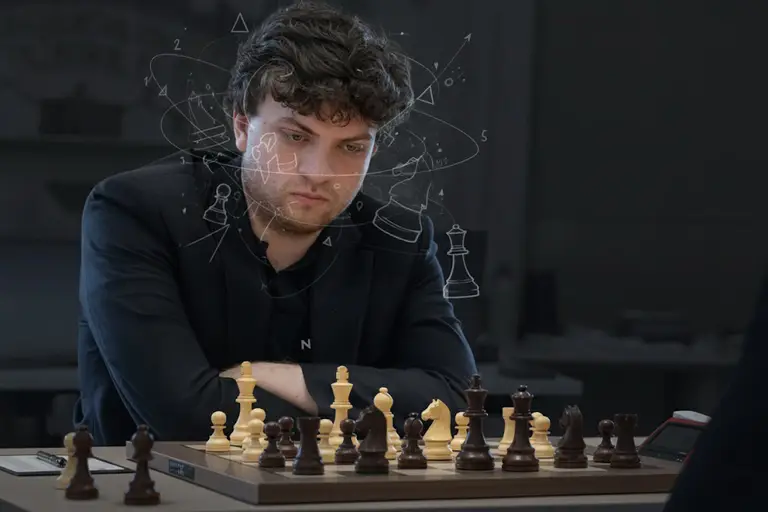
Hans Niemann is one of the most talked-about figures in modern chess. At just 22 years old, the American grandmaster combines undeniable talent with constant controversy. Known for his aggressive playing style, blunt personality, and frequent Twitch appearances, Niemann has also sparked major curiosity about his intelligence. Many fans ask the same question: How high is Hans Niemann’s IQ, and does it explain both his success and his scandals?
There is no official, publicly confirmed IQ score for Niemann. Still, pieces of his life story, childhood testing, and chess achievements give us enough clues to make a reasonable estimate. This article breaks everything down simply, using known facts, reported experiences, and careful logic rather than hype.
What IQ Means in Chess
IQ, or Intelligence Quotient, is designed to measure cognitive abilities such as reasoning, memory, problem-solving, and pattern recognition. An average IQ is around 100. Scores above 130 are typically considered “gifted,” while anything over 145 enters rare genius territory.
Chess strongly rewards certain IQ-related skills, especially visual pattern recognition and deep calculation. Many elite players are believed to have very high IQs. For example, former world champion Magnus Carlsen is often rumored to have an IQ near 190, though this has never been officially confirmed.
Hans Niemann himself has hinted that his intelligence is unusually high—but exact numbers are hard to find.
Childhood Background and Early Testing
Hans Niemann was born on June 20, 2003, in San Francisco. His childhood was far from stable. His father, David Niemann, worked as a home builder and reportedly lost around $10 million during the 2008 financial crisis, eventually filing for bankruptcy. His mother, Mary, worked for a European company, which led the family to move to the Netherlands when Hans was about seven years old.
Life there was difficult at first. The family reportedly stayed in a hostel for weeks, and the constant changes disrupted what Hans later described as a “normal” childhood.
While attending public school in the Netherlands, Hans complained that the classes were far too easy. His parents believed he might be intellectually gifted and arranged for him to take an IQ test so he could apply to the Leonardo School, an international program for gifted children where chess was part of the curriculum.
This is where the most important IQ detail appears.
The “Off-the-Chart” IQ Moment
At around eight or nine years old, Hans took an IQ test whose scoring system maxed out at 145. According to Niemann himself, his result exceeded that limit. In other words, the test could not measure how high his IQ actually was—it simply capped at 145.
Hans later described this experience openly, saying the result made him feel like a “super-genius” and admitting it contributed to arrogance at a young age.
After being admitted to the gifted program, Hans focused intensely on chess. By the time his family returned to California in 2012, he was already dominating his peers. His early chess years in the Bay Area were marked by raw talent, rapid improvement, and a reputation for being loud, rude, and extremely confident.
So What Is Hans Niemann’s Actual IQ?
There is no exact public number. The childhood test only tells us his IQ was higher than 145, not how much higher. Those tests were not designed to measure extreme outliers, and Niemann has never shared a modern IQ test result.
Some chess websites and fans estimate his IQ in the 130–150 range, which would already place him among gifted individuals and align with many grandmasters.
Based on the known facts—his childhood score exceeding the test limit, his prodigy-level development, and his rapid self-driven improvement—a reasonable estimate would place Hans Niemann’s IQ around 150.
This is not an official figure, just an educated estimate. An IQ of 150 would put him in roughly the top 0.1% of the population. It explains his ability to absorb chess concepts quickly, calculate deeply, and make dramatic rating jumps—without drifting into unrealistic claims like a “200 IQ,” which are mostly internet exaggeration. Standard IQ tests rarely measure that high without special scaling.
Why an IQ Around 150 Makes Sense
Research supports the idea that elite chess players tend to have high IQs, especially in visuospatial intelligence. A well-known academic study found that grandmasters often average between 130 and 140, with some exceptional outliers scoring much higher.
Hans Niemann’s chess progress fits the outlier category. After 2018, his rating climbed from roughly 2450 to over 2650 in just three years. That kind of jump is extremely rare, especially for someone often described as “self-taught.”
His family also positioned him well. After returning from Europe, they moved to Weston, Connecticut, an affluent area with easy access to strong chess tournaments and coaches near New York City. Hans later attended Columbia Grammar & Preparatory School, an elite private institution.
While his family is no longer ultra-wealthy, they rebuilt after the financial crash. They owned a home worth about $1.4 million, suggesting upper-middle-class stability. This allowed Hans to travel, compete internationally, and fully commit to chess during his formative years.
Intelligence vs. Emotional Control
High IQ does not guarantee emotional maturity. Niemann’s career shows this clearly.
While his chess brilliance is obvious, he has also gained attention for emotional outbursts and reckless behavior. In 2023, he reportedly caused about $5,000 in damage to a hotel room. His trash-talking, confrontational interviews, and public feuds suggest that emotional intelligence is not his strongest area.
This contrast reinforces an important point: IQ measures raw cognitive ability, not discipline, empathy, or self-control.
The 2022 Cheating Scandal
No discussion of Hans Niemann’s intelligence is complete without addressing the biggest controversy of his career.
In 2022, after Niemann defeated Magnus Carlsen at the Sinquefield Cup, cheating accusations exploded. Internet jokes escalated into serious claims involving hidden technology. Chess.com later banned Niemann, stating that he had cheated in more than 100 online games as a teenager.
Niemann admitted to cheating online in the past but strongly denied ever cheating in over-the-board games. He filed a $100 million lawsuit against Carlsen, Chess.com, and others. The case was settled in 2023, ending the legal battle without an admission of guilt.
Some critics argued that his rapid improvement looked suspicious. Others pointed out that prodigies have always surged quickly—Bobby Fischer, whose IQ was estimated around 180, showed similar leaps.
A high IQ could theoretically aid cheating, but it is just as essential for legitimate elite-level chess. Intelligence alone proves nothing either way.
Is IQ Overrated in Chess?
Many experts argue that IQ tests are limited. They can be culturally biased and fail to measure creativity, resilience, intuition, and work ethic—all crucial in chess.
Hans Niemann is often labeled “self-taught,” though that description is debatable. While he did not follow a traditional academy route, he still benefited from structured programs, strong competition, and indirect coaching.
There are also counterexamples. Hikaru Nakamura reportedly has an average IQ score but is one of the strongest blitz players in history. His success shows that elite chess performance does not depend solely on IQ.
Still, Niemann’s childhood test result strongly suggests exceptional raw potential.

I’m a passionate board game enthusiast and a skilled player in chess, xiangqi and Go. Words for Attacking Chess since 2023. Ping me at Lichess for a game or chat.