
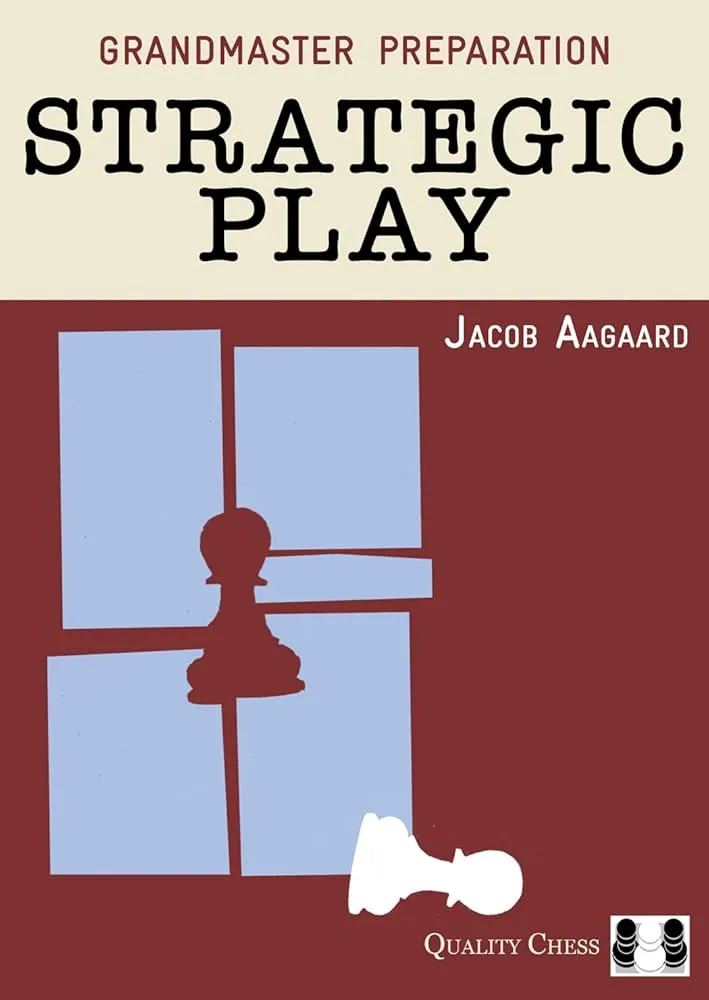
Another chess book lands with a thud. The cover is crisp, the title ambitious: Grandmaster Preparation – Strategic Play. For the seasoned club player, a familiar mix of hope and weariness sets in. Hope, because we are perennial optimists, forever searching for the secret that will unlock the next level of our game. Weariness, because our bookshelves are graveyards of such hopes. How many times have we been promised “Grandmaster” insights, only to find a rehash of old ideas, a collection of puzzles too superficial to teach anything new, or a tome so dense it’s practically unreadable?
The title itself raises an eyebrow. Grandmaster Preparation” without a single chapter on the opening? It’s a bold, almost provocative claim. It suggests that the real work—the work that separates the masters from the rest of us—happens long after the first dozen moves are played.
This brings us to the core question that every ambitious player must ask before investing not just money, but precious hours of study: Does Jacob Aagaard’s Strategic Play break the mold? Does it offer genuine, practical tools for navigating the complex, messy middlegames where games are truly won and lost? Or is it just another beautifully produced, expensive paperweight destined to gather dust next to its equally promising, equally disappointing predecessors?
This review will attempt to answer that question. We will dissect the author’s promises, deconstruct his method, and perform an autopsy on the chapters themselves. Ultimately, we will determine who will truly benefit from the arduous journey this book proposes, and who would be better off spending their time elsewhere.
The Author’s Promise: A Path to Grandmaster Thinking?
Before judging a book, it’s only fair to understand what the author set out to achieve. Aagaard is refreshingly direct about his goals in the “Series Introduction,” providing a clear benchmark against which his work can be measured. His stated objective is not merely to compile examples, but to forge a new path. He aims to “merge this classic understanding of chess with my own ideas and create a serious training plan for ambitious players.”
This is not a modest claim. It is, he hopes, a way to “show a path towards playing chess at grandmaster level for those who do not have access to a good trainer.” He is positioning this series as a potential substitute for elite coaching, a monumental undertaking that naturally invites skepticism.
Yet, Aagaard immediately tempers this ambition with a dose of realism, admitting that “there is no escaping the unavoidable imperfection of the execution.” This single sentence is revealing. It suggests an author who is aware of the immense difficulty of his task and is more interested in providing a rigorous, if imperfect, tool than in selling a flawless, magical solution. This is the honesty of a trainer, not a salesman.
The foreword by Grandmaster Surya Shekhar Ganguly provides the first piece of compelling evidence for the book’s potential. Ganguly is candid about his own development, noting that while Aagaard was impressed with his tactical skills, “he wasn’t particularly impressed with my positional play.” His testimony is direct: “Solving the positions Jacob showed me has improved my understanding of chess strategy a great deal.
But the real proof is in Ganguly’s own annotations. In his game against Karen Grigoryan, he provides a stunningly honest glimpse into the Grandmaster mind at work. Facing a complex decision, he initially planned a “brilliant” but flawed combination with 14...Nc5??, only to spot the refutation at the last second. He notes his emotions had “reached the lowest ebb,” but after re-evaluating and finding the superior 14...a4!!, they “bounced back.” This is a perfect case study of Aagaard’s method in action—a world-class player wrestling with a “complex decision,” catching his own error, and finding the correct strategic path.
In essence, the author’s promise is profound. This book does not aim to teach you a set of strategic rules. It aims to fundamentally rewire your thought process for handling the most complex and demanding positions on the board. It’s a claim that sets an extraordinarily high bar, and one that we must now test against the book’s actual content.
The Aagaard Method: Deconstructing the Decision
The true value of a training manual lies not in its individual examples, but in its underlying philosophy. Any author can find brilliant games to illustrate a point. The real question is whether they provide a coherent framework for thinking that a student can apply to their own games. Aagaard attempts to do just this in his preface, building a theoretical model for decision-making at the board.
Positional vs. Strategic
Aagaard begins with a distinction that, at first blush, feels like the kind of semantic hair-splitting common in academic chess texts: the difference between “positional play” and “chess strategy.” For many, these terms are interchangeable, but he insists on a crucial difference rooted in their dictionary definitions.
• Positional Play deals with the here-and-now: improving your position based on its current features. He offers the move 18.Rb3! from Alexander Ivanov – Shen Yang as a classic example—a simple, strong move that improves a piece and forces a concession.
• Chess Strategy is about the long term: “a plan designed to achieve a particular long-term aim.” His prime example is 21...c5!! from Mihail Marin – Jonathan Rowson. At first glance, the move seems anti-positional. But strategically, it correctly anticipates that in the long run, it is White’s light-squared bishop that will suffer, permanently “hemmed in by the black pawns” on a5 and c5.
As the Marin-Rowson example powerfully demonstrates, this is no mere intellectual exercise; it’s a vital clarification that separates club-level thinking from master play. It teaches one to differentiate between immediate, tangible improvements and more abstract, long-range plans.
The Four Decision Types
Aagaard builds on this foundation by categorizing every decision a player makes into one of four types. This model serves as the theoretical backbone for the entire book.
| Decision Type | Characteristics |
| 1) Decisions where you know what to do | Includes opening theory, standard endgame technique, and forced recaptures. The goal is to execute these moves quickly and accurately. |
| 2) Simple decisions | Involves choices of limited significance where calculation is often fruitless. Deciding which piece to recapture with in a quiet position is a typical example. |
| 3) Critical moments | Highly tactical positions where a single mistake can be decisive. The focus is almost exclusively on calculation. |
| 4) Complex decisions | The most difficult type, forming the core of this book. These positions cannot be solved by positional judgment or pure calculation alone. They often require weighing long-term gains against short-term losses and navigating a landscape too vast for any human (or computer) to see to the end. |
The “So What?” Layer
Is this framework a practical tool or an overly academic model? For the player who, in Aagaard’s words, suffers from “time trouble addiction,” this categorization could be a powerful diagnostic tool. By analyzing where time is wasted, a player can identify if they are burning minutes on “simple decisions” or being paralyzed by “complex decisions.”
Aagaard isn’t just presenting hard puzzles; he has a specific pedagogical reason for doing so. By isolating “Complex decisions,” he forces the reader to train the most difficult and often-neglected aspect of chess thought processing. This reframes the book’s difficulty not as a simple characteristic, but as a direct consequence of its core philosophy.
This overarching philosophy of structured thinking provides the theoretical blueprint. His training system for simpler positions is based on three questions: Where are the weaknesses?, Which is the worst-placed piece?, What is the opponent’s idea? But as any tournament player knows, the real test is how such a blueprint holds up under the pressure of concrete, chaotic positions. We now turn to the book’s five chapters to see if Aagaard’s method can be built from the bricks he provides.
A Chapter-by-Chapter Autopsy: Strengths and Weaknesses
A book’s philosophy is one thing; its execution is another. It is in the structure and content of the individual chapters that Aagaard’s method meets the messy reality of chess training. Let’s dissect the book’s five main sections to see what they deliver.
Chapter 1: Squares
This chapter nominally focuses on weaknesses and strongpoints. However, the examples quickly move beyond simple textbook concepts. The featured game, Alexei Shirov – Dragan Solak, showcases the mind-bending move 9...Ng8!!.
Here, a knight makes four moves to return to its starting square, a concept that seems to violate every principle of development. Yet, Aagaard demonstrates its deep strategic logic. The 28 exercises that follow are similarly challenging, often feeling less like illustrations of a single theme (“squares”) and more like a curated collection of profoundly difficult strategic puzzles.
Chapter 2: Pieces
The theme here is the correct long-term organization of one’s forces. Aagaard contrasts two types of piece play. First is the clean, logical approach exemplified by Magnus Carlsen – Arkadij Naiditsch, where Naiditsch’s greedy 20...Rxa3? is punished by Carlsen’s “natural piece play.”
The second type is grittier and far less intuitive, perfectly illustrated by the shocking move 18...Bh8! in John Shaw – Suat Atalik. This ugly-looking retreat is the key to repositioning other pieces for a decisive advantage. The chapter champions the idea that knowing where your pieces belong sometimes requires looking beyond their “natural” squares.
Chapter 3: Prophylaxis
This chapter is dedicated to the crucial skill of thwarting an opponent’s intentions. The cautionary tale is Arkadij Naiditsch – Peter Leko, where Leko, a player renowned for his defensive prowess, plays the optimistic 27...gxh5?.
He was so focused on his own attacking ideas down the g-file that he completely missed Naiditsch’s devastating reply, 29.Nf5!.
Aagaard uses this and other examples to hammer home a central tenet of high-level play: your opponent has ideas too, and ignoring them is a recipe for disaster.
Chapter 4: Dynamics
Aagaard uses a Formula One analogy to explain dynamics: a driver must “maintain the highest possible speed, but you also need to slow down for the bends.” This chapter is aimed at players who have a poor “feel for dynamics”—those who either play too passively when the position demands action or attack recklessly without regard for the consequences. The material focuses on developing the judgment to know when to press the accelerator and when to apply the brakes.
Chapter 5: Fighting the Tide
This final section serves as a practical, “odds-and-ends” chapter. It deals with defense, dynamic reactions, and navigating difficult situations where one is objectively worse. The primary example is Michael Adams – Leinier Dominguez Perez, where Black is a pawn down and must, in the words of Dylan Thomas, “rage, rage against the dying of the light.” Instead of passive defense, Dominguez finds active counterplay with29...Qc2!, fighting to create problems and keep the game alive.
Ultimately, the five-chapter structure feels somewhat forced, a point Aagaard himself seems to concede when he writes, “It has been quite difficult to find suitable exercises for this book and even harder to squeeze them into five square boxes.” The themes provide a loose organizational principle, but the book’s real identity lies not in its chapter titles but in the consistently high difficulty and complexity of the positions it presents.
Assessing the Material: Originality, Difficulty, and Repetition
Any serious training manual must answer three critical questions: Is the content new? Is it pitched at the right level? And does it respect the reader’s time by presenting its material effectively?
Recycled Genius or New Synthesis?
Aagaard is upfront about his intellectual lineage, expressing his hope that the series will help “in the same way that Mark Dvoretsky’s books have, and the way that Artur Yusupov’s series of nine books have.” This is high praise for his predecessors and an honest admission that he is building on the work of giants. However, he also states his goal is to merge this classic understanding with his “own ideas.”
The book’s originality lies not in inventing new principles, but in its synthesis and its intellectual honesty. In a remarkable note on his selection process, Aagaard discusses the fallibility of chess authors, citing an exercise from another book (Taimanov – Kapengut, 1969) where the intended solution was refuted by a deeper line (13...Nxd4!) found by a student. He then applies this standard to himself: “I am certain that there will be exercises in this book where the reader will find reasons to disagree with the poor author.” This self-awareness is the book’s greatest strength. It is a work that grapples with the difficulty of creating chess knowledge, presented with the humility of a true trainer. This, combined with the almost exclusive use of games from 2007-2012, makes the material feel both fresh and intellectually rigorous.
A Test of Mettle (and Sanity)
This book is brutally difficult. Aagaard himself acknowledges this, writing, “I am not sure that the title of this book is entirely accurate, maybe it would have been better to call it Complex Positions.” This is not a gentle guide to strategic thinking; it is a trial by fire. The exercises are not designed to be solved in a few minutes. They are deep, multi-layered problems that demand hours of intense concentration. The provided annotations, such as the labyrinthine variations in the Ganguly-Tkachiev game, are a clear indicator of the level of calculation and positional understanding required to even begin to grasp the material. This is not a book for the faint of heart.
The Grind: Repetitive Structure as Method
A potential criticism of the book is its repetitive structure: each chapter presents a brief introduction, a few deeply annotated illustrative games, and then a barrage of exercises. For some, this may feel like a grind. However, this structure is clearly intentional.
The repetition is not a failure of imagination; it is the core of Aagaard’s training philosophy. Improvement in chess, he argues, does not come from passively absorbing ideas. It comes from the focused, repeated, and often painful work of solving difficult problems. The book’s structure is designed to facilitate this process. It is a feature, not a bug, crafted for a very specific type of learner who understands that real progress is forged in the crucible of hard work.
Who Should Buy This Book, and Who Should Run Away?
So, does Strategic Play break the mold, or is it just another brick in the wall of a chess player’s library? The answer is that it does both. It is another very difficult chess book, but it breaks the mold by being unapologetically honest about its purpose and its audience. This is not a book for everyone, and its value is directly proportional to the effort the reader is willing to invest.
Who should read this book:
This book is for the highly ambitious, dedicated player, likely rated 1900/2000 FIDE or higher, who has hit a plateau. This player’s tactical ability is sharp, and their basic positional understanding is sound, but they find themselves lost in messy, complex middlegames where clear plans are hard to find. They must be willing to treat this book not as a passive reading experience, but as an active, demanding training partner. They must be prepared to set up positions on a board and spend hours wrestling with a single exercise, knowing that the reward is not a simple solution, but a deeper, more nuanced understanding of chess.
Who should skip this book:
Casual club players, those looking for easily digestible rules of thumb, and players who are still developing their tactical and basic positional foundation should run, not walk, away from this book. For this group, the sheer difficulty of the material will be a source of immense frustration and demotivation. It will feel impenetrable, and the lessons it seeks to teach will be lost in a sea of complexity. Buying this book before you are ready is a surefire way to kill your enthusiasm for chess improvement.
Strategic Play is less a book to be read and more a mountain to be climbed, with the rewards reserved only for those willing to endure the ascent.
Rating: 4.6/5
Guest Author: Ethan Doyle
If you’d like to dive deeper into Aagaard’s method, you can purchase the book through Forward Chess or Amazon.
Buying through these affiliate links comes at no extra cost to you.

AttackingChess Guest Contributors is a collective author profile representing chess enthusiasts, reviewers, coaches, and community members who contribute book reviews, insights, and educational material to the site.
Articles published under this profile may come from different writers with varying backgrounds in strategy, tournament experience, chess literature, and long-term training. All submissions are edited and fact-checked by the AttackingChess editorial team to ensure quality, accuracy, and practical value for readers.
This contributor profile is designed to give a voice to many chess lovers who want to share their perspectives without maintaining individual author accounts.