
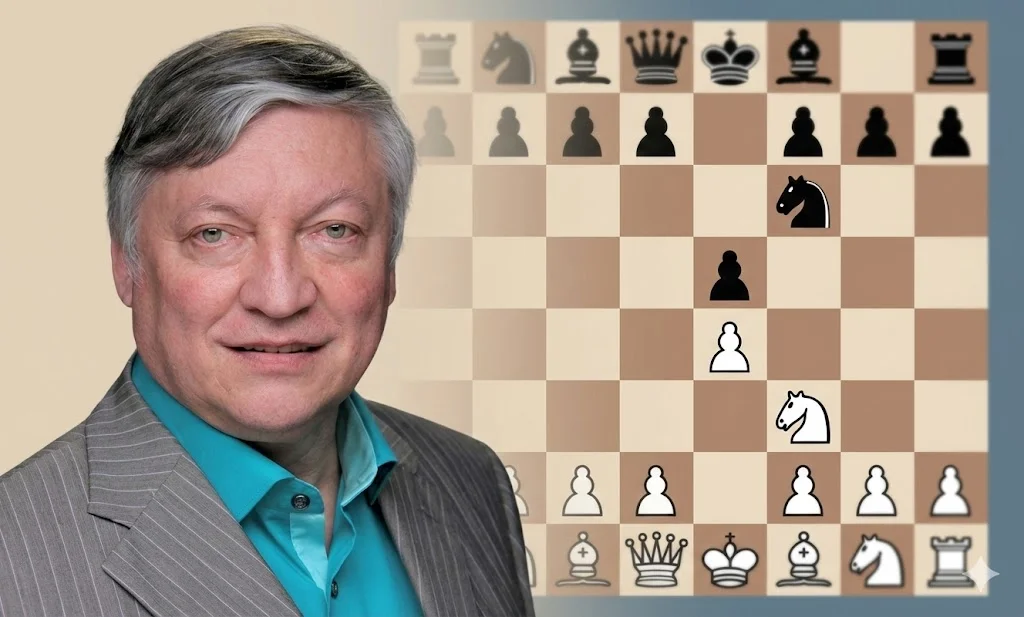
For generations, the Petroff Defense (1.e4 e5 2.Nf3 Nf6), also known as Petrov Defense or the Russian Game, has carried a distinct reputation: a solid, reliable, but ultimately drawish path for Black. It was seen as a way to neutralize White’s initiative, often leading to symmetrical positions where a handshake was the most likely outcome.
However, in his seminal work, Winning with the Petroff, World Champion Anatoly Karpov presents a compelling counter-narrative. He argues that the Petroff, far from being a mere tool for securing a half-point, is a dynamic and fighting opening capable of producing decisive results for Black. For ambitious players seeking a resilient and multifaceted response to 1.e4, this re-evaluation is of profound strategic importance.
The modern theory of the Petroff was forged in the crucible of one of chess history’s greatest rivalries: Karpov’s own world championship matches against Garry Kasparov. As Karpov notes, “throughout its history the Petroff has never been studied with such intensity as after my duels with Kasparov.”
Buy Winning with the Petroff on AmazonTheir seven encounters in this opening, six featuring the main line with 3.Nxe5 and one with 3.d4. This guide will systematically explore the opening’s major branches, grounded in the critical games and deep analysis presented in Karpov’s work. We will deconstruct the strategic plans, key novelties, and subtle nuances that transform this classic defense from a safe harbor into a potent weapon for victory.
Table of Contents
Part I: The Main Line with 3.Nxe5 (Informator C42)
The capture 3.Nxe5 is White’s most common and historically significant continuation, initiating the vast majority of theoretical discussions within the Petroff Defense. This approach immediately challenges Black’s central footing and leads to open, complex positions. This section deconstructs the main variations that spring from this capture, focusing on the critical choices Black must make on moves 6 and 7, decisions that, as Anatoly Karpov demonstrates, fundamentally define the character of the ensuing middlegame.
1. The Classical System: 6…Nc6 and 7…Be7
This system represents what Karpov describes as “by far the most fashionable choice for Black in recent times.” Here, Black combines solid, classical development with a firm grip on the central squares. The resulting positions are not about immediate tactical fireworks but lead to rich, strategic middlegames where a deep understanding of typical plans, pawn structures, and piece coordination is paramount for success.
1.1. The Portisch Debate: 8…Bf5 and Karpov’s 9.c4!
In 1982, a series of games between Anatoly Karpov and the formidable Hungarian Grandmaster Lajos Portisch ignited a new theoretical fire in the Petroff. This strategic duel, which Karpov states “prepared the ground well for a new debate,” centered on Black’s active development of the light-squared bishop.
The primary line of this variation is: 1.e4 e5 2.Nf3 Nf6 3.Nxe5 d6 4.Nf3 Nxe4 5.d4 d5 6.Bd3 Nc6 7.0-0 Be7 8.Re1 Bf5
In this position, Karpov unleashed a powerful novelty he had originally prepared for his world championship match with Viktor Korchnoi: 9.c4!. This move was a surprise, immediately challenging Black’s central structure and fighting for the initiative.
As seen in Game 1 (Karpov-Portisch, Turin 1982), Karpov’s plan is multifaceted. White aims to exert sustained pressure on the d5-pawn and seeks to expand on the queenside, often with the move a4. Black, in response, must fight to create footholds for his pieces and challenge White’s central control, as Portisch attempts with 9...Nb4.
The subsequent games of their “triptych” revealed the depth of Karpov’s preparation. Against Portisch’s attempt to vary with 10...dxc4 (Tilburg 1982), Karpov demonstrated the strength of 11.Nc3!, seizing the initiative by rapidly developing a piece to its best square and reinforcing control over d5.
In their final encounter on this theme (Lucerne 1982), Karpov varied with 12.cxd5, once again obtaining a dominant position by clarifying the central tension on his own terms. This system proved so effective in Karpov’s hands that it forced theoreticians to seek alternative paths for Black, underscoring the power of a well-prepared central strike.
1.2. White’s Quick Central Attack: 8.c4 Nb4
In contrast to the more common developing move 8.Re1, White can immediately strike at the center with 8.c4. This aggressive approach forces Black to react precisely to avoid being squeezed from the opening.
The critical sequence is: 1.e4 e5 2.Nf3 Nf6 3.Nxe5 d6 4.Nf3 Nxe4 5.d4 d5 6.Bd3 Be7 7.0-0 Nc6 8.c4 Nb4
In Game 3 (Karpov-Kasparov, World Ch 41), a game with immense historical significance, Karpov introduced the key novelty 9.Be2!. He explains this is a significant improvement over the previously played 9.cxd5, as it avoids the exchange of White’s powerful light-squared bishop and preserves the advantage of the bishop pair.
The strategic battle that unfolds is a testament to the Petroff’s complexity. White’s plan is to leverage the bishop pair and build lasting central pressure. Black, in turn, seeks to neutralize this pressure through timely exchanges and precise piece maneuvering, aiming to simplify into an equal or favorable endgame. This high-stakes encounter spurred intense theoretical development in the 8...Nb4 line, as players sought to refine both White’s attack and Black’s defense.
1.3. The Modern Be6 System: 9…Be6
Following the intense scrutiny of the Karpov-Kasparov matches, the move 9...Be6 emerged as the main theoretical battleground. Its strategic purpose is clear: Black reinforces the d5-pawn, prepares to challenge White’s control of the center, and develops a piece to an active square.
The starting position for this complex system is: 1.e4 e5 2.Nf3 Nf6 3.Nxe5 d6 4.Nf3 Nxe4 5.d4 d5 6.Bd3 Be7 7.0-0 Nc6 8.c4 Nb4 9.Be2 Be6 10.Nc3 0-0 11.Be3
From this juncture, Karpov’s analysis highlights three principal continuations for Black:
1. The Bishop Maneuver (11…Bf5):
As explored in Games 4, 5, and 6, this is a natural developing move that places immediate pressure on White’s center. The analysis reveals a subtle duel based on White’s queen placement (12.Qb3 versus the quieter 12.Re1). The strategic consequences are significant, with Black’s decision to play a solidifying ...c6 versus an immediate pawn exchange with ...dxc4 leading to vastly different types of middlegames.
2. The Energetic Thrust (11…f5!?):
Karpov assesses this move as a way for Black to seize “active counterplay on the kingside.” As shown in Games 7 and 8, this pawn thrust creates immediate imbalances and leads to sharp, tactical positions. White’s response is critical; the analysis contrasts the outcomes of 14.Qa4 (Karpov-Seirawan), which maintains pressure, with the clarifying 14.cxd5 (Hubner-Yusupov), which leads to a more structural battle.
3. The Blocking Move (11…Bf6):
In Game 9 (Ljubojevic-Karpov), Karpov himself employs this subtle move as Black. The idea is to control key central squares and prepare a potential pawn break with ...c5. This approach steers the game towards a more positional struggle, where understanding the nuances of piece placement and long-term plans is paramount.
The 9...Be6 system is a testament to the Petroff’s strategic depth. It leads to complex, non-forced positions where a profound understanding of pawn structures, piece activity, and long-term planning is essential for both sides.
2. The Sharp System: 7…Bg4
This system offers a stark contrast to the solid development of 7...Be7. As Karpov explains, Black uses the move 7...Bg4 for “immediate pressure on the centre,” pinning the f3-knight and challenging White’s d4-pawn. However, this aggression comes at a cost: it delays king safety and can leave Black vulnerable to a swift central attack. Consequently, this variation often leads to sharper, more tactical battles where precise calculation is the key to survival and success.
2.1. The Pawn Sacrifice Variation: 9.Nc3
This is White’s most principled and challenging response. By developing a piece, White ignores the pin and directly challenges Black’s control of the e4-pawn, often leading to a pawn sacrifice for long-term initiative.
The critical sequence leading to the sacrifice is: 1.e4 e5 2.Nf3 Nf6 3.Nxe5 d6 4.Nf3 Nxe4 5.d4 d5 6.Bd3 Nc6 7.0-0 Bg4 8.c4 Nf6 9.Nc3 Bxf3 10.Qxf3 Nxd4
White is a pawn down but has superior development and attacking prospects. The choice of queen check on move 11 is critical and was a major point of debate in the Karpov-Kasparov matches:
• 11.Re1+:
Analyzed in Game 11 (Kasparov-Karpov, Match 2, Game 15), this check allows Black to simplify. After Kasparov’s 12.Qd1!?, Karpov demonstrates the power of the simplifying response 12...Ne6!.
• 11.Qe3+:
This became a major theoretical test in Game 12 (Kasparov-Karpov, Match 3, Game 6). White’s plan is to use the two bishops and the open lines to generate a lasting initiative for the sacrificed pawn. Black, in turn, must consolidate carefully, often using the queen on the a-file for counterplay, as Karpov successfully did.
• 11.Qh3!:
Described by Karpov as a “more decisive try to justify the pawn sacrifice” in Game 14 (Kupreichik-Yusupov). This aggressive move poses significant problems, but modern theory has found a powerful antidote in 11...Ne6!.
A deeper look reveals a vital lesson for the Petroff player. The ...Ne6 maneuver is a thematic and crucial defensive resource for Black across multiple lines in this pawn sacrifice system. In both the 11.Re1+ and 11.Qh3 variations, this knight move serves to challenge White’s control of the central d4-square, provoke simplifying exchanges, and ultimately neutralize White’s initiative.
Understanding this recurring defensive idea is key to navigating these sharp waters. Karpov’s analysis demonstrates that while White’s pawn sacrifice leads to dangerous positions, Black has reliable and well-tested methods to prove the material advantage, making this sharp line a calculated risk for both players.
3. The Symmetrical System: 6…Bd6
In the introduction to Chapter 4 of his book, Karpov notes that this “symmetrical variation” has recently acquired great popularity. The strategic idea is for Black to sidestep the complex theoretical debates arising from ...Nc6. Instead, Black mirrors White’s setup with a bishop on d6 and prepares to create a solid central pawn structure with ...c6, aiming for a game of strategic maneuvering rather than tactical skirmishes.
The foundational position for this system is: 1.e4 e5 2.Nf3 Nf6 3.Nxe5 d6 4.Nf3 Nxe4 5.d4 d5 6.Bd3 Bd6 7.0-0 0-0 8.c4 c6
The character of the game is largely determined by White’s ninth move. Karpov analyzes three main approaches:
1. 9.Qc2:
As seen in Game 17 (Timman-Salov), this move prepares queenside expansion and places indirect pressure on Black’s center. White’s plan often involves a minority attack or creating weaknesses in Black’s pawn structure, while Black aims to maintain solidity and generate counterplay.
2. 9.Nc3:
This move forces clarification in the center. After 9...Nxc3 10.bxc3 dxc4, White obtains an open b-file and a strong pawn center in exchange for doubled c-pawns. Game 18 (A. Sokolov-Oll) is famous for the stunning knight sacrifice discovered in this line (18...Nxg4!) and the critical defensive improvement (23...Qh2+!) that ultimately proved the sacrifice to be sound.
3. 9.cxd5:
Examined in Game 19 (Dvoiris-Rozentalis), this is a positional approach where White resolves the central tension early to play against Black’s isolated d-pawn or hanging pawns. The game becomes a technical battle focused on exploiting structural weaknesses.
The symmetrical variation leads to highly strategic battles where a deep understanding of pawn structures and long-term planning is more critical than immediate tactical calculation. It is a testament to the Petroff’s versatility, offering a solid positional path alongside its sharper alternatives.
4. White’s Early Deviations
While the main lines of the Petroff receive the most attention, ambitious players must be prepared for White’s attempts to sidestep established theory. These deviations, while less common, often lead to unconventional positions where a firm grasp of fundamental principles is essential. Chapter 5 of Karpov’s book addresses the most notable of these attempts.
• The Cochrane Gambit (4.Nxf7?!):
This speculative sacrifice, featured in Game 20 (Vitolins-Raetsky), defines a unique branch of the Petroff. 1.e4 e5 2.Nf3 Nf6 3.Nxe5 d6 4.Nxf7 Kxf7
White receives two pawns and attacking chances against the exposed black king in return for the knight. While dangerous against an unprepared opponent, Karpov’s analysis shows that with correct play, Black can consolidate and exploit the material advantage. The key is a proper defensive setup, typically involving 5...c5 or the fianchetto plan with 5...g6, to control the center and bring the king to safety.
• Other Tries: Karpov briefly addresses other, less critical deviations in the introductory text to Game 20. Moves such as 4.Nc4, 3.d3, 3.Bc4, and 3.Nc3 are generally considered less challenging. They tend to lead to positions of equality or transpose into other well-known openings (like the Four Knights Game or the Two Knights Defense), where Black has no specific problems to solve.
Part II: The Steinitz Attack with 3.d4 (Informator C43)
The move 3.d4 represents the other major philosophical approach for White in the Petroff. Instead of capturing the e5-pawn, White immediately stakes a claim in the center, seeking to challenge Black directly. Karpov notes that this system was “very much in vogue” and was prominently featured in his fifth World Championship match with Garry Kasparov, making it a critical area of modern theory.
1. Black’s Main Reply: 3…Nxe4
Capturing the d4-pawn with 3...Nxe4 is Black’s principal and most theoretically sound response. This choice immediately opens the game, leading to a dynamic struggle where the speed of development and the activity of the pieces become the most crucial factors.
1.1. The Modern Main Line: 5…Nd7
This knight move is the most popular modern approach for Black and leads to one of the most critical and theoretically dense positions in the entire Petroff Defense.
The main line is: 1.e4 e5 2.Nf3 Nf6 3.d4 Nxe4 4.Bd3 d5 5.Nxe5 Nd7 6.Nxd7 Bxd7 7.0-0 Qh4
Black’s early queen development signals aggressive intentions. The main battleground, covered extensively in Games 22, 23, and 24, arises after the sequence 8.c4 0-0-0 9.c5 g5.
In this incredibly sharp position, both sides are playing for a direct attack. The analysis evaluates the key branching points for White, such as 10.Nc3 versus 10.f3, and the corresponding replies for Black, like 11...f5 versus 11...Rhe8. Karpov’s book highlights a critical defensive resource for Black, discovered by Akopyan: the stunning exchange sacrifice ...Rxe2!, which can dismantle White’s attacking coordination and turn the tables.
1.2. The Classical Approach: 5…Bd6
This is the older, more classical method for Black, developing a piece to a natural square and preparing to castle kingside quickly.
The key line is: 1.e4 e5 2.Nf3 Nf6 3.d4 Nxe4 4.Bd3 d5 5.Nxe5 Bd6 6.0-0 0-0
The analysis, based on Game 21 (Kasparov-Anand), focuses on the critical line 7.c4 Bxe5 8.dxe5 Nc6 9.cxd5 Qxd5.
This leads to a largely forced sequence of moves resulting in a complex and unbalanced endgame. White emerges with the advantage of the two bishops and a lasting initiative for a sacrificed pawn. Black’s defensive task is difficult, requiring precise play to neutralize White’s pressure and hold the position.
2. Karpov’s Match Surprise: 3…exd4
For his tenth World Championship game against Kasparov in 1990, Anatoly Karpov unveiled a surprise weapon. By choosing 3...exd4, he deliberately sidestepped the massive body of theory associated with 3...Nxe4 and presented his opponent with a different set of strategic challenges.
The opening moves of the game were: 1.e4 e5 2.Nf3 Nf6 3.d4 exd4 4.e5 Ne4 5.Qxd4 d5 6.exd6 Nxd6 7.Nc3 Nc6 8.Qf4
Here, the novelty prepared by Karpov’s second, Igor Zaitsev, was revealed: 8…Nf5!?.
Karpov himself describes this as a “paradoxical move.” In the opening, moving a piece that has already been developed is typically a loss of time. However, in this specific structure, the move is highly effective. The knight repositions itself to a superior square, challenging White’s control and preparing to support Black’s central setup.
The analysis of Game 25 (Kasparov-Karpov, World Ch 10) shows how this new concept worked to perfection. Black successfully neutralized White’s early initiative, equalized the position comfortably, and secured a draw. This game validated Zaitsev’s paradoxical idea and added a significant new weapon to Black’s arsenal in the Steinitz Attack.
Part III: Uncharted Territory & Practical Wisdom
While the previous sections have focused on the specific variations analyzed in Anatoly Karpov’s book, this final part aims to synthesize the broader strategic lessons contained within his work. Furthermore, to provide a more complete guide for the modern player, we will explore a popular contemporary line that rose to prominence after the book’s publication, offering a complete picture for the ambitious Petroff player.
1. The Stafford Gambit: A Modern Deviation
Please note: The Stafford Gambit is a modern, popular line that is not covered in Anatoly Karpov’s “Winning with the Petroff.” The following analysis is based on contemporary theory and is included to provide a more complete guide for the modern player.
The Stafford Gambit arises after the moves 1.e4 e5 2.Nf3 Nf6 3.Nxe5 Nc6.
The main idea is for Black to sacrifice a pawn immediately in exchange for rapid development and direct attacking chances against the White king. It is an opening designed to create chaos and avoid the deep strategic waters of the main lines.
A typical line illustrating Black’s attacking ideas is: 4.Nxc6 dxc6 5.d3 Bc5 6.Be2 h5
Here, Black is already threatening to create an attack with ...Ng4 and sacrifices on f2 or h2. The opening is rife with traps and requires careful, concrete calculation from both sides.
The philosophy of the Stafford Gambit stands in stark contrast to Karpov’s approach to the Petroff. The Stafford is a sharp, tactical, and somewhat speculative opening that relies on surprising the opponent and capitalizing on immediate threats. Karpov’s treatment of the Petroff, on the other hand, is grounded in deep positional understanding, central control, and long-term strategic maneuvering. While Karpov seeks to outplay his opponents in complex middlegames, the Stafford player aims for a quick knockout.
2. Karpov’s Core Principles for Winning with the Petroff
Synthesizing the wisdom from his introduction and game commentaries reveals several overarching strategic themes that define Karpov’s approach to the opening. These principles are the true key to “winning with the Petroff.”
The Fight for the Center At the heart of nearly every variation in Karpov’s book is the battle for the central squares, particularly d4, d5, and e5. The Petroff is not a passive defense; it is an immediate challenge to White’s central control. Black’s entire setup, whether through the pawn thrust ...d5, the knight development to c6, or the pin with ...Bg4, is designed to prevent White from establishing an uncontested space advantage. Success in the Petroff often hinges on Black’s ability to maintain a share of central influence, using it as a springboard for future operations on the kingside or queenside.
Symmetry and Tension Karpov demonstrates that the Petroff player must be a master of managing tension. He shows a deep understanding of when to maintain symmetrical structures for solidity and when to break them to create imbalances and winning chances. In the Symmetrical System (6...Bd6), Black is content with a solid, mirror-image setup, confident in his ability to outmaneuver the opponent in a purely strategic battle. In sharper lines, however, Black actively breaks the symmetry—sacrificing a pawn, thrusting ...f5, or creating an imbalanced pawn structure—to generate dynamic possibilities and fight for the full point.
Middlegame and Endgame Transitions A recurring lesson from Karpov’s analysis is the importance of understanding the typical middlegame and endgame transitions that arise from the opening. The Petroff’s relatively open nature frequently leads to simplified positions where material is equal, but imbalances in piece activity and pawn structure are decisive.
This is evident in the positional squeeze Karpov engineered in Game 1 (Karpov-Portisch), where the long-term pressure initiated by 9.c4! proved decisive. It is also seen in the critical endgame of Game 3 (Karpov-Kasparov), where Karpov’s missed win with the pawn break 33.a6! demonstrates how a subtle structural advantage can be converted into victory. Even in quiet, symmetrical structures, dynamic possibilities are ever-present, as shown by the stunning tactical discovery of 18...Nxg4! in Game 18 (A. Sokolov-Oll).
Karpov advises players to focus not just on surviving the opening but on steering the game towards structures where their pieces will be more active in the long run.
Conclusion: The Petroff as a Weapon for Victory
Anatoly Karpov’s central thesis is both clear and revolutionary: the Petroff Defense is far from a simple drawing weapon. It is a rich, complex, and remarkably resilient system that offers Black every opportunity to fight for a win against 1.e4. Its dual nature is its greatest strength, capable of producing both the solid, strategic positional games favored by classical masters and the sharp, unbalanced tactical battles demanded by modern chess.
For the dedicated student, the Petroff is a deep well of strategic ideas. A thorough study of this opening, guided by the unparalleled insights of a World Champion like Anatoly Karpov, can transform it from a mere defense into a formidable and reliable weapon for victory.
Grab Winning with the Petroff on Amazon here. Buying through this link supports this site at no extra cost to you.
I’m Xuan Binh, the founder of Attacking Chess, and the Deputy Head of Communications at the Vietnam Chess Federation (VCF). My chess.com and lichess rating is above 2300. Send me a challenge or message via Lichess. Follow me on Twitter (X) or Facebook.