
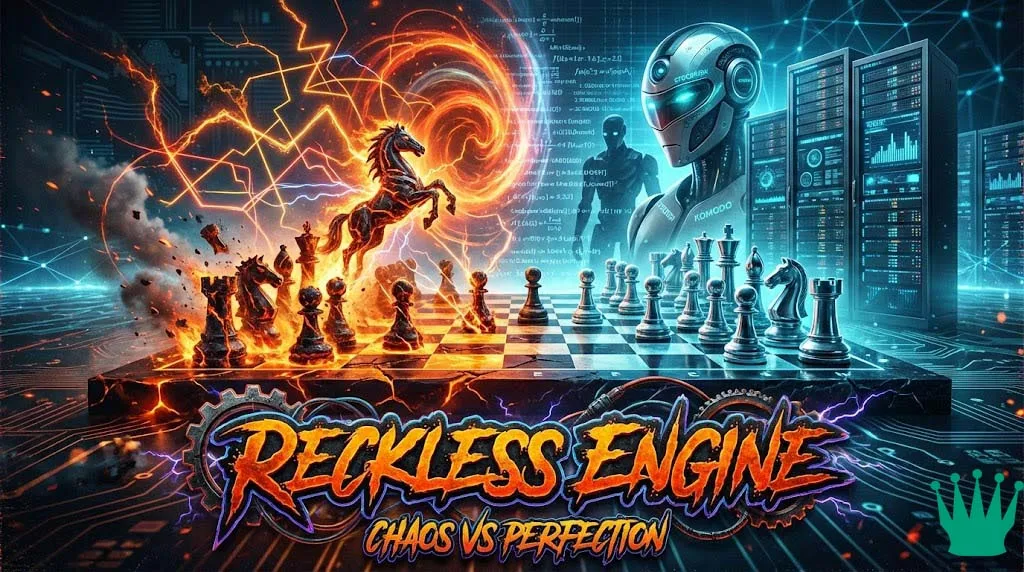
In the modern world of computer chess, the landscape is often dominated by cold, calculating giants. Names like Stockfish and Komodo represent the pinnacle of “perfect” play, machines that grind down opponents with suffocating accuracy and zero emotion. They are the “gods” of chess, but they can also be incredibly boring to watch or play against.
Enter Reckless.
Reckless is a chess engine that has captured the curiosity of the chess programming community and players on platforms like Lichess. As its name suggests, it brings a different flavor to the board. It is powerful, modern, and built with a distinct philosophy that sets it apart from the old guard of chess AI.
This article explores what the Reckless engine is, how it works, and why it has become a fascinating project in the open-source chess world.
What is the Reckless Chess Engine?
At its core, Reckless is a UCI (Universal Chess Interface) chess engine. This means it is the “brain” that calculates moves, which must be plugged into a graphical user interface (GUI) like Arena, Banksia, or Cute Chess to be playable.
It is an open-source project developed primarily by Tijl Fiers (often operating under the handle codedeliveryservice on GitHub). Unlike older engines written in C or C++, Reckless is written in Rust, a modern programming language that has gained massive popularity for its speed and memory safety.
While it is not the number one engine in the world (a title firmly held by Stockfish), Reckless is a “Super Grandmaster” level engine. With an estimated rating hovering around 3000 Elo (depending on the hardware and time control), it is strong enough to crush almost any human player, yet it is often tuned or described in a way that suggests a more “dramatic” personality than its peers.
The “Reckless” Personality
Most chess engines are designed to be “safe.” They prioritize not losing above all else. If Stockfish sees a move that leads to a complicated, messy position with a 51% chance of winning, and a boring move that guarantees a draw, it will often choose the path of least resistance if it senses danger.
Reckless, particularly in its branding and bot persona, implies a different approach. On its official Lichess bot profile, the engine is described as:
“Friendly, dramatic, slightly overconfident with its brilliance.”
This description highlights why people are drawn to it. A “dramatic” engine is one that might prefer sharp, tactical lines over slow, positional maneuvering. It mimics the style of a human player who is incredibly talented but perhaps a bit arrogant—willing to enter complications just to prove it can calculate its way out of them.
This “overconfidence” makes Reckless a fantastic training partner. It doesn’t just slowly squeeze you to death like a python; it throws punches. This gives human players a chance to practice defensive resilience in sharp positions, something that is hard to do against engines that lock down the board.
Under the Hood: The Rust Revolution
To understand why Reckless is special, you have to look at how it is made. Reckless is part of a new wave of chess engines written in Rust.
For decades, C and C++ were the only languages that mattered in chess programming because they were the only ones fast enough to calculate millions of positions per second. However, these languages are notoriously difficult to manage; a single error in memory management can crash the whole program.
Reckless showcases the power of Rust. Rust offers the performance of C++ but with built-in safeguards that prevent crashes and bugs. By building Reckless in Rust, the developers have created an engine that is:
- Modern: It utilizes the latest coding standards.
- Stable: It is less prone to the random crashes that plague older amateur engines.
- Fast: It can calculate deeply and quickly, making it a formidable opponent in Blitz and Bullet games.
The Brain: NNUE Technology
Like almost all top-tier engines today, Reckless utilizes NNUE (Efficiently Updatable Neural Network) technology.
In the old days, chess engines used “hand-crafted” evaluation functions. Programmers had to manually write code telling the engine, “Knights are good in the center” or “Bishops are better than Knights in open positions.”
NNUE changed everything. Instead of human rules, Reckless uses a neural network that has “learned” chess by analyzing millions of positions. It doesn’t just follow rules; it has an intuition. When Reckless looks at a board, its neural network gives it a “feeling” for the position similar to how a human Grandmaster thinks, but backed by the calculation power of a computer.
The “RecklessNetworks” repository on GitHub stores these neural files, which serve as the engine’s distinct brain, giving it its unique evaluation style compared to other engines.
Performance: The “Bad Boy” of Lichess
Reckless is widely known for its presence on Lichess.org as a bot account (RecklessEngine). It plays thousands of games against humans and other bots, specializing in fast time controls like Bullet (1 minute) and Blitz (3 to 5 minutes).
Its performance statistics are impressive:
- Bullet Rating: Often exceeding 3000.
- Blitz Rating: Consistently high Grandmaster level (~2900-3000).
However, true to its name, Reckless has been observed to have “time management” quirks. In computer chess tournaments (like CCRL), engines are expected to manage their clock perfectly. Reckless has occasionally been noted to lose on time or play insanely fast in critical moments. While a developer might call this a “bug,” for the casual fan, it fits the “reckless” persona perfectly. It plays fast, it plays hard, and sometimes it crashes and burns—just like a real human daredevil.
Why You Should Try Reckless
If you are a chess enthusiast, you might wonder why you should bother with Reckless when Stockfish exists. Here is why:
1. A More “Human” Game: Stockfish 16+ is so strong it feels alien. Its moves are often incomprehensible to humans. Reckless, while still superhuman, often plays in a way that feels more relatable. Its neural network may steer it toward positions that look “scary” or “exciting” rather than just clinically sterile.
2. Open Source Learning: If you are a programmer interested in AI, Reckless is a goldmine. Because it is written in clean, modern Rust, the code is often easier to read and understand than the ancient, complex codebases of older engines. It is a great starting point for learning how a chess engine works.
3. The Fun Factor: Chess is supposed to be fun. Playing against an engine that is branded as “overconfident” adds a layer of narrative to your practice. Beating Reckless feels like punishing an arrogant opponent, which is satisfying in a way that beating a nameless computer is not.
How to Install Reckless
Since Reckless is a UCI engine, you cannot just “run” it like a video game. You need a GUI. Here is the simple process for Windows users:
- Download a GUI: Programs like Arena Chess GUI, Banksia, or Cute Chess are free.
- Download Reckless: Go to the “codedeliveryservice/Reckless” GitHub page and download the latest release (usually a
.exefile). - Install: Open your GUI, look for “Engines” > “Install New Engine,” and select the Reckless file you downloaded.
- Play: Start a new game and select Reckless as your opponent.
FAQ
1. What is the Reckless chess engine?
Reckless is an open-source UCI chess engine written in Rust. It uses NNUE neural network evaluation and aims to provide strong, modern engine performance while maintaining clean, safe, and efficient code.
2. Who created Reckless?
Reckless is primarily developed by Tijl Fiers (known as codedeliveryservice on GitHub), with contributions from the open-source computer chess community.
3. How strong is the Reckless engine?
Reckless typically performs at a Super-Grandmaster level, with an approximate strength around 3000 Elo depending on hardware, neural network version, and time control.
4. What programming language is Reckless written in?
The engine is written in Rust, a modern systems programming language known for memory safety, concurrency guarantees, and high performance.
5. Does Reckless use NNUE?
Yes. Reckless uses an NNUE (Efficiently Updatable Neural Network) evaluation function, which allows it to assess positions using a learned model rather than hand-crafted rules.
6. Can I use Reckless inside a chess GUI?
Yes. Reckless is a UCI engine and can be installed in any compatible GUI such as Arena, Cute Chess, Banksia, or Fritz.
7. Is Reckless better than Stockfish?
No. Stockfish remains significantly stronger. Reckless is notable for its modern architecture, clean codebase, and playing style, but it does not aim to surpass Stockfish’s raw strength.
8. Where can I download the Reckless engine?
You can download the latest releases from the official GitHub repository under the codedeliveryservice/Reckless project.
9. What makes Reckless different from other engines?
Reckless stands out due to:
- Its Rust-based design
- NNUE evaluation
- Clean, modern, readable code
- A more dynamic, tactical playing style compared to ultra-defensive top engines
10. Can beginners or intermediate players use Reckless for training?
Yes. Despite being very strong, Reckless can be configured with lower difficulty settings or used to analyze positions. Its sharper playing style may be easier for humans to learn from than hyper-accurate engines like Stockfish.
11. Is Reckless open source?
Yes. Both the engine and its neural networks are available under open-source licenses, allowing developers to study, modify, or contribute to the project.
12. Does Reckless run on all operating systems?
Reckless can be built and run on Windows, macOS, and Linux, depending on available builds or by compiling from source using Rust.

I’m Xuan Binh, the founder of Attacking Chess, and the Deputy Head of Communications at the Vietnam Chess Federation (VCF). My chess.com and lichess rating is above 2300. Send me a challenge or message via Lichess. Follow me on Twitter (X) or Facebook.