
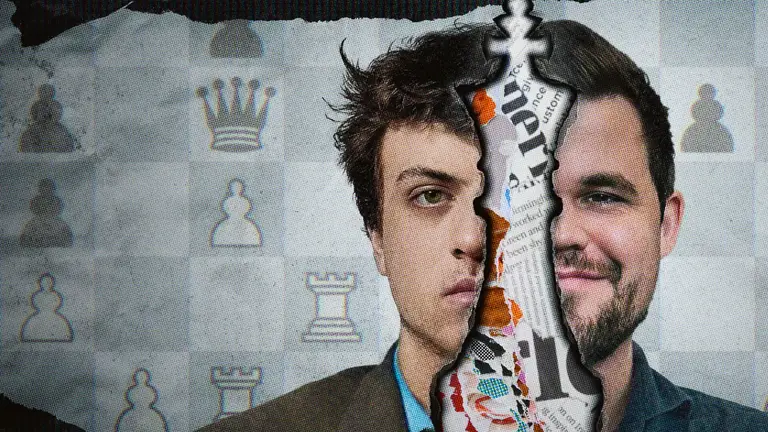
When Untold: Chess Mates dropped on Netflix on April 7, it did more than revisit one of the most explosive controversies in modern chess. It reignited it.
For casual viewers, the 74-minute documentary offers a dramatic, almost cinematic retelling of the 2022 scandal involving Magnus Carlsen and Hans Niemann. For those already deep in the chess world, however, the film feels less like a revelation and more like a reckoning. It adds nuance, confirms suspicions, and exposes how messy, emotional, and human the entire saga really was.
But if Netflix expected a unified reaction, it got the exact opposite. The chess community is more divided than ever.
What the Documentary Actually Reveals
At its core, Untold: Chess Mates revisits the fallout from the 2022 Sinquefield Cup, where Carlsen stunned the chess world by withdrawing after losing to Niemann. The documentary brings together key figures, including Carlsen himself, Niemann, Hikaru Nakamura, and Chess.com executives like Erik Allebest and Danny Rensch.
There are a few major takeaways that stand out.
First, Carlsen provides his most detailed explanation yet. He admits that during the game, he felt something was deeply off. His now-famous line—“I felt that I was not playing a human”—captures the psychological intensity of the moment. But the documentary also shows that his belief was not based on concrete over-the-board evidence. Instead, it was shaped by prior suspicions, rumors, and conversations behind the scenes.
Second, the film highlights a crucial misunderstanding. Carlsen suggests he believed Chess.com had stronger evidence of Niemann cheating over-the-board than they actually did. As one Reddit user, DramaLlamaNite, summarized:
“Magnus saying that he felt that chesscom had more or less promised him that they had evidence of Hans cheating OTB… this documentary confirms what it was and why it turned out that he just had air.”
Third, Niemann expands on his past admissions of online cheating. While he previously downplayed the extent, he now acknowledges cheating in roughly 9 games as a child and up to 20–30 games as a teenager. This aligns more closely with Chess.com’s earlier report, though still falls short of their estimate of over 100 games.
And finally, perhaps the most important point: there is still no evidence that Niemann ever cheated in an over-the-board game.
A Community Divided: “No One Came Out Looking Good”
If there is one consensus across the chess world, it’s this: nobody emerges as a clear hero.
Reddit user Traditional_Ad_2641 put it bluntly:
“Not a single person came out looking good in this doc. Everyone comes out looking pretty douchey…”
That sentiment is echoed widely. Many viewers feel the documentary exposes flaws on all sides. Carlsen appears emotional and impulsive. Chess.com executives come across as overly eager to prove a theory. Niemann, meanwhile, remains a polarizing figure whose personality continues to divide audiences.
User atopix captured this balance well:
“That whole thing was a shit show and doesn’t make any of them look good… they all look at the very least irresponsible.”
This “everyone loses” narrative may be the documentary’s most powerful takeaway.
The Anti-Chess.com Backlash
One of the strongest reactions has been directed at Chess.com and its leadership.
Several viewers believe the documentary reinforces the idea that the platform overstepped its role. Instead of acting as a neutral party, it appeared to align too closely with Carlsen during the controversy.
User playerwhoisneurotic didn’t hold back:
“chesscom are opportunistic and business minded… already trying to do damage control.”
Meanwhile, TheChessHasSpoken went even further, accusing the company and Carlsen of coordinated wrongdoing:
“Carlsen and the Chess.com monopoly… colluded to commit arguably the greatest cyber-bullying campaign in history.”
Even more measured voices still questioned the company’s judgment. Sorry4YourLoss noted:
“Danny was… pissed when they found no evidence… Seems like there is legitimacy to Hans’ claims that they really wanted to nail him.”
This perception that Chess.com wanted Niemann to be guilty, has become one of the documentary’s most controversial implications.
Sympathy for Niemann… With a Catch
Ironically, the film may have improved Niemann’s image, at least in one specific way.
Many viewers now believe he was treated unfairly during the scandal. The lack of over-the-board evidence, combined with the scale of the backlash he faced, has led to a wave of sympathy.
User Happybadger96 wrote:
“It definitely made Hans look like the victim… I root for him.”
Similarly, Establishment240 emphasized:
“What the documentary cleared was that he definitely didn’t cheat OTB.”
However, this sympathy comes with a major caveat: Niemann himself.
His personality remains a sticking point. Several viewers found him difficult to support despite agreeing he was wronged.
GenGaara25 summed up this contradiction perfectly:
“You really wanna like this scrappy, ambitious underdog… Then you hear him talk for 5 minutes and your eyes roll…”
And noxvillewy added:
“There’s no evidence that he cheated OTB… yet it’s really hard to care when… he is [so unlikeable].”
Reassessing Carlsen: Right Feeling, Wrong Execution?
Carlsen’s reputation also takes a nuanced hit.
Few doubt his sincerity. Many viewers accept that he genuinely believed something was wrong during the game. But the documentary raises serious questions about how he handled the situation.
User ValhallaHelheim offered a balanced take:
“Magnus was right but handled wrong.”
Others were less forgiving. Some argue that accusing a player without evidence set a dangerous precedent.
User BackgroundValue suggested:
“He should come out and apologize… Now that we know he doesn’t [have evidence].”
Yet even here, opinions remain split. As DramaLlamaNite pointed out, an apology is unlikely if Carlsen still believes his original intuition was correct.
“Nothing New”… or Everything Confirmed?
Another major theme in reactions is whether the documentary actually reveals anything new.
Many experienced chess fans say it doesn’t.
User ishanuReddit commented:
“There was nothing new… felt more like a commentary on the whole saga.”
Similarly, freighttrain420 wrote:
“It was good, no new info though.”
But others argue that the value lies not in new facts, but in confirmation and perspective.
User CFE_Champion highlighted several details that felt new or clarified:
- The phone call between Carlsen’s camp and Chess.com
- The extent of Niemann’s admitted cheating
- Internal beliefs at Chess.com about over-the-board cheating
For newer audiences, the documentary serves as a comprehensive introduction. As Perfect_Librarian873 noted:
“It’s all new for people not in the niche.”
A Broader Impact: Chess, Trust, and the Future
Beyond individual reputations, the documentary has reignited deeper questions about chess itself.
Can cheating ever be fully prevented?
Did the scandal permanently damage trust between players?
And how much power should platforms like Chess.com have in shaping narratives?
User East-Profit-3754 raised a critical point:
“If Hans is truly cheating… he is the greatest cheater ever… no one ever came up with a plausible way.”
Meanwhile, CreditorsAndDebtors questioned the logic behind the entire investigation:
“Why… did he think Chess.com… would have ‘smoking gun’ evidence [for OTB cheating]?”
These debates go far beyond one player or one game. They strike at the heart of competitive chess in the digital age.
Final Thoughts: A Documentary That Settles Nothing
If Untold: Chess Mates set out to deliver closure, it failed.
Instead, it has done something far more interesting. It has reopened the case, reframed the narrative, and forced the chess world to confront uncomfortable truths.
- Carlsen may have acted on belief rather than proof.
- Chess.com may have overreached.
- Niemann may have been wronged, but remains deeply polarizing.
And perhaps most importantly, the line between suspicion and evidence in modern chess is still dangerously thin.
Three years later, the moves are still being analyzed. The arguments are still being played.
And in the court of public opinion, this game is far from over.
I’m Xuan Binh, the founder of Attacking Chess, and the Deputy Head of Communications at the Vietnam Chess Federation (VCF). My chess.com and lichess rating is above 2300. Send me a challenge or message via Lichess. Follow me on Twitter (X) or Facebook.