
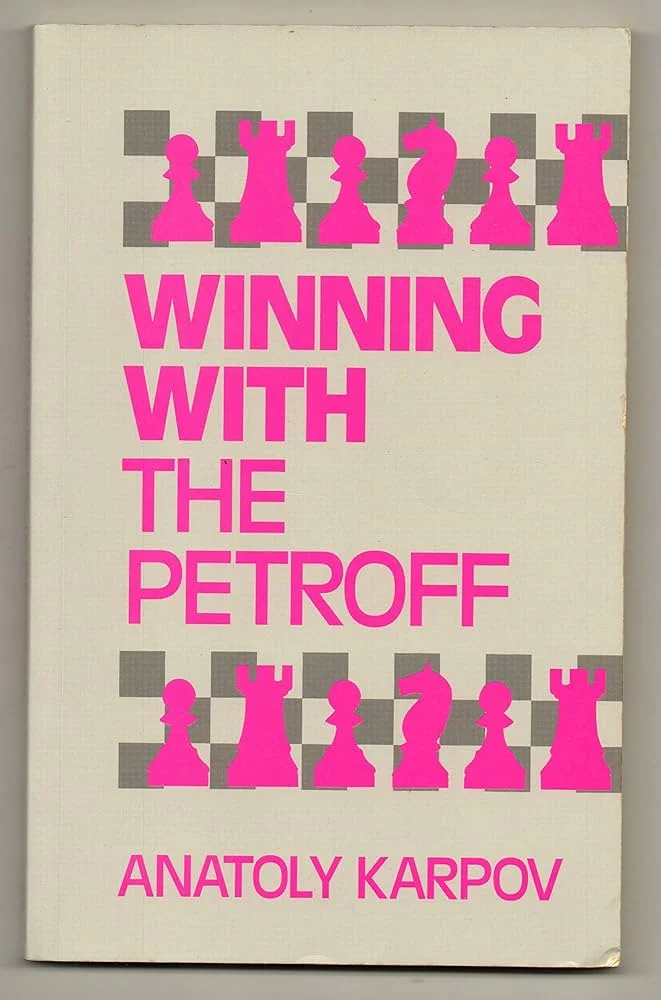
For any serious student of the open games, holding a monograph written by the 12th World Champion, Anatoly Karpov, feels less like reading a textbook and more like sitting across the table from a legend for a private lesson. Winning with the Petroff, published in 1993, captures a specific and fascinating moment in chess history. It arrives in the wake of the titanic struggles between Karpov and Garry Kasparov, matches where the Petroff Defense (1.e4 e5 2.Nf3 Nf6) served as a critical battleground.
Buy Winning with the Petroff on AmazonAs a tournament player who has often viewed the Petroff with a mixture of respect and frustration (it is notoriously difficult to crack), I dove into this book expecting a dry, technical manual on how to draw. What I found instead was a spirited defense of the opening’s fighting potential and a rich, albeit dense, collection of high-level analysis.
The Philosophy: Not Just for Draws
The first thing that strikes you in Karpov’s introduction is his desire to rehabilitate the Petroff’s reputation. He acknowledges the stigma: that against an equal opponent, Black plays 2…Nf6 to “risk” finding safety in a draw immediately. However, Karpov pushes back against this “deficiency,” arguing that in modern practice, White generally tries to take the initiative, which leads to an “enthralling struggle with equal chances”.
Karpov’s perspective is unique because he has been on both sides of the board in the most critical Petroff games of the 20th century. He notes that in four of his five matches with Kasparov, this opening was contested, and he claims without exaggeration that “the Petroff has never been studied with such intensity as after my duels with Kasparov”. This book, therefore, is not just a theoretical survey; it is a document of the highest-level theoretical debate of the 1980s and early 90s.
Structure and Approach
The book is structured around the “Complete Games” format rather than a dry encyclopedic tree of variations, although it certainly contains dense thickets of sub-variations within the annotations. Karpov uses 25 contemporary games (mostly from the late 80s and early 90s) as the skeleton for his theoretical survey.
The content is divided into six chapters based on the standard Informator classification (C42 and C43):
1. Main Line: 3.Nxe5 d6 4.Nf3 Nxe4 5.d4 d5 6.Bd3 Nc6 7.0-0 Be7.
2. Main Line (Sharper): The same sequence but with 7…Bg4.
3. Solid Systems: 6…Be7 7.0-0 0-0.
4. Symmetrical: 6…Bd6.
5. White’s 4th Move Alternatives: 4.Nxf7 and 4.Nc4,.
6. 3.d4: The Steinitz Attack and related lines.
Deep Dive: The Main Lines and the Kasparov Connection
The heart of this book lies in the first two chapters, where Karpov dissects the 3.Nxe5 complex. He emphasizes that the “fashionable choice” of the era was the system involving 6…Nc6 and 7…Be7.
The Karpov-Portisch Triptych In Chapter 1, Karpov treats us to his “theoretical duel” with Lajos Portisch from 1982. He presents Game 1 (Karpov-Portisch, Turin 1982) as a masterclass in handling White’s side against the 8…Bf5 variation,. Karpov explains the nuance of developing the bishop to f5—a move introduced by Robert Hübner—and how he prepared a specific novelty (9.c4!) that had been intended for Korchnoi in Merano but went unused,.
What I appreciated here was Karpov’s honesty about the psychological aspect of opening preparation. He mentions that Korchnoi avoided the Petroff after a psychological blow in Merano, which meant the 9.c4 novelty was sprung on Portisch instead,. The analysis of the resulting positions, particularly the tactical skirmishes arising from 9…Nb4 10.Bb1, is exceptionally deep.
The Kasparov Games Naturally, the games against Kasparov are the highlights. Karpov includes Game 3 (Karpov-Kasparov, World Championship Game 41, 1984), which features the maneuvering of the black knight to b4. Karpov details the strategic tension where Black tries to neutralize White’s centre. He candidly discusses the evolution of theory during their marathon match, noting how move orders like 9.c4 vs. 9.Re1 were refined in real-time under the pressure of the World Championship.
In the section on 7…Bg4 (Chapter 2), Karpov analyzes Game 11 (Kasparov-Karpov, Game 15, 1985). He explains that by playing …Bg4 immediately, Black saves a tempo by omitting …Be7, putting “serious pressure on the d4-pawn,” though at the cost of leaving the King in the center longer. The scrutiny given to the “Kasparov Gambit” line (9.Nc3 Bxf3 10.Qxf3 Nxd4 11.Qe3+) is immense. In Game 12, he breaks down Kasparov’s novelty 11.Qe3+ and his own reaction over the board, which involves a deep queen maneuver to a6,.
The “New” and the “Rare”
While the main lines are handled with the expected rigor, I was pleasantly surprised by the attention Karpov gives to less common setups.
The Symmetrical Variation (6…Bd6) Chapter 4 covers the “Symmetrical Variation,” which Karpov notes avoids the “risky” variations of the main lines. Through Game 17 (Timman-Salov), he explores the strategic nuances of the pawn structure after 8.c4 c6. He shows that even in these seemingly quiet lines, there are sharp tactical pitfalls, as evidenced by the analysis of 10…Bg4.
The Cochrane Gambit and 3.d4 For players who enjoy living dangerously, Chapter 5 is a treat. Karpov examines the Cochrane Gambit (4.Nxf7?!) through Game 20 (Vitolins-Raetsky). While he labels it with a “?!” and calls it a “rare” continuation, he admits it appeals to players with a “sharp style”. He doesn’t dismiss it out of hand but provides concrete lines like 5.d4 c5 where White can get into trouble,.
In Chapter 6, Karpov addresses 3.d4, noting it was “very much in vogue” at the time of writing. He uses Game 25 (Kasparov-Karpov, 1990) to showcase a specific novelty he prepared: 3.d4 exd4… 8.Nf3!?. He calls this Zaitsev-inspired move “paradoxical” because the knight moves so many times in the opening, yet he defends its logic with great conviction.
Instructional Value and Readability
Clarity of Explanations Karpov is a positional genius, and his explanations reflect that. He focuses heavily on the placement of pieces and the timing of breaks. For instance, in Game 25, he explains the concept of “corresponding squares”: “When the knight is on c3 the corresponding square for the bishop is d6, and when the knight is on e4 the bishop must move to e7”. This kind of high-level conceptual advice is gold for intermediate to advanced players.
Annotations The annotations are dense. This is not a book for a casual skim. Variations often run deep without diagrams, requiring a board (or two) to follow. However, the balance between tactical variations and verbal explanations is reasonable. He often explains why a move was played in a historical context, such as Spassky’s persistence with 5.Qe2 despite it bringing him “no particular success”.
Instructional Philosophy Karpov explicitly states his goal in the Introduction: “learning off by heart countless variations… will be of some use. However, I believe that familiarity with the games… will give the reader a contemporary understanding of the opening”. He succeeds in this. You walk away understanding the tension of the Petroff—the fight for the e5 and d4 squares—rather than just a list of moves.
Critique: Strengths and Weaknesses
Strengths:
1. Authority: There is no substitute for reading the thoughts of the man who defended this opening against Kasparov. The insights into their match psychology are invaluable.
2. Depth: The coverage of the 3.Nxe5 main lines is exhaustive for its time.
3. Honesty: Karpov is surprisingly critical of his own play and that of his peers. He highlights mistakes and missed opportunities, such as in Game 4 where he points out that “The difference in the activity of the two kings is too great” leading to a loss for White.
Weaknesses and Constructive Criticism:
1. Dated Theory: The elephant in the room is the year 1993. Opening theory moves at light speed. For example, the assessment of the Cochrane Gambit (4.Nxf7) or the specific evaluations of the 3.d4 lines have undoubtedly evolved with the advent of engines like Stockfish and AlphaZero. The book captures the “truth” of 1993, which is not always the truth of today.
2. Lack of Engines: Modern readers accustomed to computer-checked lines might find some assessments “human.” While this makes the book more readable, a modern tournament player would need to double-check these lines against an engine before playing them.
3. Dense Layout: The Batsford/Owl Book layout from this era is text-heavy. The variation trees can be hard to visualize without more frequent diagrams.
4. Limited Scope on Sidelines: While he covers alternatives, the focus is heavily skewed toward the lines Karpov played. If you are looking for a complete repertoire against every Anti-Petroff system, this might feel incomplete.
Practical Usefulness and Target Audience
Who is this book for? I would argue it is best suited for Advanced Players (1800-2200+ Elo) and Opening Theorists. Beginners and lower-intermediate players will likely find the strategic subtleties regarding “corresponding squares” and “isolated queen’s pawns” overwhelming, and the dense variations difficult to digest.
For tournament preparation, the book serves as a foundational text. You cannot play the Petroff at a high level without understanding the ideas Karpov lays out here, particularly regarding the pawn structures in the C42 system. However, it cannot be your only source. It must be supplemented with a modern database to check which of Karpov’s 1993 evaluations have been overturned by silicon monsters.
Final Verdict
Winning with the Petroff is a chess classic, not because it is a flawless roadmap to 2024 theory, but because it is a manifesto of the opening’s fighting spirit written by its greatest champion. It transforms the Petroff from a “drawing weapon” into a complex battlefield.
Karpov’s voice is sincere and authoritative. He respects the reader’s intelligence, offering deep strategic concepts rather than quick fixes. While the theory is naturally dated, the strategic understanding imparted is timeless.
Rating: 4/5
Justification: I deduct points only for the inevitable obsolescence of specific variations and the somewhat dense, older-style formatting. However, for its depth, historical importance, and the sheer quality of the positional explanations, it remains an essential volume for the library of any serious e4-e5 player. It is a testament to an era when opening preparation was a deeply human, creative endeavor.
Grab Winning with the Petroff on Amazon here. Buying through this link supports this site at no extra cost to you.
I’m Xuan Binh, the founder of Attacking Chess, and the Deputy Head of Communications at the Vietnam Chess Federation (VCF). My chess.com and lichess rating is above 2300. Send me a challenge or message via Lichess. Follow me on Twitter (X) or Facebook.