
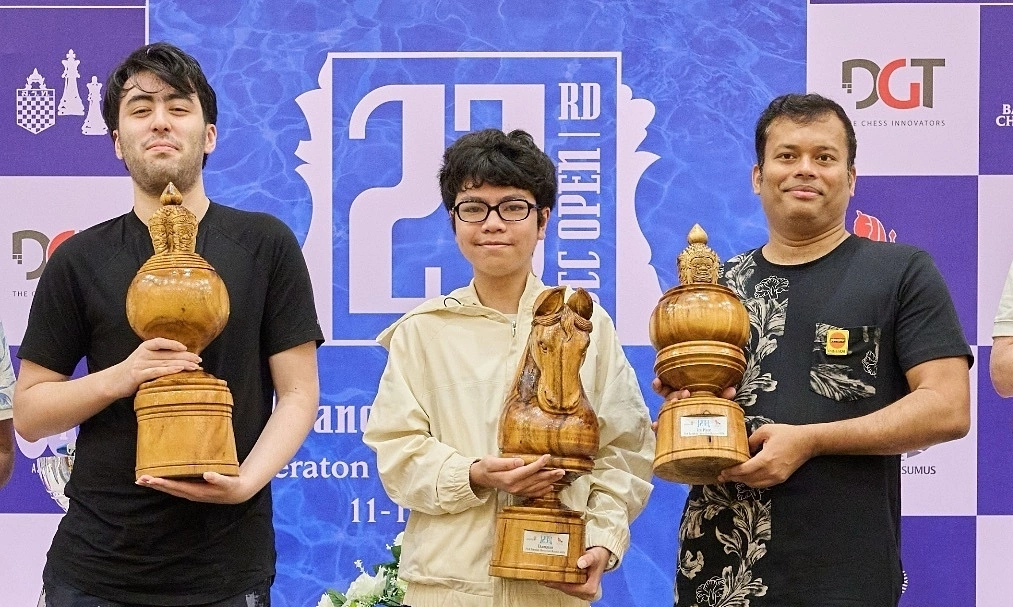
At 14, Dau Khuong Duy is closing in on one of chess’s biggest milestones: the Grandmaster (GM) title. His recent double triumph at the Bangkok Open has strengthened the sense that he is entering a decisive phase of his career.
For international readers, it’s worth noting that in Vietnamese naming order, “Dau” is the family name, while “Khuong Duy” is the given name. In practice, he is often referred to simply as Duy or Khuong Duy.
More than two years ago, at a tournament in Budapest, Duy drew attention for an unusual habit—wearing the same shirt for several days in a row. His reasoning was straightforward: as long as he kept winning, there was no need to change it. His coach, Luong Trong Minh, joked about “environmental inspectors” catching him, a comment the young player briefly took seriously.
That sense of ritual resurfaced at the 2026 Bangkok Open, albeit in a different form. Over 10 days in Hua Hin, Duy and his coach barely requested room service. Essentials like water and towels were collected outside. For them, maintaining a winning rhythm mattered more than comfort. Resort staff initially found the situation odd, but the confusion faded once Duy emerged as the tournament champion.
These details don’t explain his results, but they offer a glimpse into his mindset: trust the process, minimize disruption, and stay locked into form.
Duy’s title in Bangkok came in a strong open tournament featuring 16 Grandmasters. The result earned him his second GM norm, moving him within one step of the highest title in chess. At 14 years, 8 months, and 30 days at the time, he is now in position to potentially complete the GM requirements before turning 15.
That would be notable, considering that many elite players typically reach the GM title around age 16.
The Bangkok performance is another milestone in a rapid rise. Duy first gained international attention with a bronze medal in the World U8 Championship in 2019. Four years later, he won gold in the World U12 Championship in classical chess. Along the way, he has collected multiple medals at Asian youth events and global competitions in rapid and blitz formats.
He also gained an International Master (IM) norm at 11—an unusually early achievement—and crossed the 2300 Elo mark by age 12.
As of April 2026, Duy’s classical Elo stands at 2502, placing him among the top young players in the world. In the global ranking of players born in 2011 or later, he sits fourth, behind standout names such as Yagiz Kaan Erdogmus and Faustino Oro. The gap suggests he is not yet leading his generation, but firmly in the group of top contenders.
| # | Name | FED | Elo (Apr 2026) | Year of birth |
|---|---|---|---|---|
| 1 | Erdogmus, Yagiz Kaan | TUR | 2687 | 2011 |
| 2 | Oro, Faustino | ARG | 2528 | 2013 |
| 3 | Vaz, Ethan | IND | 2522 | 2011 |
| 4 | Dau, Khuong Duy | VIE | 2502 | 2011 |
| 5 | Gloeckler, Christian | GER | 2487 | 2011 |
| 6 | Ahmad, Khagan | AZE | 2483 | 2011 |
| 7 | Jiang, Haochen | CHN | 2459 | 2011 |
| 8 | Tudor, Henry Edward | ROU | 2457 | 2011 |
| 9 | Ruzhansky, Elias | BEL | 2451 | 2011 |
| 10 | Kuru, Atilla | TUR | 2444 | 2011 |
Having two GM norms before 15 is a strong foundation. Under FIDE regulations, a player needs three norms and a minimum rating of 2500 to earn the GM title, with at least one norm coming from an open tournament. Duy has already met the rating requirement and secured two norms, including one from Bangkok.
The final step, however, is often the hardest. Many players need years to secure their last norm, as competition becomes tougher and opportunities more limited.
Duy’s timeline inevitably draws comparisons with leading players such as Le Quang Liem, who became a Grandmaster at 15 years and just over two months. While Duy is unlikely to beat the youngest national record, he still has a realistic chance to reach the GM title at a similar—or even slightly earlier—age than Liem if he completes his final norm soon.
His development has been shaped by early commitment. From a young age, Duy trained intensively—often around six hours a day—while balancing school. Like many rising players, however, he faces the practical challenge of funding international tournaments, which are essential for gaining experience and earning norms.
The Bangkok Open showed that Duy can compete on equal terms in a strong open field, handle experienced opponents, and convert opportunities into tangible progress. Reaching the GM title at a young age—or pushing his rating even higher—would open doors to elite invitational events and stronger competition.
In the end, the stories about not changing shirts or avoiding room service are just small pieces of a bigger picture. They reflect a young player trying to hold on to momentum in a demanding sport.
Duy has already proven himself at youth level. The next step is clear: translating that promise into sustained success on the global stage.

I’m the senior editor of Attacking Chess, a keen chess player, rated above 2300 in chess.com. You can challenge me or asking questions at Chess.com.