
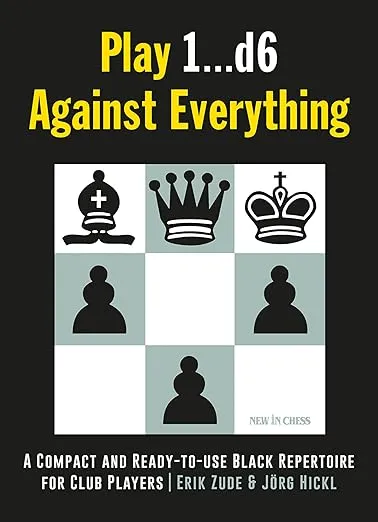
As a dedicated, self-taught chess player, I’ve spent countless hours navigating the labyrinth of opening theory. The journey of a solo learner is a unique one, marked by a constant search for clarity amidst a sea of information. Without a coach to distill complex ideas or steer me away from theoretical dead ends, the biggest challenge is finding a trustworthy guide—a resource that doesn’t just list moves, but explains the reasons behind them.
I’ve waded through dense tomes that feel more like encyclopedias than lesson plans, often leaving me more confused than when I started. It was in this context that I picked up IM Erik Zude and GM Jörg Hickl’s Play 1…d6 Against Everything, hoping it might finally be the comprehensive, understandable system I was looking for. This review is my honest assessment of whether it lives up to that hope, written for any fellow player charting their own course of improvement.
The Promise of a Repertoire for the Rest of Us
Before diving into the specific moves and variations, it’s crucial to understand the book’s core philosophy. Laid out in its forewords, this philosophy is what makes the repertoire so immediately appealing to the amateur player. From the very first pages, the authors make their intentions clear. This is not a book written by grandmasters for other grandmasters.
Instead, as the “Editor’s Foreword” explains, its goal is to provide learning material that is “well structured and manageable” for the average club player. The authors explicitly acknowledge that most of us are enthusiasts with busy lives, and this foundational respect for the reader’s time sets a welcoming and practical tone. The book isn’t just a collection of lines; it’s a proposed method for how to approach chess improvement when time is your most precious resource.
The book’s appeal is built on a few core arguments that directly address the pain points of the amateur player.
• Focus on Understanding, Not Memorization: The authors argue that true improvement comes from grasping fundamental concepts, not from rote memorization of endless computer lines. They believe that a deep understanding of recurring structures and plans will serve a player far better than shallow knowledge of fashionable theory. Co-author Jörg Hickl states it perfectly: “Understanding fundamental themes in chess, such as dealing with structures, squares and the many other tactical and strategic elements of chess, has a far greater impact on overall performance than does opening theory.
• Time Efficiency: The book is designed for players who have “a challenging professional life with intensive social involvements.” It rejects the idea that amateurs must study thousand-page opening manuals to be competitive. The authors present their work as a realistic solution: “Effective time management is needed – opening theory should not constitute the main focus of a club player’s efforts! Play 1…d6 Against Everything provides a good 200 pages of manageable opening knowledge for a chess player’s everyday routine.”
• Practical Advantages Over Theoretical Perfection: Zude and Hickl are refreshingly honest about the objective standing of their chosen lines. They concede that the Antoshin Variation and the Old Indian may be “somewhat inferior” to the absolute main lines. However, they argue that the practical benefits of wielding a “small, solid and uncommon repertoire” far outweigh this minor theoretical concession. As Erik Zude explains: “This book was put together primarily for today’s circumstances, a slim repertoire book for club players with an Elo rating between 1400 and 2200. But it should also offer some interesting suggestions to players at a higher level.”
The promise is compelling: a complete, time-efficient repertoire built on a foundation of understanding. The question, then, is whether the book’s teaching style and execution can deliver on this ambitious philosophy.
The “Coach in a Book”: Evaluating the Explanatory Style
A solo learner has no coach to turn to when a position seems confusing or a recommended move feels counter-intuitive. The book itself must anticipate these moments of uncertainty and provide clear, reassuring explanations. It must, in essence, act as a coach. This is where Play 1…d6 Against Everything truly shines.
The authors consistently demonstrate an ability to see the position through the eyes of a club player. A perfect example appears in Chapter 1, “The Endgame Variation,” a line that begins with an early queen trade. As a student, my initial reaction to the resulting position (1.e4 d6 2.d4 ♘f6 3.♘c3 e5 4.dxe5 dxe5 5.♕xd8+ ♔xd8 6.♗c4 ♗e6 7.♗xe6 fxe6) was one of alarm.
My king is stuck in the center and my pawn structure looks ruined! A lesser book might simply present variations from this point, but Zude and Hickl pause to address these fears directly:
“But the decisive factor here is the coordination of Black’s pieces and pawns: 1) King safety: after …♗d6 and …♔e7 Black’s king would be hard to get at… And an opening up of the middle of the board is precluded for the most part by the doubled pawns.”
This kind of clear, conceptual explanation is worth more than a dozen pages of raw analysis. It builds confidence and provides a strategic anchor, transforming a worrying position into one of understanding and purpose.
At one point in the foreword, the authors offer a piece of advice that felt like it was spoken directly to me. It perfectly encapsulates the book’s coaching philosophy and its goal of empowering the reader to think for themselves.
“Always work at a full-size board and, more and more, make the transition from the critical (!) reading of this book to your own, independent analysis – this usually results in the best progress. The numerous variations cited are not to be memorized, but used as orientation and stimulation for your own analysis. When you ask, ‘What is the best play for both sides? I will check this for myself!’ – then you have started on an auspicious path for increasing your understanding and your playing strength.”
The book’s instruction is grounded in practical application. The authors frequently use their own games to illustrate key concepts, which adds a powerful layer of authenticity. This isn’t just sterile theory; it’s a battle-tested system that they have trusted in their own careers. In the notes to the Pötsch-Zude game, for instance, Zude adds a personal touch that makes the lesson more engaging: “This game was played in the last round and would decide the championship of Germany, a fact that greatly motivated both contestants.” This context reminds the reader that chess is a human struggle, making the strategic lessons all the more memorable.
The book often succeeds brilliantly in its role as a coach, explaining concepts with clarity and empathy. Now, let’s look at how the chess content itself is structured to guide the solo student.
A Roadmap for the Solo Student: Navigating the Repertoire
A good repertoire book needs more than just sound analysis; it requires a logical and intuitive structure that allows a student to build their knowledge systematically without getting lost. Zude and Hickl have organized their material into a clear roadmap that is perfectly suited for self-study.
Part I: Battling 1.e4 (Chapters 1-3)
• This section forms the heart of the repertoire, providing a complete system against White’s most common opening move. The authors wisely break it down into manageable parts.
◦ Chapter 1 (The Endgame Variation) is presented first, addressing the early queen trade that many white players use to try and punish the 1…d6 setup. By tackling this potentially intimidating line head-on, the book helps the reader build confidence in handling queenless middlegames right from the start.
◦ Chapter 2 (The Antoshin Variation) is the main event. This is the core of the repertoire against 1.e4, where Black keeps queens on the board and enters a rich, strategic middlegame.
Part II: Facing 1.d4 and the English (Chapters 4-6)
• Here, the book provides a coherent system against White’s other major opening choices, leveraging a key advantage for the solo learner: structural similarity.
◦ The repertoire transitions to the Old Indian Defense (Chapter 4) to meet 1.d4. The authors emphasize a system-based approach where similar pawn structures, piece placements, and strategic plans appear again and again. This repetition makes the ideas easier to absorb and recall over the board.
◦ The coverage is rounded out by a plan against The English Opening (Chapter 6), which often transposes into the familiar Old Indian structures, further reinforcing the core concepts of the repertoire.
Part III: Handling the Sidelines (Chapters 3, 5, and 7)
• For the practical tournament player, these chapters are invaluable. Club-level opponents will frequently employ unusual flank openings and obscure side variations, hoping to take you out of your preparation. This book ensures you are never caught off guard. It provides simple, reliable plans against these lesser-known systems, often by showing how to steer the game back toward familiar territory.
As the authors state in Chapter 7: “In the seventh and last chapter of our little d6-repertoire we consider the flank systems. These rarely occur in practical play, and the next most common moves (after 1.e4, 1.d4, 1.♘f3 and 1.c4), 1.g3 and 1.f4, are about ten times less frequent than 1.c4. Hence we do not analyze these variants in detail, but with the help of model play show how you can use the formations discussed, in most cases intensively, in our repertoire.”
The book’s structure is a model of clarity, guiding the student from the most common responses to the less frequent ones in a logical progression. While the map is excellent, any honest journey includes a few difficult patches of terrain.
Bumps in the Road: When the “Coach” Gets Technical
No single chess book is perfect, and even the most accessible coach can sometimes delve into analysis that is difficult to follow. For the sake of an honest review, it’s important to acknowledge the moments where Play 1…d6 Against Everything becomes dense and could potentially challenge a player studying alone. Setting realistic expectations is crucial for any student.
There are sections where the analysis becomes highly complex. In the notes to the Pötsch-Zude, Hofbieber 2014 game from Chapter 2, Zude describes White’s “pawn roller g4-g5 and f5-f6.” The ensuing variation is long and fraught with tactical dangers—so much so that Zude himself admits to losing his way with an “aimless ‘developing move’,” demonstrating the practical difficulty. This specific example points to a broader challenge: the long trees of variations that open some chapters, such as in “The Endgame Variation,” can feel intimidating at first glance. Without a coach to point out the most critical lines, the student must rely on the authors’ advice to focus on the main ideas first and return to the details later.
Perhaps the most powerful tool the book offers for navigating these difficult moments is the authors’ own candor. They don’t pretend that their system leads to easy, risk-free positions. On the contrary, they openly share their own struggles and uncertainties, which makes their guidance feel far more credible. Erik Zude’s confession while analyzing the Kachiani-Gersinska-Zude game is a moment of profound relatability for any tournament player:
“As happens so often in tournament practice, in spite of my good preparation I could no longer remember my concrete analysis and began to improvise at the board… Whereas both players have up to this point strengthened the game largely in accordance with the requirements of the position, supported by their concrete preparation, they now proceed – only a few moves later! – to deviate more and more from it.”
This admission is incredibly valuable. It normalizes the experience of forgetting theory and having to rely on one’s own understanding at the board. Instead of being a flaw, the inclusion of these complex and challenging moments serves as a sign of the book’s integrity. It doesn’t promise magical solutions, but rather prepares the reader for the true, messy, and beautiful complexity of a real game of chess.
Having explored the book’s philosophy, teaching style, and content, it’s time to bring these threads together for a final verdict.
The Final Verdict: Your New Coach in Black
So, we return to the central question: Is Play 1…d6 Against Everything a suitable coach for the self-taught player? After working through its pages and testing its ideas, my answer is an emphatic yes. It is one of the best single-volume resources a solo learner could hope to find.
Why This Book Succeeds as a Solo Guide
• A Clear, Practical Philosophy: It is written for busy adults with limited study time. Its entire approach is built on practicality and respect for the reader.
• Exceptional Conceptual Explanations: The book excels at explaining the ideas behind the moves. It consistently answers the “why,” which is the most critical question for anyone studying without a coach.
• A Truly Complete and Coherent Repertoire: It provides a reliable response to all of White’s major opening moves (1.e4, 1.d4, 1.c4) as well as the tricky sidelines, all within a single, interconnected system.
• Honesty and Authenticity: The authors are not afraid to show their own mistakes and struggles. This vulnerability makes their advice more credible and their instruction more relatable.
The book does contain moments of high complexity and dense variations. However, this should not be seen as a flaw. Chess is a difficult game, and an honest guide must reflect that. The authors themselves advise the reader to approach these sections with patience, focusing first on the illustrative games and core concepts before diving into the detailed sub-variations.
For my fellow self-taught players, the search for a trustworthy guide can be a long one. If you are looking for a repertoire that values deep understanding over rote memorization, and if you want a “coach” who speaks to you with clarity, respect, and unflinching honesty, then this book is an outstanding choice. It will not only provide you with a solid set of moves but will also, as promised, deepen your understanding of the game as a whole. It has earned a permanent place on my bookshelf, and I believe it can do the same for yours.
Rating: 4.5/5
Guest Author: Thomas Mitchell
If you’d like to dive deeper into this repertoire, you can purchase the book through Amazon. Buying through these affiliate links comes at no extra cost to you.

AttackingChess Guest Contributors is a collective author profile representing chess enthusiasts, reviewers, coaches, and community members who contribute book reviews, insights, and educational material to the site.
Articles published under this profile may come from different writers with varying backgrounds in strategy, tournament experience, chess literature, and long-term training. All submissions are edited and fact-checked by the AttackingChess editorial team to ensure quality, accuracy, and practical value for readers.
This contributor profile is designed to give a voice to many chess lovers who want to share their perspectives without maintaining individual author accounts. You could submit your article to hxb4693@gmail.com.