
Every improving chess player knows the feeling. You’ve played a brilliant opening, navigated the middlegame with care, and built a completely winning position. Victory is within your grasp. Then, in a single, horrifying moment, you make a move, hit the clock, and see it: a knight fork, a hanging piece, a back-rank mate you completely missed. The ecstasy of a well-played game evaporates into the agony of a needless loss. It’s the experience that defines the rating plateau, the frustrating cycle of two steps forward, two steps back that makes genuine progress feel just out of reach.
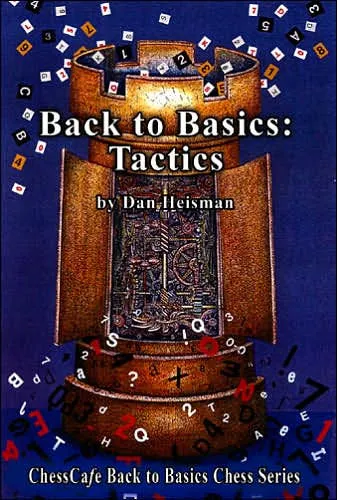
In the search for an antidote to these struggles, one name and one book are recommended with near-universal acclaim: National Master Dan Heisman and his foundational text, “Back to Basics: Tactics.” This slim volume has become a rite of passage for countless players looking to build a solid foundation. This review aims to explore not just what the book contains, but why its philosophy and meticulously crafted structure are so profoundly effective for its target audience.
Does this classic text from 2007 still hold the key to unlocking consistent chess improvement in the modern era? Let’s find out.
Who is National Master Dan Heisman?
In a subject as complex and humbling as chess, the credentials and teaching philosophy of the author are paramount. A grandmaster’s analysis, while brilliant, can be impenetrable to a club player. An author who has forgotten what it’s like to be a beginner can offer advice that is technically correct but practically useless. This is where Dan Heisman’s unique qualifications shine.
As the book’s back cover states, Heisman is a National Master and a professional chess instructor based in the Philadelphia area. More importantly, his entire career has been dedicated to understanding and correcting the specific thought processes that hold amateur players back. His popular monthly column for beginners, “Novice Nook,” has been a staple at ChessCafe.com since 2001, demonstrating a long-term commitment to guiding those at the start of their journey. His best-selling chess book Looking for Trouble was one of the first to highlight the critical importance of identifying an opponent’s possible tactical threats. He is not a distant grandmaster writing from an ivory tower; he is a seasoned coach who has spent thousands of hours in the trenches, observing the common mistakes and triumphs of his students.
This deep empathy for the improving player’s mindset is the guiding principle behind “Back to Basics: Tactics,” and it informs every chapter, example, and piece of advice within.
Why Tactics Are the “Single Most Important Thing”
The beginner is often paralyzed by choice: “Should I study openings? The endgame? Strategy?” Dan Heisman cuts through this noise with a clear, uncompromising doctrine that forms the philosophical core of his book: tactics come first, last, and always.
Heisman argues that tactical proficiency is the bedrock upon which all other chess skills are built. He isn’t presenting a radical new idea, but rather endorsing a time-tested truth of chess pedagogy, building on the work of authors like Michael de la Maza and the wisdom of the Russian chess school. As Heisman states in his introduction, “I learned from the Russians that repetitive study of basic tactics is probably the single most important thing any beginner can do to improve at chess.”
This isn’t just a casual suggestion; it’s a direct command to the student. He challenges the common temptation to memorize complex opening lines, a siren song for many new players, by highlighting a more fundamental truth of amateur chess:
"It doesn't matter who gets the advantage out of the opening if one of the players is likely to lose a piece to a simple tactic in the middlegame."
His prescription is therefore simple and direct:
"So study tactics, not openings, until you almost never lose pieces to simple tactical motifs."
The impact of this “tactics-first” approach is transformative. By focusing on the fundamental patterns of piece safety and attack, the student builds a solid floor for their game. It inoculates them against the simple, game-losing blunders that cause so much frustration. Only once this foundation is secure does the study of openings, positional play, and complex strategy become truly meaningful. Without tactical vision, any strategic advantage is temporary and likely to be squandered.
This philosophy is the “why” behind the book. Let’s now explore the “what” and “how” by examining its structure.
A Look at the Table of Contents
The structure of “Back to Basics: Tactics” is not a random assortment of puzzles. It is a deliberate, logical progression designed to build tactical understanding from the most fundamental concepts to more complex, game-like situations. The Table of Contents reveals a carefully planned curriculum for the aspiring player.
• Introduction 5
• How to Use This Book 10
• Acknowledgements 11
• Chapter 1 Safety and Counting 12
◦ Counting Problems 33
◦ Solutions to Counting Problems 37
• Chapter 2 Tactical Motifs 38
◦ 2.1 Trapped Pieces 38
▪ Trapped Piece Problems 40
▪ Solutions to Trapped Piece Problems 46
◦ 2.2 Pins 47
▪ Pin Problems 50
▪ Solutions to Pin Problems 56
◦ 2.3 Skewers 58
▪ Skewer Problems 61
▪ Solutions to Skewer Problems 63
◦ 2.4 Double Threats 63
▪ Double Threat Problems 65
▪ Solutions to Double Threat Problems 68
◦ 2.5 Double Attacks 68
▪ Double Attack Problems 70
▪ Solutions to Double Attack Problems 74
◦ 2.6 Knight and Pawn Forks 75
▪ Knight and Pawn Fork Problems 77
▪ Solutions to Knight and Pawn Fork Problems 80
◦ 2.7 Removal of the Guard 82
▪ Removal of the Guard Problems 85
▪ Solutions to Removal of the Guard Problems 94
◦ 2.8 Discovered Attack and Discovered Check 96
▪ Discovered Attack and Discovered Check Problems 98
▪ Solutions to Discovered Attack and Discovered Check Problems 105
◦ 2.9 Promotion and Underpromotion 106
▪ Promotion and Underpromotion Problems 110
▪ Solutions to Promotion and Underpromotion Problems 112
◦ 2.10 Other Tactical Motifs 113
▪ Miscellaneous Problems 115
▪ Solutions to Miscellaneous Problems 117
• Chapter 3 Checkmates 118
◦ 3.1 Basic Endgame Checkmate Patterns 118
◦ 3.2 Basic Checkmate Patterns 122
▪ Checkmate Problems 127
▪ Solutions to Checkmate Problems 134
• Chapter 4 Opening Sequences 135
• Chapter 5 Defensive Tactics 144
◦ Defensive Problems 145
◦ Solutions to Defensive Problems 151
• Chapter 6 78 Problems on 64 Squares 153
◦ Solutions to 78 Problems on 64 Squares 166
• Chapter 7 The Seeds of Tactical Destruction 172
• Chapter 8 Is There a Win? 183
◦ Solutions to “Is There a Win?” Problems 186
• Appendix A The Five Levels of Tactics 189
• Appendix B Chess Guidelines 190
Deconstructing the Core Chapters
While a full chapter-by-chapter summary is beyond the scope of this review, a deep dive into the most impactful sections reveals the book’s pedagogical genius. It’s in these core chapters that Heisman’s approach transforms from a philosophy into a practical, effective training program.
Why “Safety and Counting” Comes First
In what can only be described as a masterstroke of pedagogy, Heisman begins not with flashy combinations, but with the mundane—and absolutely critical—concepts of “Safety and Counting.” Where most beginner books tempt players with the sugar rush of exciting tactics like forks and skewers, Heisman understands that this only reinforces a habit of looking for tricks. His approach is a fundamental paradigm shift in chess instruction: first, he builds the discipline to not lose. He correctly identifies that the vast majority of games below the expert level are lost to simple blunders where a player miscalculates a sequence of captures or leaves a piece undefended. Chapter 1 tackles this problem head-on.
Heisman reframes the very idea of tactics, presenting it first as a defensive skill:
"Tactics can be considered the science of piece safety..."
He then defines the core skill required to ensure that safety:
"Counting is the process of determining whether any series of captures might lead to losing material..."
By forcing the reader to master the simple arithmetic of exchanges before anything else, Heisman builds the student’s confidence from the ground up. Mastering this chapter is an emotional turning point for many players. It marks the transition from a state of constant, low-level fear of blundering to a state of confidence that, at the very least, your pieces are safe. This is the chapter that cures the improving player’s most painful disease: giving away games for no reason.
The Compendium of Tactical Motifs
Chapter 2 is the heart of the book, a comprehensive catalog of the fundamental tactical patterns that decide most chess games. Its structure is simple, repetitive, and highly effective. For each motif—pins, skewers, removal of the guard, and so on—Heisman provides a clear definition, illustrates the concept with examples, and then presents a series of problems for the reader to solve.
Heisman’s teaching method excels in its clarity. He explicitly states that the simplicity of his diagrams is a deliberate pedagogical choice. On page 8, he contrasts a full-board problem (Example 1-1) with a simplified one (Example 1-2) to show his method: “In this book, I will use both types of positions, with isolated pieces used for illustrating motifs and easy problems…” This “isolate and repeat” method strips away distracting, irrelevant pieces and burns the core geometric pattern into the reader’s memory.
Woven throughout the book are short, memorable “nuggets of wisdom” in text boxes that distill key concepts into easily digestible advice. These serve as constant reminders of the book’s core principles.
• "When a piece is overworked, simply make it do one of its jobs and then it cannot do the other one!"
• "Most games between lower rated players are won or could be won on tactics, so studying tactics when you are lower rated is much more important than anything else."
• "An absolute pin is when the opponent's king is behind the attacked piece."
You can also check out another book by Heisman here:
Advanced Concepts for the Real World
If the first two chapters build the tactical foundation, later chapters elevate the book from a simple puzzle collection to a comprehensive training manual for over-the-board play. They build a powerful narrative arc that teaches the student how to actually use tactics in a real game.
First, Chapter 2 teaches you the alphabet of tactics—the individual motifs like pins, forks, and skewers. This is the raw vocabulary. But knowing the alphabet isn’t enough; you need to know how to form words. That’s where Chapter 7, “The Seeds of Tactical Destruction,” comes in. This brilliant chapter teaches you how to recognize the conditions that allow tactics to exist. It trains you to spot positional ingredients—like unguarded pieces, a vulnerable king, or geometric alignments—that signal when you should even start looking for a combination.
Finally, Chapter 8, “Is There a Win?”, teaches you syntax and judgment. This section presents realistic positions and asks you to decide if a forced win exists or if the position is merely better. This is the crucial skill of distinguishing between a position that allows for a decisive, winning “sentence” and one that is merely advantageous. It bridges the gap between seeing a tactic and correctly evaluating its consequences. As Heisman notes:
"Tactics just don't come from deep thinking. Tactics spring from superior positions, and you don't get superior positions against decent opposition unless you understand positional play."
Woven into this journey is Chapter 5, “Defensive Tactics,” a section of immense practical value. Heisman teaches you the gritty art of saving lost positions—a skill that will win you more rating points in the long run than any flashy sacrificial attack. By learning to use tactics to save a bad position, you build the resilience and fighting spirit of a true competitor.
The Heisman Method: How to Extract Maximum Value
Owning a great chess book is one thing; studying it effectively is another. Heisman is a coach first and foremost, and he provides explicit instructions on how to get the most out of his material. The core of his recommended method is one word: repetition.
Heisman is not interested in whether a student can solve a problem once. The goal is to achieve unconscious competence—to recognize the basic patterns so quickly that they become second nature. He makes an elegant analogy on page 10:
"It is very similar to memorizing your multiplication tables before you attempt algebra or calculus."
The practical implication is that the student should not simply work through the book from cover to cover and then place it on the shelf. The basic motifs in the early chapters should be reviewed again and again, “until you can solve them almost by recognition.” This is how a player builds the “mental ‘tactical database'” Heisman refers to on page 65. The goal is instant recall, not slow, deliberate calculation. This rigorous, repetition-based method is what separates passive reading from active training, and it is the key to translating study into tangible, over-the-board improvement.
Is This Book Right for You?
Having analyzed the book’s philosophy, structure, and content, we can now move to the final, practical question for any prospective buyer: is this book the right tool for your specific chess journey?
The Ideal Reader
Heisman is remarkably clear about his target audience. This book is written for “beginning players who have never played tournament chess or who possess a U.S. Chess Federation rating lower than 1500.” He later clarifies that this also applies to players whose primary experience is online, extending the audience to anyone with “a rating below 1700.”
The ideal reader is ambitious and wants to improve, but finds their progress stalled by tactical oversights. They are the player who frequently analyzes their games and discovers they lost from a perfectly good, or even winning, position due to a one- or two-move blunder. If this describes you, this book was written specifically to solve your biggest problem.
Who Might Look Elsewhere?
To provide a balanced perspective, it is important to identify who this book is not for. Players rated significantly above the 1500 USCF / 1700 online threshold will likely find the majority of the approximately 500 examples to be too simple. While Heisman notes that “there are definitely some problems in this book that would challenge players above 1500,” they are not the primary audience.
For these stronger players, the core principles of safety and pattern recognition are already second nature. Their improvement depends on solving more complex, multi-move combinations and deepening their strategic understanding. While the philosophy of this book is timeless, these players would be better served by more advanced tactical collections.
Conclusion: The Verdict on a Modern Classic
Dan Heisman’s “Back to Basics: Tactics” is far more than a simple collection of chess puzzles. It is a masterfully designed training program built on a deep and empathetic understanding of the beginner’s mind. Its strength lies in its impeccable logic: starting with the absolute fundamentals of piece safety, building a comprehensive arsenal of tactical motifs through clear instruction and repetition, and finally teaching the reader how to apply these skills in the messy reality of a real game.
Heisman’s “tactics-first” doctrine is not just a training tip; it is the single most effective philosophy for any player seeking to break through the beginner and intermediate plateaus. The book’s unwavering focus on eliminating simple blunders and building a reliable tactical vision provides the essential foundation for all future learning. It answers the beginner’s most urgent need before anything else.
For any player serious about building a lasting foundation for their chess journey, “Back to Basics: Tactics” is not just a recommendation; it is essential reading.
Rating: 4.3/5
Guest Author: Ethan Doyle
If you’d like to dive deeper into attacking play, you can purchase the book through Forward Chess or Amazon.
Buying through these affiliate links comes at no extra cost to you.

AttackingChess Guest Contributors is a collective author profile representing chess enthusiasts, reviewers, coaches, and community members who contribute book reviews, insights, and educational material to the site.
Articles published under this profile may come from different writers with varying backgrounds in strategy, tournament experience, chess literature, and long-term training. All submissions are edited and fact-checked by the AttackingChess editorial team to ensure quality, accuracy, and practical value for readers.
This contributor profile is designed to give a voice to many chess lovers who want to share their perspectives without maintaining individual author accounts. You could submit your article to hxb4693@gmail.com.