
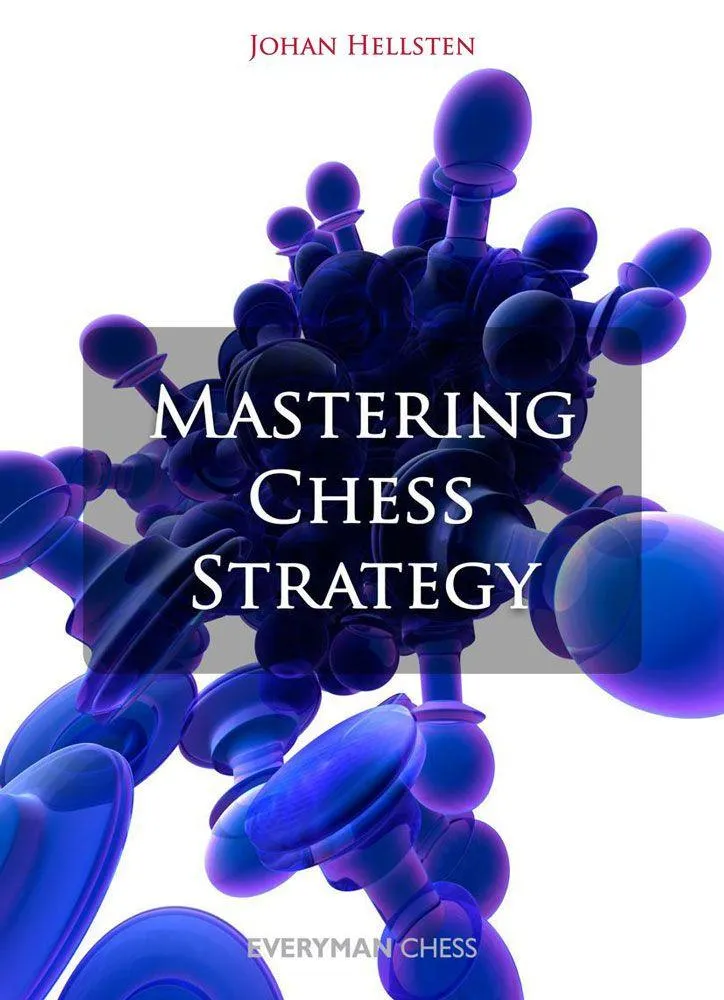
For any chess player serious about improvement, the bookshelf begins to feel like a graveyard of good intentions. We collect books on openings, tactics, and endgames, each promising to unlock the next level of our potential.
Yet, the most significant leap—the one from simply knowing tactical patterns to truly understanding the strategic currents of a game—remains the most elusive. It’s in this challenging space that Johan Hellsten’s Mastering Chess Strategy has carved out its reputation not as a new, flashy title, but as a substantial and indispensable workhorse in a player’s library. This review is a thoughtful analysis of how, and for whom, this book bridges that critical gap.
Hellsten himself sets a clear and unpretentious standard for his work. In the Preface, he states the book’s objective is “purely practical: to help the reader to improve his skills within chess strategy.” This single sentence provides the perfect lens through which to evaluate the entire volume. It isn’t a book of chess history, art, or groundbreaking theory; it is a training manual.
The central question, then, is a simple one: Does Hellsten deliver on this practical promise? Is his method effective for the ambitious club player, and who stands to benefit most from this deep dive into the strategic soul of chess?
The Hellsten Method: A Philosophy of Active Learning
The structure of a chess book is not a trivial matter; it reflects the author’s entire teaching philosophy. A poorly organized book can leave a student with a collection of disconnected ideas, but a well-designed one builds a cohesive, intuitive understanding. Hellsten’s approach is nothing if not methodical, built around the core principle of active engagement rather than passive reading.
The book is organized thematically into clear, digestible chapters focusing on the core pillars of middlegame play: “Improving the Pieces,” “Exchanges,” “Pawn Play,” and “Prophylaxis.” This conceptual structure stands in contrast to books organized by specific openings or the collected games of a single grandmaster, immediately signaling its focus on universal strategic principles that can be applied in any position.
At the heart of the book is Hellsten’s pedagogical cycle, a simple but powerful three-step process he advises for each section:
1. Go through the explanatory examples;
2. Solve the related exercises;
3. Compare your solutions.
This isn’t just a suggestion; it’s the fundamental architecture of the book. Hellsten is a firm believer that true chess skill is forged through work, not just reading. He makes his conviction plain in the Introduction:
“I am a strong supporter of the intensive use of exercises in the learning process… What most of us need is practice, practice…”
The commitment to this philosophy is evident in the book’s very layout. It is organized into a theoretical section, followed by 382 carefully selected exercises. A substantial final section, nearly 120 pages long, is devoted to comprehensive solutions, making the “theory-plus-practice” model robust and self-contained. Each block of exercises corresponds directly to a specific section of the theoretical chapters.
For instance, the section on “The bishop” in Chapter 2 is reinforced by exercises 1-20, while the concept of “Restriction” in Chapter 5 is practiced in exercises 247-266. This tight integration of theory and practice is the book’s greatest structural strength, ensuring that every concept is not just explained but actively reinforced.
Ultimately, the book’s architecture is a deliberate and highly effective engine for building practical skill. It treats the reader not as an audience member, but as a student in a masterclass, ready to roll up their sleeves and work.
A Deep Dive into the Strategic Core
While the book’s structure provides the framework for learning, its true value lies in the clarity and depth of its strategic content. Hellsten excels at breaking down complex middlegame concepts into their constituent parts, allowing the club player to build a sophisticated understanding from the ground up.
Improving the Pieces: Beyond Development
Chapter 2, “Improving the Pieces,” teaches a lesson that separates intermediate players from advanced ones: pieces are not static objects with fixed values, but dynamic assets whose potential must be constantly evaluated and maximized. This goes far beyond the simple opening principle of “develop your pieces.
• The Bishop: Hellsten demonstrates how to recognize and seize critical diagonals. In the Bujakevich-Kritz example, he highlights White’s 12 b3!. This isn’t just a random pawn move; it’s played with the clear intention of placing the bishop on b2, where it will dominate the long diagonal, a key strategic feature of the open position.
• The Knight: The chapter explores the knight’s unique power, particularly its ability to dominate from a protected square. In the classic game Kasparov-Piket, the analysis of Kasparov’s play is a masterclass in knight usage. The manoeuvres 19 Ncd6! followed by 23 Nc5! illustrate how a well-placed knight can paralyze an opponent’s position and serve as the anchor for a decisive attack. Hellsten is teaching a repeatable pattern: identify a key square, prove you can control it, and then relentlessly occupy it to dismantle your opponent’s coordination.
This chapter builds the foundational skill of piece evaluation, a prerequisite for the more complex topic of making purposeful exchanges.
The Art of the Exchange: Trading with Purpose
For many club players, exchanges are reactive or based on simple material counts. Chapter 3, “Exchanges,” is a highlight of the book because it provides a powerful strategic framework for this difficult subject. Hellsten categorizes trades by their ultimate purpose, giving the reader a mental checklist for evaluating any potential exchange. These objectives include:
• Realizing a positional advantage
• Eliminating key pieces
• Reducing enemy activity
• Facilitating an attack or defence
A brilliant illustration of this is found in the game A.Khalifman-M.Adams. After White plays 22 Ne4, threatening to swap Black’s powerful knight, Adams responds with the decisive 22...Bf5!. Hellsten’s explanation is crystal clear:
“Black prepares to exchange his bishop for the white knight, so that his own, powerful knight will remain on the board.”
This single, purposeful exchange transforms the position into a classic “good knight vs. bad bishop” scenario, giving Black a clear and lasting advantage. This chapter’s true power is that it re-programs a club player’s instincts. Hellsten provides a mental checklist that transforms the exchange from a tool of simplification into a precise surgical instrument for creating specific, favorable imbalances.
Prophylaxis and Restriction: Thinking for Both Sides
Chapter 5 is where Hellsten introduces the concepts that truly elevate a player’s thinking: Restriction, Prophylaxis, and Provocation. This is the chapter that separates the 1600 player who only thinks about their own plan from the 2000+ player who is playing a two-person game. Hellsten makes it clear that half of chess is played in the opponent’s mind.
The game E.Lobron-R.Dautov serves as a perfect demonstration.
After White plays 27 Re2, threatening the back rank, Black responds with 27...g6!. Hellsten’s analysis reveals the deep thinking behind this quiet pawn move:
“A typical prophylactic measure. With …Kg7 next, Black safeguards the king from any surprises along the back rank.”
But Dautov’s play goes further. A few moves later, he employs provocation with 29...h5!, a move designed to induce weaknesses in the white kingside. This chapter is crucial because it trains the player to adopt a grandmaster-level mindset, constantly asking, “What does my opponent want to do, and how can I stop it?”
An Honest Assessment: Strengths and Weaknesses
While Mastering Chess Strategy is an exceptional resource, no single volume is perfect for every player. A fair review must acknowledge its limitations alongside its considerable virtues to provide a complete picture for the prospective student.
What Hellsten Gets Right
• Unwavering Practical Focus: The book delivers precisely on the author’s stated goal of being “purely practical.” Every example and exercise is geared towards tangible improvement on the board.
• Superb Structure: The “theory-plus-practice” model, with explanatory examples followed by a large volume of tightly correlated exercises, is brilliantly executed for reinforcing knowledge and building intuitive skill.
• Clarity of Explanation: Hellsten’s writing is true to his stated “didactical” intention. He avoids the “excessive use of analysis” that plagues many advanced chess books, instead focusing on the strategic ideas behind the moves, making complex concepts accessible.
• Comprehensive Strategic Coverage: The book covers an impressive breadth of strategic topics, from the fundamentals of piece play to advanced concepts like prophylaxis, offering a complete curriculum for the middlegame.
Potential Shortcomings
This critique is offered not as a harsh complaint, but as a thoughtful observation for the discerning player.
• A Pedagogical Misstep: The placement of concepts like “The initiative” and “Weak squares” in “Chapter Six: Miscellaneous” is more than a structural quirk; it is a pedagogical misstep. It implicitly signals to the developing player that these are secondary concepts, when in fact they are the very cornerstones of strategic play. An aspiring player might gloss over the single most important concept in dynamic chess—the initiative—simply because it’s filed away in a catch-all section.
• A Note on Game Selection: While the examples are highly instructive, the author notes that he has “used a lot of my own games and fragments, simply because these are the games that I know best.” This is perfectly understandable and doesn’t detract from the lessons. However, a player might observe that a broader selection of games from a more diverse set of grandmasters could have offered different stylistic perspectives on the same strategic themes.
The Verdict: Who Should Buy This Book?
This section provides the ultimate practical advice: should this book be on your shelf? The answer depends entirely on where you are in your chess journey.
The ideal reader for Mastering Chess Strategy is the ambitious club player, roughly in the 1400-2200 Elo rating range.
This recommendation is based on the author’s own assessment and the book’s content. As Hellsten notes in the Introduction, “To experienced players some parts of the book will appear rather basic,” while for “Club players will probably see a lot of things for the first time.” Players below the 1400 level might find the concepts overwhelming and would be better served by focusing first on basic tactics. Players above 2200 may already have a strong command of these principles.
It is the player who has mastered basic tactics—who no longer hangs pieces and can spot simple forks and pins—but who struggles to formulate a coherent plan in the middlegame, who will reap the greatest rewards. If you find yourself looking at a position and wondering, “What should I do now?”, this book provides the answer—not by giving you a specific move, but by teaching you how to think about the position. Ultimately, Mastering Chess Strategy is not a book you read; it’s a training system you implement. Its value is directly proportional to the student’s willingness to engage with the “practice, practice…” philosophy that underpins every page.
Final Score
Rating: 4.5 / 5.0
For its unparalleled structure, clarity, and immense practical value for the aspiring club player, Mastering Chess Strategy earns a resounding recommendation. Its brilliant “theory-plus-practice” model makes it one of the most effective training manuals available for building a deep, intuitive grasp of the middlegame. While the organizational choice to relegate cornerstone concepts to a “Miscellaneous” chapter is a minor pedagogical flaw, it does little to detract from the overall excellence and profound utility of the work. This is a book to be studied, not just read, and it will reward the dedicated student with a true and lasting improvement in their strategic understanding.
Guest Author: Ethan Doyle
Grab Mastering Chess Strategy ebook on Amazon here (affiliate link) or get the Forward Chess ebook. Buying through these links supports this site at no extra cost to you.

AttackingChess Guest Contributors is a collective author profile representing chess enthusiasts, reviewers, coaches, and community members who contribute book reviews, insights, and educational material to the site.
Articles published under this profile may come from different writers with varying backgrounds in strategy, tournament experience, chess literature, and long-term training. All submissions are edited and fact-checked by the AttackingChess editorial team to ensure quality, accuracy, and practical value for readers.
This contributor profile is designed to give a voice to many chess lovers who want to share their perspectives without maintaining individual author accounts. You could submit your article to hxb4693@gmail.com.