
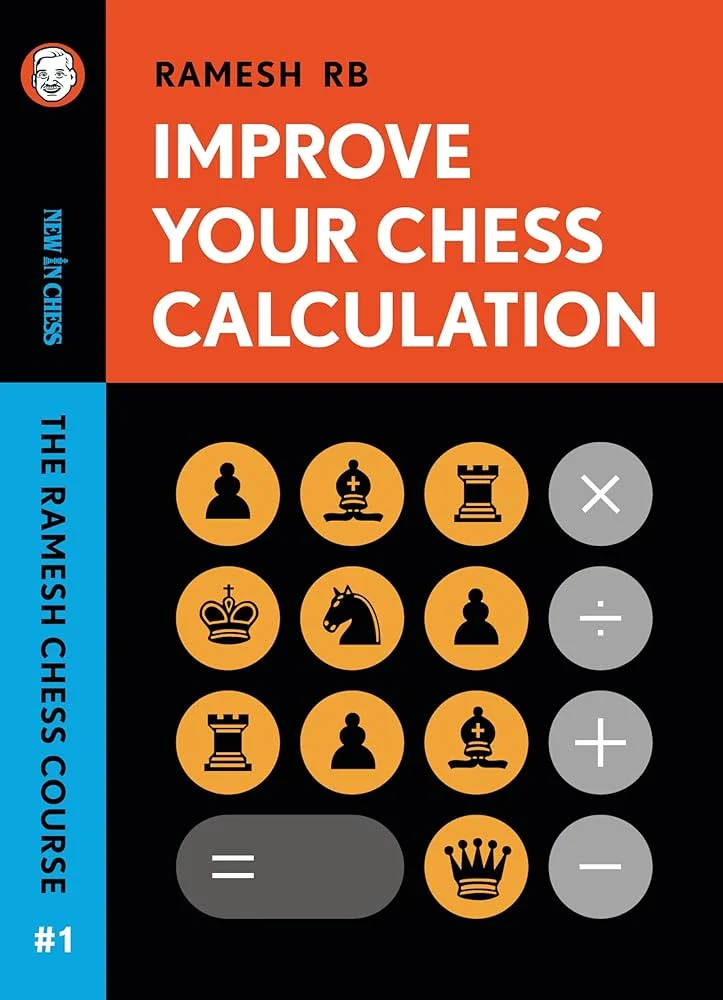
If you have been following the meteoric rise of Indian chess over the last decade, you have likely heard the name GM R.B. Ramesh. As the coach behind prodigies like Praggnanandhaa and Aravindh Chithambaram, and the captain of the Indian Olympiad team, Ramesh has earned a reputation as a “super coach”. Naturally, when I picked up his book, Improve Your Chess Calculation, published by New In Chess, I expected a collection of difficult puzzles.
What I found instead was a profound, sometimes grueling, but ultimately transformative course on how to think.
I have spent the last several weeks living with this book—not just reading it, but suffering through it, sweating over the exercises, and trying to rewire my brain according to Ramesh’s methods. If you are a club player tired of hitting your rating ceiling, or an ambitious junior looking to master the chaos of the middlegame, this review is for you. Here is what you can expect from what I consider one of the most important chess training books of the modern era.
More Than Just Puzzles: The Structure
The first thing to understand is that this is not a puzzle book in the traditional sense. It is a training manual structured to simulate the intensity of a coaching session at Ramesh’s “Chess Gurukul” in Chennai.
The book is divided into seven distinct chapters, moving from the definitions of dynamic and static positions to calculation training, the analytical process, forcing moves, common mistakes, and finally, endgame studies.
Ramesh categorizes the material into five levels based on Elo rating, ranging from Level 1 (1200–1600) to Level 5 (2600 and above). Do not let these numbers fool you. As someone who falls comfortably in the middle range, I found even the “Level 1” positions to be surprisingly biting. They require you to see the whole truth, not just the first two moves.
Core Principles: Rewiring the Brain
The book does not just ask you to “calculate deeper.” It provides the framework for how to do it. Ramesh identifies that a chess player is constantly torn between two influences: their own nature (biases, laziness, fear) and the objective demands of the position.
Here are the core principles that Ramesh drills into the reader:
1. Dynamic vs. Static Positions Ramesh simplifies position assessment into two categories. Static positions are quiet; time is less of a factor, and general principles apply. Dynamic positions—which make up the bulk of this book—are those where things change quickly. In dynamic positions, factors like king safety and time value trump material quantity. If you try to apply static rules (like “don’t double your pawns”) in a dynamic position where your king is being hunted, you will lose.
2. Forcing Moves and the “CCTP” Method We have all heard of looking for Checks, Captures, and Threats. Ramesh adds a crucial fourth element: Pawn Breaks. He argues that many players miss tactical solutions because they ignore pawn breaks as forcing moves. He drills the habit of analyzing these forcing moves first, no matter how unnatural they look, because they dictate the flow of the game.
3. The Drawback Principle This was a lightbulb moment for me. Ramesh teaches that almost every move has a drawback. It might weaken a square, leave a piece undefended, or block a line. In dynamic positions, instead of just playing “good moves,” you must actively look to exploit the immediate drawback of your opponent’s last move.
4. The “No Moving Pieces” Rule This is the hardest part of the book. Ramesh insists that to improve visualization, you must analyze the position without moving the pieces on the board. You must reach a conclusion in your head, check it for errors, and only then compare it with the text. He notes that even 1800-rated players can eventually analyze complex Level 4 positions blind if they persist in this training.
The “Ramesh Style”: Coaching, Not Just Authoring
What makes this book unique compared to other calculation manuals is Ramesh’s voice. He writes humbly, admitting that English is not his first language, but his communication is crystal clear. He writes not as a distant Grandmaster, but as a coach standing right next to you.
The most fascinating section of the book is Chapter 2: Calculation Training with Students. Here, Ramesh presents a position and then transcribes the actual analysis given by his students—ranging from 1400-rated players to Super GMs like Praggnanandhaa.
Reading this section is a revelation. You see the 1800-player make the same mistake you just made. Then, you see Ramesh gently correct them, pointing out why they missed a resource (usually due to a lack of alertness or visualization issues). You then see how a 2600-player approaches the same position. It humanizes the struggle of calculation. You realize that strong players don’t just “see” everything instantly; they have a more disciplined process for error-checking and candidate move selection.
Practical Impact on Real Games
After weeks of studying this book, I noticed a distinct shift in my tournament play.
1. The “River Crossing” Mindset Ramesh uses a brilliant metaphor for calculation. He compares it to crossing a river at night using an iron rod to poke for rocks (safe moves) versus crocodiles (blunders). Before this book, I would often fall in love with a move and try to force it to work. Ramesh taught me to be objective. If I poke a move and it moves (it’s a crocodile/bad move), I must immediately eliminate it and check the next option. I stopped wasting time on variations that simply didn’t work just because I wanted them to.
2. Embracing the “Abnormal” Ramesh emphasizes that when normal moves don’t work, you must look for “abnormal” moves—desperados, strange retreats, or quiet prophylactic moves in the middle of an attack. In a recent rapid game, I found a winning resource solely because I forced myself to ask, “What is the most forcing pawn break here?” even though it looked risky. It was a direct application of his CCTP principle.
3. Defensive Resilience The book is brutal regarding defensive resources. Ramesh points out that we often stop calculating when we see a threat, assuming we are winning. He forces you to find the opponent’s best defense. This has saved me points; I no longer assume my opponent will cooperate. I look for their saving resource, and if I find it, I look for a way to crush it.
Strengths and Weaknesses
Strengths:
• The Selection of Material: The positions are fresh. You won’t find the same old puzzles from 1950s anthologies. Many are from recent games or studies.
• The “Coach’s Comments”: The explanations focus on the psychology of the mistake. For example, he explains that players often miss backward knight moves or fail to re-evaluate a position after a sacrifice.
• Studies for Practical Players: I used to think endgame studies were just artistic fluff. Ramesh proves that solving studies is the best gym for calculation because every piece has a purpose and you must calculate to the very end.
Weaknesses:
• Difficulty: This is not a “feel-good” book. Even Level 1 positions can be demoralizing if you aren’t focused. It requires serious effort.
• Visualisation Strain: If you are not used to calculating without moving pieces, you will get a headache. It is mentally exhausting.
Target Audience: While Ramesh includes a “Level 1” (1200-1600), I believe this book is most beneficial for ambitious club players (1500+) up to titled players. A 1200-rated player might find the depth of variations overwhelming unless they have a coach guiding them through it. However, any player willing to put in the “hard work” will benefit.
Comparison to Other Calculation Books
How does this stack up against the giants like Kotov’s Think Like a Grandmaster or Aagaard’s Grandmaster Preparation series?
Kotov is classic but often criticized for being too rigid with his “candidate move trees.” Aagaard is brilliant but often incredibly difficult, aimed squarely at masters. Ramesh finds a middle ground. He is less dogmatic than Kotov but more accessible than Aagaard. He focuses more on the human flaws in calculation—laziness, fear, and lack of visualization—than just the dry variations.
Comparatively, Ramesh is more “hands-on.” He addresses the emotional side of calculation—the fear of sacrificing material and the laziness of not checking the opponent’s resources.
Personal Reflections: The Joy of “Finding It”
There were moments of genuine frustration while reading this book. I remember staring at a study by Leonid Kubbel (Game 95) for 20 minutes, convinced I had solved it, only to check the solution and realize I had missed a defense on move 2.
But then there were the breakthroughs. There is a specific feeling Ramesh describes—the transition from confusion to clarity. He encourages you to use “elimination” when stuck. If three moves lose and one looks crazy, analyze the crazy one.
One of my favorite insights was his take on laziness. He notes that many players simply stop calculating when things get hazy or difficult. They play a move on “intuition” (which is often just guessing). Reading this felt like he was calling me out personally.
Ramesh demands that you train harder than you play. He compares it to a runner training with weights on their legs. By struggling through these complex variations at home, tournament games actually start to feel slower and easier.
Conclusion
Improve Your Chess Calculation is not a book you read; it is a book you do. It is a simulator for the difficult decisions you face over the board.
GM Ramesh doesn’t offer magic pills. He offers a mirror. He shows you that your calculation errors aren’t just “bad luck”—they are failures of visualization, alertness, and psychology. But he also provides the tools to fix them.
If you are willing to turn off your engine, set up the board, and sit in silence with your thoughts for 30 minutes at a time, this book will change your chess. It is a masterpiece of coaching literature that bridges the gap between knowing about chess and actually playing it well.
My Rating: 4.9/5 Stars. Essential reading for the serious club player.
Guest Author: Ethan Doyle
Grab Improve Your Chess Calculation on Amazon here or get the Forward Chess ebook. Buying through these links supports this site at no extra cost to you.

AttackingChess Guest Contributors is a collective author profile representing chess enthusiasts, reviewers, coaches, and community members who contribute book reviews, insights, and educational material to the site.
Articles published under this profile may come from different writers with varying backgrounds in strategy, tournament experience, chess literature, and long-term training. All submissions are edited and fact-checked by the AttackingChess editorial team to ensure quality, accuracy, and practical value for readers.
This contributor profile is designed to give a voice to many chess lovers who want to share their perspectives without maintaining individual author accounts. You could submit your article to hxb4693@gmail.com.