
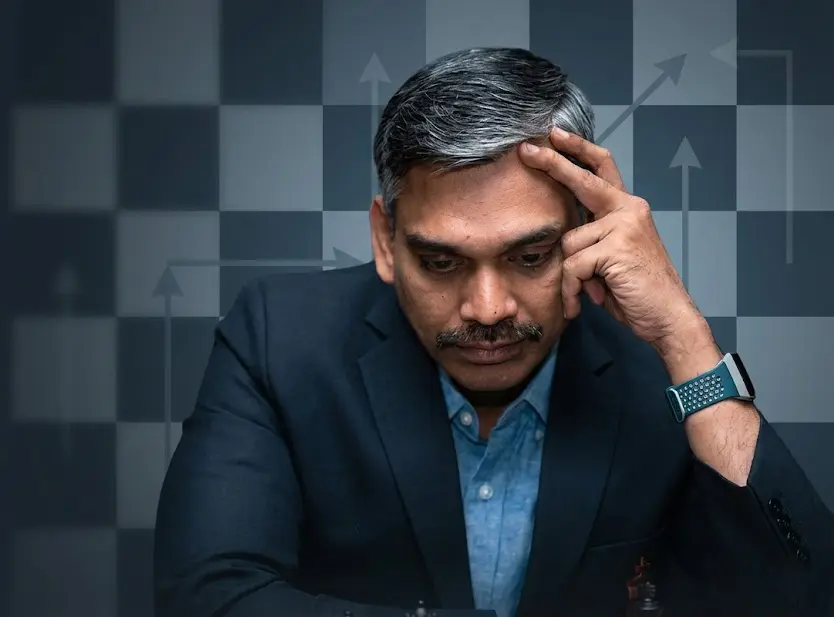
If you have ever stared at a chessboard, felt overwhelmed by the tangled mess of pieces, and thought, “I know there is a win here, but I just can’t see it,” you are not alone. The ability to calculate variations accurate, deep, and quick is often the primary divider between you and the next rating tier.
Many players rely on intuition or general principles. They play moves that “look natural.” But chess is a concrete game. As the legendary Mikhail Botvinnik said, “Chess is the art of analysis”. To become a strong player, you must learn to navigate the chaos. You must learn to calculate.
This guide from the world class coach, GM R.B. Ramesh will walk you through the mechanics of calculation, stripping away the mystery and replacing it with a structured, trainable process used by grandmasters and super-coaches.
What Calculation Actually Means
In practical chess, calculation is not just “looking ahead.” It is a deliberate, forceful process. It is the act of looking ahead in a position through a series of moves—usually of a forcing nature—to achieve a concrete aim.
Calculation is different from general analysis. When you analyze, you might use strategic concepts like “improve the knight” or “control the open file.” Calculation is brute force. It is the tool you use to verify your ideas. It requires you to overcome your own nature—your fears, your laziness, and your biases—and look objectively at the board. It forces you to think concretely rather than generally.
The Step-by-Step Process
Strong players do not simply stare at the board and wait for inspiration. They follow a mental checklist. An efficient thought process looks something like this:
1. Objectivity: Look at the position with concentration. Do not let your fear of the opponent or your previous bad results affect your view.
2. The Opponent’s Intent: Pay adequate attention to your opponent’s previous move. What is the threat? What is the drawback of their move?.
3. Candidate Moves: Identify all reasonable moves. Do not just look at one. Make a list.
4. Analysis: Use calculation to verify these moves.
5. Evaluation: Once the calculation ends, assess the resulting position. Is it won, lost, or drawn?.
6. Decision: Choose the best continuation based on your evaluation.
This sounds simple, but the difficulty lies in the execution. Let’s break down the specific techniques you need to master this process.
The Power of Candidate Moves
The most common mistake amateur players make is seeing one tempting move and immediately diving into calculating it without looking for alternatives. This is dangerous. If that move turns out to be a dead end after five minutes of thinking, you have wasted time and have to start over.
You must create a list of candidate moves before you begin calculating,.
When you look at a position, scan for possibilities. Do not reject moves because they look “ugly” or “risky” at first glance. Once you have a list, you have four ways to handle it:
1. Forcing first: Always calculate the most forcing moves (checks and captures) first.
2. Preliminary check: Do a quick, shallow check of every move on the list to eliminate obvious failures.
3. The Instinctive approach: Calculate the move you intuitively feel is best. If it works, play it. If not, go to the next.
4. Elimination: Prove the other moves are bad, leaving you with one logical choice.
Ideally, you should mix these methods. If you intuitively feel a move is right, try to make it work. But if you get stuck, go back to your list. Do not be a “loyal slave” to your first impulse.
The “CCTP” Method: Forcing vs. Quiet Moves
You have heard of “Candidate Moves,” but which ones should be on your list? You must prioritize Forcing Moves. These are moves that limit your opponent’s responses, making calculation easier and more accurate.
Most players know to look for Checks and Captures. However, a complete calculation diet requires two more elements: Threats and Pawn Breaks,.
The Hierarchy of Forcing Moves:
1. Checks: The most forcing. The King must respond.
2. Captures: Changes the material balance.
3. Threats: Direct attacks on pieces or mate threats.
4. Pawn Breaks: This is often ignored but vital. A pawn break (like playing …c5 to challenge a d4 pawn) changes the structure and opens lines. It dictates the flow of the game,.
Only when you have exhausted all forcing moves (CCTP) and found they do not yield a result should you look at “quiet” or positional moves. If you start with quiet moves, you are swimming in an ocean of possibilities. Forcing moves keep you on a narrow path.
The Tree of Variations and the “River Crossing”
Calculating is like navigating a tree. You start at the trunk (current position), and the branches are the moves. Some branches are short; others are long and twisty.
A brilliant analogy for navigating this tree is Crossing the River-. Imagine you must cross a river at night. There are objects in the water—some are rocks (safe footing) and some are crocodiles (danger). You have an iron rod.
• You poke an object. If it moves, it is a crocodile (a bad variation). You eliminate it.
• You poke the next object. It is solid. It is a rock (a good move). You step on it.
• From that rock, you poke around for the next step.
In chess, if you analyze a move (poke it) and find a refutation (it’s a crocodile), you must immediately stop, go back to the previous position, and try a different candidate move. Do not try to stand on the crocodile! Many players find a line is bad but keep staring at it, hoping it will magically turn into a good move. Accept the refutation and switch paths,.
Visualization: The Inner Eye
You cannot calculate what you cannot see. Visualization is the ability to see the board in your mind after a sequence of moves without actually moving the pieces.
If you have poor visualization, it is like being short-sighted. Nearby objects (1-2 moves deep) are clear, but distant objects (4-5 moves deep) become blurry. You might forget where a pawn is, or not realize a file has opened.
Drills to Improve Visualization:
1. No Moving Pieces: When training at home, never move the pieces on the board while solving a puzzle. Force your brain to hold the image.
2. Retracing: If the position gets hazy in your mind, start from the initial position and replay the moves mentally up to the current point.
3. Blindfold Tracking: Read the notation of a game without a board and try to follow as far as you can.
When to Stop Calculating?
One of the hardest practical decisions is knowing when to stop. Do you calculate 3 moves deep or 10?
You should stop calculating only when:
1. Forcing moves have ended: There are no more checks or captures that demand a response.
2. The evaluation is clear: You have reached a position that is clearly won, drawn, or lost.
A common error is stopping as soon as you see a move that looks “good enough.” You see a check that wins a pawn, so you stop. But perhaps two moves later, your opponent traps your Queen! You must calculate until the position settles down (a “quiescent” position).
The Drawback Principle
Every move has a consequence. Even a good move has a downside. It might leave a square undefended, weaken a pawn, or block a piece. This is the Drawback Principle.
When your opponent makes a move, do not just ask, “What is he threatening?” Ask, “What is the drawback of that move?” or “What square did he just leave behind?”
If you can identify the drawback, you can often find the tactical solution. For example, if a pawn advances to attack you, it may have left a square behind it weak. That weak square is your target. This principle helps you find candidate moves that exploit the immediate changes in the position.
Typical Calculation Mistakes (And How to Fix Them)
Even strong players make mistakes. Here are the most common traps and how to avoid them:
1. The “Ghost” Defense You reject a winning line because you hallucinate a defense for your opponent. You assume they have a resource they don’t actually have.
• Fix: Double-check your analysis. Don’t trust your fear. Verify the defense.
2. Missing the Opponent’s Best Move You calculate a beautiful attack, but you only look at your opponent’s weak responses. You miss their strongest defense, and your attack collapses.
• Fix: Always play the best move for your opponent in your head. Be objective. If you find a good defense for them, try to refute it. If you can’t, your idea is wrong,.
3. Materialism (Greed) You refuse to sacrifice material even when the position demands it. You value your pawns more than your King’s safety or piece activity.
• Fix: Understand that activity and time often outweigh material. Do not be afraid to give up a pawn to activate your pieces,.
4. Emotional Decisions You play a move because you “like” it or because you are afraid of complications, rather than because calculation proves it is best.
• Fix: Rely on the logic of variations, not your feelings. If the calculation says a “risky” move wins, play it.
Time Management Strategies
In a tournament, you do not have infinite time. You cannot calculate everything to the end.
• The Critical Moment: Learn to identify critical moments—situations where the game can change drastically (e.g., pawn breaks, sacrifices, heavy contact). Spend your time here.
• Intuition vs. Calculation: If you are low on time, or if the position is purely strategic (static), rely more on intuition and principles. If the position is dynamic (tactical chaos), you must calculate,.
• The “Good Enough” Rule: If you see a move that leads to a clear advantage and you are low on time, play it. Do not waste 10 minutes looking for a slightly better mate in 5 if you already have a winning endgame.
Daily Exercises for the Ambitious Player
To improve, you must train harder than you play. Here is a practical routine:
1. Solve Studies: Endgame studies are the gym for calculation. They have few pieces, but every piece is essential. They force you to be precise and creative. Try to solve 1-2 studies a day.
2. No-Touch Solving: Set up a position from a puzzle book. Do not touch the pieces. Calculate the variation to the very end in your head. Only when you are sure, write down the solution and check it. If you got it wrong, find out why (did you miss a check? A defense?),.
3. Analyze Your Own Games: Take a critical position from your recent game. Cover the moves. Try to find the best move again without the pressure of the clock. Compare your calculation now with what you saw during the game.
Grab Improve Your Chess Calculation on Amazon here or get the Forward Chess ebook. Buying through these links supports this site at no extra cost to you.
I’m Xuan Binh, the founder of Attacking Chess, and the Deputy Head of Communications at the Vietnam Chess Federation (VCF). My chess.com and lichess rating is above 2300. Send me a challenge or message via Lichess. Follow me on Twitter (X) or Facebook.