
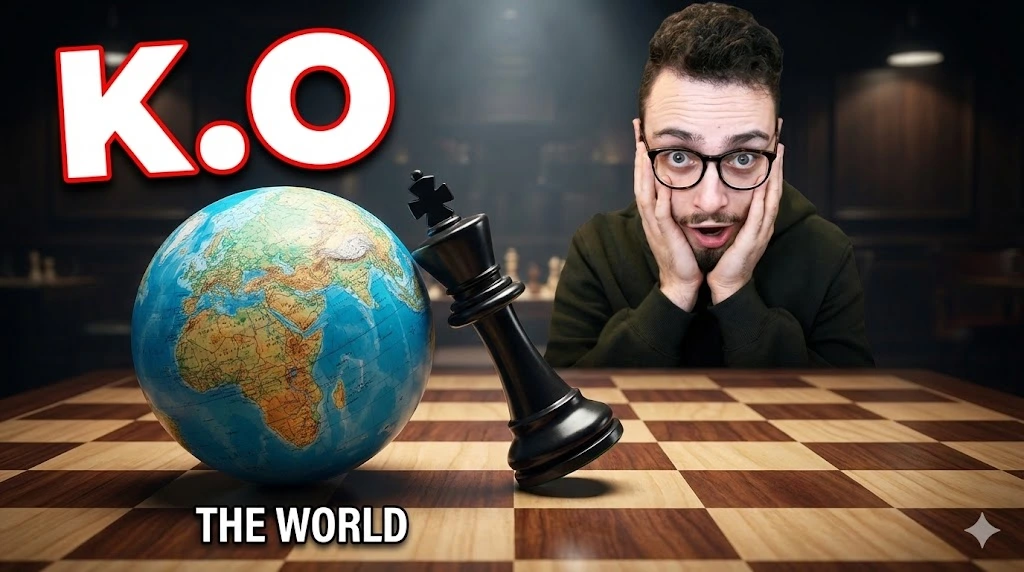
When the dust finally settled on November 30, 2025, the scoreboard read the only thing that mattered: GothamChess 1 — The World 0.
One player had checkmated 225,136 opponents.
It was the culmination of a record-shattering two-month saga, a global voting war fought move by move over 63 days, and a historic attempt by hundreds of thousands to defeat the Internet’s Chess Teacher on his home turf. What began as a playful challenge soon transformed into a full-scale strategic drama, part crowd-theory experiment, part masterclass, part chaos. And in the end, GothamChess, IM Levy Rozman, stood alone with the win.
This is the story of how the World lost.
A Record Fell Before the Game Even Began
The first signs were there.
Two moves into the match, GothamChess vs. The World had already smashed the all-time participation record with over 144,000 players, beating the previous high set by Magnus vs. The World. That game, astonishingly, held Magnus Carlsen to a draw. Even Vishy Anand’s earlier match had only attracted around 70,000 participants.
This new event, though, was different.
Rozman, with his 6.9 million YouTube subscribers and “Internet’s Chess Teacher” persona, brought something entirely new: a vast online audience built on years of instruction, entertainment, and accessibility. For the first time, fans didn’t just watch him, they played against him.
Chess.com officials knew this one would be large. They did not expect 200,000+ people.
By the time the game reached its late teens, more than 225,000 participants had cast votes. The World Team was guided by WIM Ayelen Martinez and NM Dane Mattson, the same analytical duo who helped hold Magnus to a draw. Their job was to coordinate and stabilize a crowd the size of a large city, while also trying to defeat a seasoned International Master.
It was the most ambitious chess coordination project ever attempted.
The Opening: Levy’s Dream Title Begins
Before move one, Rozman joked:
“Can you imagine the YouTube title ‘I Beat The World With The Caro-Kann’? It’s gonna be so good.”
He opened with 1…c6, his trademark Caro-Kann Defense.
The World responded with the solid 2.d4, voted by 58% of players.
It was a perfectly respectable start from the crowd: disciplined, classical, free of chaos. For a moment, it looked like order might prevail. The early middlegame remained balanced. Both sides traded minor pieces; nothing dramatic occurred.
Then came 17.c5.
Turning Point #1: The Quiet Pawn Push That Wasn’t Quiet at All
By move 17, material was level and the position still rich with possibilities. Gotham had just rerouted a knight to b6, preparing long-term pressure.
The World now had dozens of reasonable options.
Instead, after an intense global debate, the winning vote went to 17.c5, a move that titled players immediately understood as a positional concession.
Why?
Because it handed Black the d5 outpost for free.
The knight on b6 suddenly had a dream square, and Gotham certainly did not miss the opportunity. He jumped in with 17…Nd5, planting a piece in the heart of White’s camp that could never be kicked away by a pawn.
The first crack in the World’s structure had appeared.
And Gotham smelled blood.
Turning Point #2: The World’s Fatal Pawn Lunge
If 17.c5 was a positional slip, 21.g4 was a strategic disaster.
The move seriously weakened the f4 square and tore open White’s kingside. Martinez and Mattson had tried steering the crowd toward quieter, stabilizing moves, but in a giant democracy of chess, persuasion has its limits.
Rozman responded with 21…e5, instantly blasting the center open.
Suddenly, the world’s king was exposed and Gotham’s pieces were accelerating toward it with frightening clarity.
Within minutes of the move being played, Levy’s reaction on stream said it all, eyes widened, eyebrows raised, a smile creeping in:
“Oh wow… They played g4. Okay then.”
This moment was the second irreversible shift. Black now had attacking chances, open lines, and target weaknesses. The World was in trouble.
They would soon be in checkmate danger.
Turning Point #3: The Forced Sacrifice on f4
After 22.gxh5 Qg4+, the World’s king became stuck in a tactical mating net. White had only one move to stay alive:
24.Qxf4, giving away the queen to prevent immediate mate.
It was a brilliant defensive necessity chosen by the crowd, proof that even in chaos, hundreds of thousands can sometimes find the best move. But the price was monstrous.
After 24…exf4, Gotham’s attack became a tidal wave:
- The f-pawn turned into a battering ram.
- The open g- and h-files let the queen infiltrate.
- White’s king was stranded on the kingside with no shelter.
When the dust settled a few moves later, Gotham had everything:
better pieces, a safer king, and a long-term structural advantage.
The World had only problems.
The Endgame Assault
Despite being down material and under pressure, the World fought on. The voting system required that moves be accompanied by analysis, and the global discussion channels lit up with desperation and creativity.
But Rozman is still a titled player with decades of practical experience. Once he consolidated, the result was never in doubt.
The final sequence, beginning around move 32, showcased clean, professional conversion:
- Simplifying with checks.
- Driving the king into the open.
- Coordinating rooks and queen with textbook precision.
- And finally delivering checkmate with 41…Rxa2#.
The last moment of the game, a rook slamming down on a2 as the white king tried to flee across the board, symbolized everything about Gotham’s approach: consistent pressure, clarity, and the ability to capitalize on mistakes made by a massive, decentralized opponent.
What Really Happened? Why the World Lost
It wasn’t randomness.
It wasn’t luck.
It wasn’t even just the strength difference between an International Master and a global crowd.
The World lost because:
1. Democracy is not a chess engine
Some moves required precise calculation that a voting system simply cannot consistently produce.
2. Chaos scales faster than accuracy
The more participants, the harder coordination became. A single troll move in a small group is noise; in a population of 200,000, it can become policy.
3. Gotham played the human element perfectly
Rozman didn’t need computer-level play.
He needed mistake-provoking play.
- As soon as weaknesses appeared, he struck.
- As soon as structure collapsed, he opened lines.
- As soon as tactics existed, he calculated them cleanly.
4. The World’s biggest blunders came from structural misunderstandings
Moves like 17.c5 and 21.g4 are exactly the kind of subtle, position-destroying errors that group decision-making tends to produce. They look active. They feel aggressive. They’re exciting.
But they ignore the fundamentals Gotham has spent years teaching.
Ironically, the World lost to principles GothamChess himself popularized.
What This Win Means for GothamChess
For Rozman, this match was history.
This was:
- The largest online chess match ever.
- A game with 225,136 opponents.
- A global showcase of his teaching, personality, and competitive instincts.
- A chance to join Anand, Kasparov, and Carlsen in the “Vs. The World” lineage.
And he delivered.
After stepping away from competitive chess in 2022, then returning in 2024 with the goal of becoming a Grandmaster, this victory was symbolic:
proof that his influence extends far beyond ratings lists.
He is no longer just a streamer.
No longer just a coach.
No longer just a content creator.
This match cemented him as a central figure in modern chess culture.
What This Match Means for Chess
The biggest takeaway is simple:
Chess has never been more global, more interactive, or more community-driven.
A match with 50,000 participants was unimaginable in 1999.
Magnus Carlsen’s 143,564-person showdown was historic in 2025.
GothamChess vs. The World blew past all of that.
200,000+ players.
Dozens of nationalities.
Hundreds of discussion channels.
Voting wars.
Move debates.
Global tension.
This was chess not as a battle between two players, but as a worldwide event.
I’m Xuan Binh, the founder of Attacking Chess, and the Deputy Head of Communications at the Vietnam Chess Federation (VCF). My chess.com and lichess rating is above 2300. Send me a challenge or message via Lichess. Follow me on Twitter (X) or Facebook.