
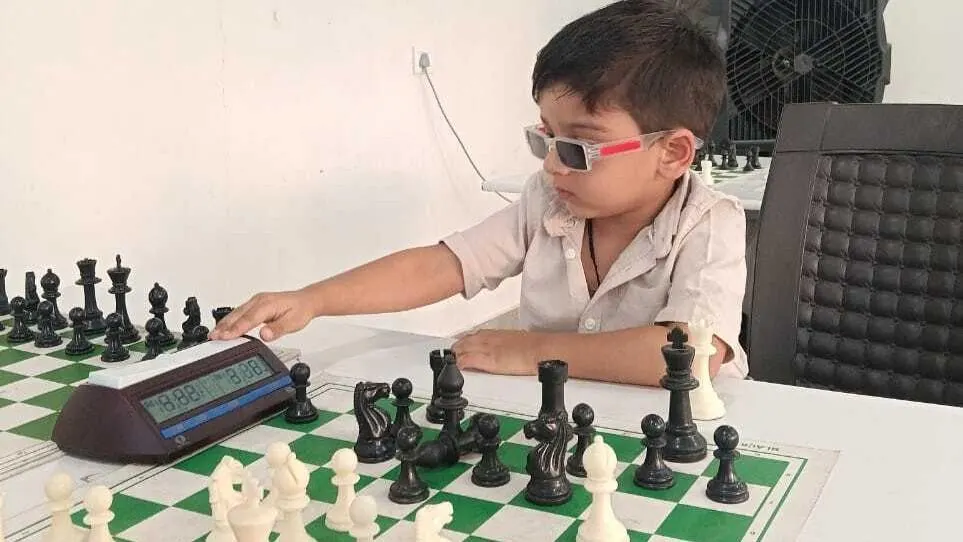
Imagine a toddler, still enrolled in nursery school, staring across a chessboard with the focus of a seasoned master. He has to stand on his chair, or sit on a precarious stack of three, just to see the entire 64-square battlefield. His opponent, often a grown adult, watches as this tiny prodigy thumps a piece into place, slaps the clock with menacing confidence, and slowly dismantles their strategy. This isn’t a scene from a movie; it’s the astonishing reality of Sarwagya Singh Kushwaha, India’s newest chess sensation.
At the tender age of three years, seven months, and 20 days, Sarwagya has etched his name into the annals of sporting history, becoming the youngest FIDE-rated chess player the world has ever seen. With this single achievement, Sarwagya has fired a starting pistol on what could be one of the most astonishing chess careers of a generation, emerging from a nation rapidly solidifying its status as a global chess powerhouse. His story is a captivating blend of innate genius, surprising origins, and the kind of dedication usually reserved for elite professional athletes.
Contents
1. He Didn’t Just Break the Record—He Smashed It by a Month
Becoming the world’s youngest FIDE-rated player is one of the most coveted records in youth chess. It signifies not just early exposure but a demonstrable level of skill against established competition, putting a player on the global map before they’ve even finished kindergarten. The record is a moving target, with prodigies from around the world constantly pushing the boundaries of what’s possible at a young age.
When Sarwagya earned his rating, he did so at the exact age of three years, seven months, and 20 days. This achievement dethroned the previous record holder, fellow Indian prodigy Anish Sarkar, who had set the benchmark just months earlier at three years, eight months, and 19 days old.
Sarwagya didn’t just inch past the previous record; he beat it by approximately one full month. In the world of child prodigies, where development is measured in weeks and days, this is a significant and decisive margin. For a child still learning that ‘C’ is for cat, to be thinking ‘C’ is for checkmate at this level is nothing short of extraordinary. But this wasn’t merely a quirk of the calendar; it was a record built on the foundation of a rating that many adult players would envy.
2. His 1,572 Rating Is Better Than Many Adult Players
For those outside the competitive chess world, a FIDE rating can seem like an abstract number. In simple terms, it’s a numerical score that gauges a player’s skill level, designed to predict the outcome of a game between two players. It is the gold standard for measuring a player’s strength, and Sarwagya has entered the official list with a formidable rapid rating of 1,572.
To put this number into perspective, the standard base rating is 1,400. Players whose ratings fall below this threshold are considered unrated. Sarwagya’s initial rating is not only well above this minimum but places him comfortably above the level of many adult enthusiasts and club players. It’s a testament to the fact that he isn’t just participating; he’s winning.
While he has a long journey ahead, it’s fascinating to see his starting point on the same scale as the world’s elite. For context, World No. 1 Magnus Carlsen currently tops the rapid chess charts with a rating of 2,824. Furthermore, his rating will change rapidly. FIDE uses a ‘K-factor’ of 40 for new and young players, meaning his rating will be highly sensitive to wins and losses—a system designed to quickly move prodigies like him to their true strength.
3. His Journey Began as a Parental Tactic to Reduce Screen Time
In an age where parents everywhere struggle to manage their children’s screen time, Sarwagya’s chess journey began with a relatable, everyday goal. His parents, Siddharth and Shruti Singh, initially introduced him to the game as an innocent strategy to lure him away from digital devices. There were no grand ambitions of breaking world records or creating a chess champion.
“We never imagined it would turn into something this big,” his father admitted, reflecting on the humble origins of his son’s passion.
However, it quickly became apparent that this was more than just a diversion. At two and a half years old, Sarwagya’s mind was like a “sponge,” absorbing the complex rules and movements with startling speed. Within just one week of being introduced to the board, the toddler could accurately name all the pieces. Thus, a simple parental tactic to win the war on screen time accidentally uncovered a weapon of chess brilliance.
4. He Trains Like a Professional Athlete—For 4 to 5 Hours Every Day
Natural talent can only take a player so far. The gap between a gifted amateur and a rated competitor is bridged by discipline, focus, and countless hours of hard work—qualities rarely found in a three-year-old. Yet, Sarwagya’s daily routine mirrors that of a professional athlete. He dedicates a staggering four to five hours every single day to honing his craft.
His schedule is structured and intense. One hour is spent in formal instruction at a chess training center in his hometown of Sagar. The remaining hours are a mix of playing online games against a wide range of opponents and studying tactics through educational videos. This rigorous regimen is fueled by a rare quality his father identifies as the key to his success.
“What separates him from other kids his age is his patience to sit on the board and not get restless,” his father explained. This incredible focus is not just for show; he notes that if you were to wake Sarwagya in the middle of the night and ask him to play, “he will for hours without a break.”
5. His Coach Motivates Him with Toffee and Chips
How do you teach the intricate strategies of chess to a student who might burst into tears at any moment? This was the challenge facing Sarwagya’s coach, Nitin Chaurasiya. He quickly discovered that conventional coaching methods wouldn’t work. During their initial sessions, any “hint of sternness could send him bawling.”
Realizing he needed a different approach, Coach Chaurasiya devised a brilliant piece of tikdambaazi (tactic). He implemented a simple but highly effective reward system: for every correct move Sarwagya played, he would receive a toffee or a pack of crisps. This clever, age-appropriate motivation transformed the training sessions from a chore into a game.
The positive reinforcement worked wonders. Freed from pressure, Sarwagya’s natural ability began to shine. His coach observed a child with incredible “guts,” who showed no hesitation when answering tactical questions or facing off against older, more experienced children at the board.
6. He Earned His Rating by Defeating Grown Men
Earning a FIDE rating isn’t a simple matter of winning a single game; it’s a rigorous process governed by strict international regulations. According to the official FIDE rulebook, to get on the official list, a player’s initial rating must be based on playing at least five games against already-rated opponents in FIDE-approved tournaments. Sarwagya didn’t just meet this standard—he demonstrated his dominance within this framework by defeating three different rated players, all of them adults.
His list of victories is a stunning illustration of a nursery-schooler outwitting seasoned competitors:
• 22-year-old Abhijeet Awasthi (rated 1,542), whom he defeated twice.
• 29-year-old Shubham Chourasiya (rated 1,559).
• 20-year-old Yogesh Namdev (rated 1,696).
These weren’t just wins; they were intellectual upsets of David-vs-Goliath proportions. In a game of pure mental combat, a three-year-old systematically overcame opponents who had decades more life experience and established competitive ratings. These victories are the foundation upon which his historic rating was built, proving his talent is far more than just hype.
7. He Plays with the Menacing Confidence of a Veteran
Chess is as much a psychological battle as it is a strategic one. A player’s presence, confidence, and demeanor at the board can exert immense pressure on an opponent. Remarkably, at just three years old, Sarwagya already displays the intimidating mannerisms of a seasoned veteran.
Onlookers describe a player who is anything but timid. He “thumps his pieces on the squares” and “slaps the clock with a particular menace,” actions that project an aura of control and aggression. This fierce competitive behavior creates a stunning and memorable contrast with his tiny physical stature.
The image of a toddler, barely tall enough to see the whole board, making his moves with such ferocious intent is a powerful symbol of the giant intellect housed within a small frame. It’s a clear signal to his opponents: do not underestimate him.
8. He’s So Small He Needs a Stack of Three Chairs to Play
While his mind operates at an advanced level, Sarwagya still navigates a world built for people several times his size. This creates unique logistical challenges at the chessboard. Due to his small stature, he is physically unable to sit in a standard chair and comfortably play.
To make his moves and reach the other side of the board, he has to employ a creative solution: he must either stand up on his chair or sit atop a precarious stack of three chairs.
This endearing detail provides a powerful visual metaphor for his entire journey. It perfectly symbolizes his monumental talent overcoming physical limitations, a clear case of mind over matter. Every time he climbs onto his perch to play, it is a reminder of the incredible heights his intellect has already reached.
9. His Start Is Years Ahead of Chess Legends
Early development is crucial in chess, but even the greatest world champions in history were not typically competing in rated tournaments at age three. Sarwagya’s entry into the sport is not just early; it is historically unprecedented. When compared to the timelines of legendary figures, the scale of his head start becomes astonishingly clear.
| Player | Age When They Learned/Started Chess |
| Sarwagya Singh Kushwaha | 2.5 years old |
| Magnus Carlsen | 5 years old |
| Viswanathan Anand | 6 years old |
| Gukesh Dommaraju | 7 years old |
Sarwagya began his journey two and a half years before Magnus Carlsen, three and a half years before Indian legend Viswanathan Anand, and more than four years before current World Champion Gukesh Dommaraju. This data underscores just how far ahead of the historical curve he is, setting a new benchmark for what is possible in early childhood development in chess.
10. The Next Goal is Already Set: Youngest Grandmaster in History
For any serious chess player, the title of Grandmaster (GM) is the highest honor, the pinnacle of achievement in the sport. While most players spend a lifetime chasing this goal, Sarwagya’s family and coach are already aiming for it. With one historic record secured, their sights are now set on an even bigger one.
“We want him to become a grandmaster,” his father, Siddharth Singh, stated unequivocally.
This isn’t just a distant dream. His coach is actively targeting the record for the world’s youngest grandmaster ever, currently held by Abhimanyu Mishra, who achieved the title at 12 years, four months, and 25 days. This path requires more than just tournament success; it also demands reaching a formidable FIDE rating of 2500, the official benchmark for the GM title. To support this ambitious trajectory, the team is already making plans to secure advanced and online coaching. This ambition isn’t a burden of pressure but a powerful testament to the immense belief they have in his extraordinary and proven potential.
Conclusion: A King in the Making
From a clever tactic to reduce screen time to a world record that has stunned the global chess community, Sarwagya Singh Kushwaha’s journey is already the stuff of legend. With a rating that surpasses many adults, victories against seasoned opponents, and a training regimen that would tax a professional, he has redefined the meaning of “prodigy.” His story is a powerful reminder that genius knows no age limit.
Sarwagya’s historic achievement unfolds against the backdrop of India’s meteoric rise as a “global chess powerhouse.” Following in the footsteps of the legendary five-time World Champion Viswanathan Anand and joining the era of the current World Champion Gukesh Dommaraju, Sarwagya represents the next wave of talent from a nation that has truly embraced the game of kings.
He may need a stack of chairs to reach the board today, but his starting point is already head and shoulders above even the greatest players in history. As the world watches in awe, one thing is clear: a new king is in the making, and his reign has just begun.

I’m a passionate board game enthusiast and a skilled player in chess, xiangqi and Go. Words for Attacking Chess since 2023. Ping me at Lichess for a game or chat.